Activities in Nile Valley

Things to Do

Amenhotep II tomb Luxor

Amenhotep II tomb Luxor

  • Amenhotep II tomb Luxor
  • Amenhotep II tomb Luxor
  • Amenhotep II tomb Luxor
  • Amenhotep II tomb Luxor
  • Amenhotep II tomb Luxor

Amenhotep II tomb Luxor Egypt tours, booking, prices

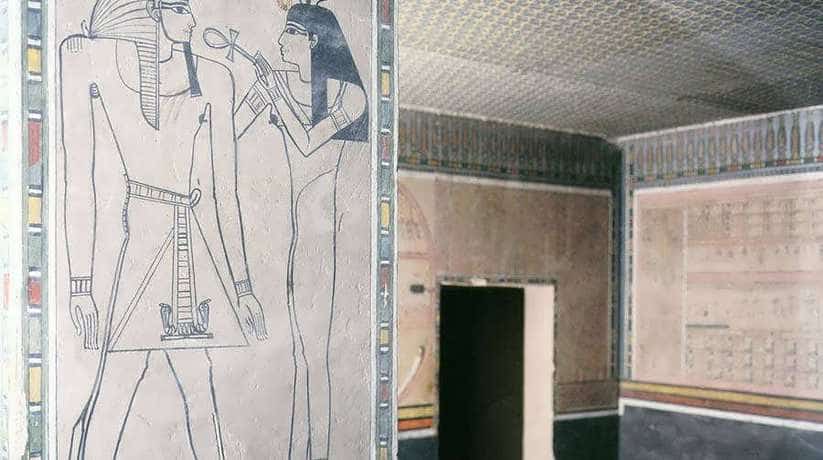
Amenhotep II tomb Luxor KV 35 (Dynasty XVIII) discovered in 1898 by Victor Loret. It is similar in plan to that of his predecessor Thutmose III. In fact, it is one of the most beautiful tombs in the Valley. The discovery was rather spectacular. It is because the tomb contained the burial of the king and his son Webensenu. Amenhotep II tomb in Luxor is a large tomb with complex architecture. It is similar in many respects to the tomb of Thutmose III. Like other tombs in the valley, there are two sets of stairways. There are also two corridors before the ritual shaft.

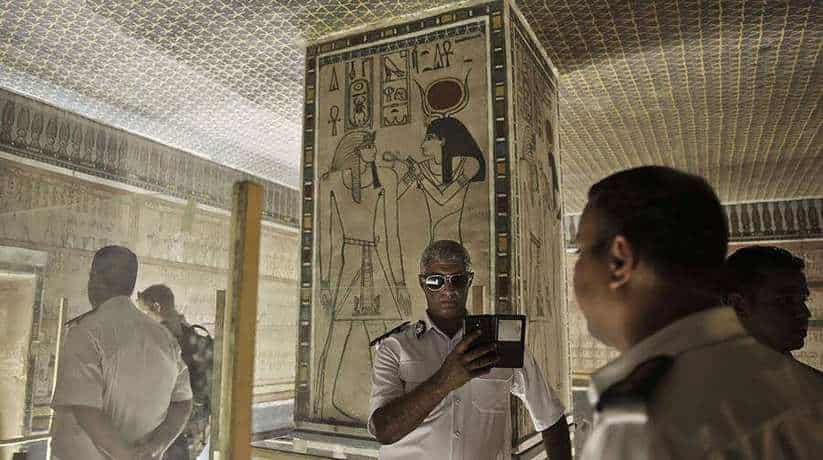
New for this tomb are decorations. They depict the king performing ritual acts before Osiris, Anubis and Hathor. From the ritual shaft, Amenhotep II tomb  takes a 90 degree turn into the two pillared vestibule. Wide flight of stairs leads out of the vestibule into a third corridor. And then, it leads into a large, six pillared room. This room has images of the king in the presence of various deities.

Further details about Amenhotep II tomb Luxor KV 35:

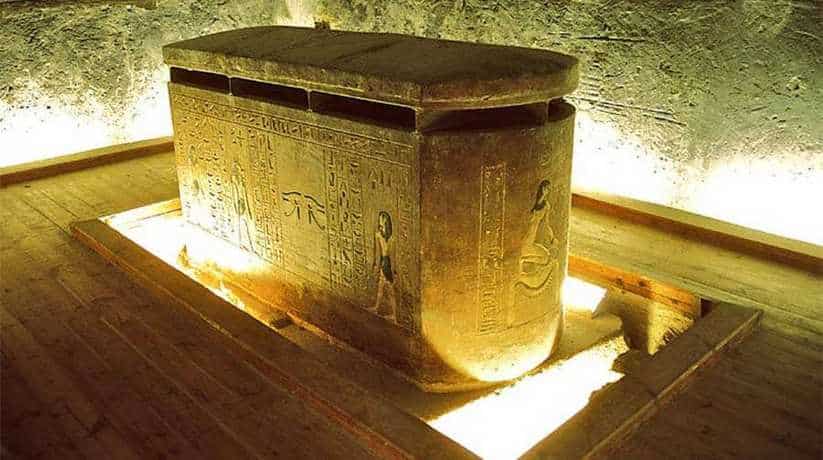
At the back (south) of the six pillared room beyond the last set of pillars is the burial chamber. The burial chamber contains the kings red quartzite sarcophagus. Until 1928, the tomb had the mummy of the king. The mummy transferred to the Cairo Museum at that time. It was one of the surprises in this tomb which was not like other tombs in the valley. Amenhotep II’s mummy found intact. It was with a garland of mimosa flowers at his neck. Though the coffin he laid in was perhaps a replacement. Tomb robbers would search the mummies for gold amulets and other valuable objects. But for some reason they ignored the mummy of this king.

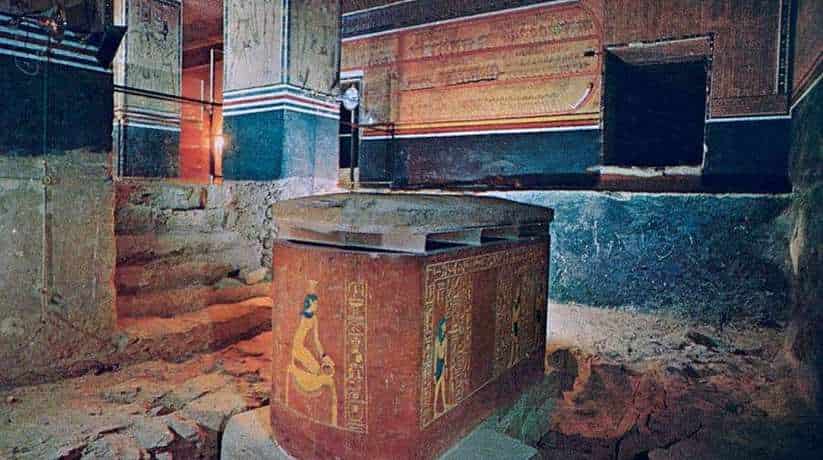
Amenhotep II tomb has one annex to either side of the six pillared room. It also has two more annexes, one one each side of the burial chamber. The burial chamber includes the complete text of the Book of Amduat. It including the corresponding illustrations. The whole text laid out as though on a huge papyrus. This text, in simple paint (no reliefs), is in cursive hieroglyphs. On the ceiling of the tomb is the familiar pattern of gold stars. It is on a dark blue background.

More details about Amenhotep II tomb in Luxor KV 35:

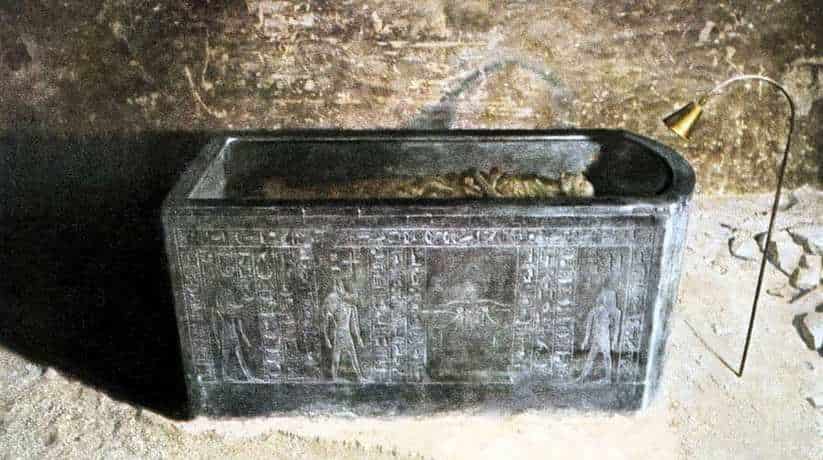
The the western lateral annex of the tomb enclosed by a stone wall. At it, Victor found his second surprise. He found the sarcophagi and mummies of nine other royal burials. It is besides his son, Webensenu, and probably his mother, Hatshepsut-Meryetre. These included Thutmose IV, Amenophis III and Merneptah. They also included Sethos II, Siptah, Setenakhte, Ramses IV, Ramses V and Ramses VI. In all, he found remains of 17 royal burials in the cache. This cache likewise note violated. Hence, Victor’s discovery of this tomb ranks high in the annuls of Egyptology.

Entrance to Amenhotep II tomb:

The tomb is currently open to visitors. Tickets can bought from the main West Bank ticket office. In fact, it is besides the ticket office at the entrance to the Valley of Kings.

Nearby attractions Information, tours and Online Booking

More of Ancient Egypt

More of Egypt attractions
MORE
Aswan Nilometer

Aswan Nilometer Egypt

  • Aswan Nilometer Egypt
  • Aswan Nilometer Egypt
  • Aswan Nilometer Egypt
  • Aswan Nilometer Egypt
  • Aswan Nilometer Egypt
  • Aswan Nilometer Egypt

Aswan Nilometer Egypt tours, prices, booking, reviews

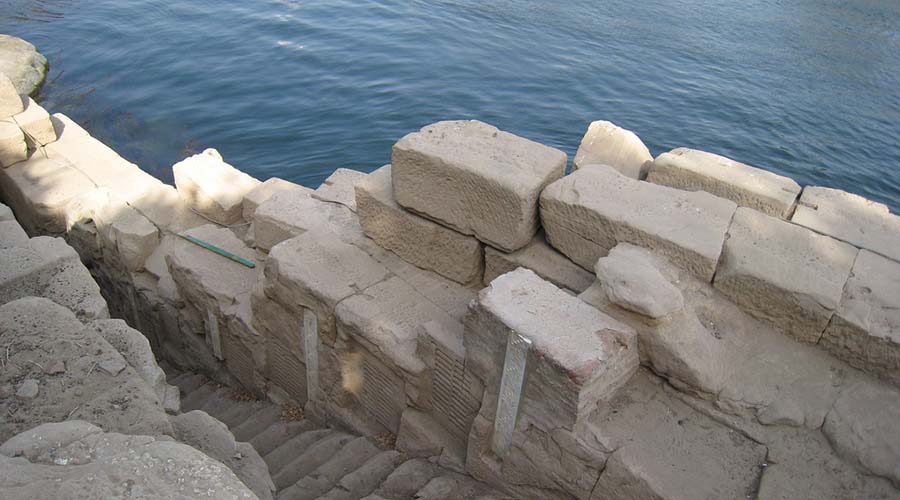
Aswan Nilometer located at Elephantine Island in Aswan. In fact, Aswan Nilometer has a greater importance more than showed in most of books about Egypt. Egypt has four Nilometers on the Nile for measurements of the level of water. In fact, the Nilometer which located at the first Cataract of the Nile, was prime. It was the earliest warning of fluctuations in the River’s depth. The changes of water level recorded and published. This information

used to predict silt levels and thus manage the agriculture. The agriculture was completely dependent on the flooding levels of the Nile River. Taxes based on the amount of flooding received up until the middle of the 20th century. Aswan Nilometer is one of the most intact relics of Elephantine Island. In fact, it was an instrument which kept in a state of repair to be useful.

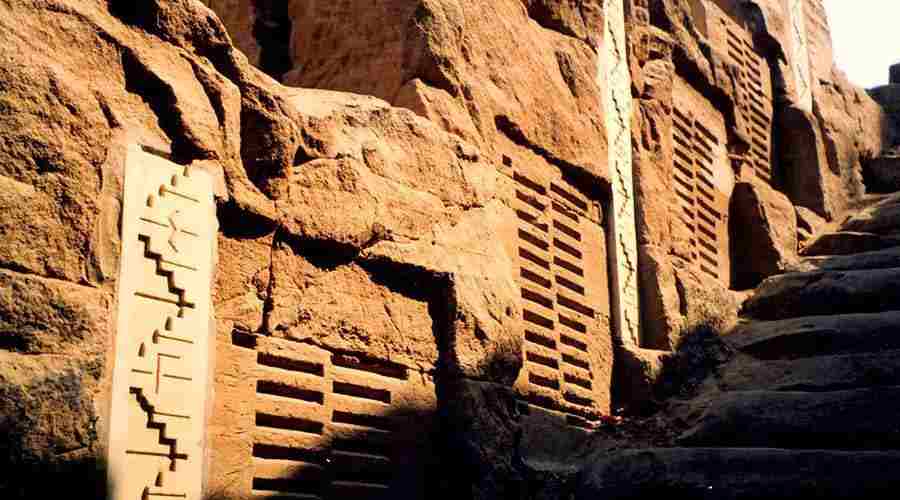
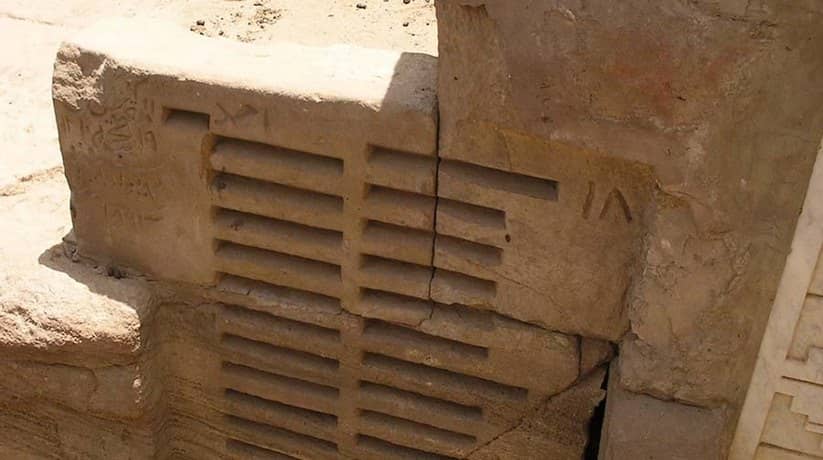
The Nilometer dates back to Roman times, with markings in cubits (about 2 1/3 inches). In fact, it was idle for some time. And then, Aswan Nilometer again rebuilt by the French and Arabs. It was during the 19th century and placed back in use. Hence, it now has markings in French and Arabic. Today, satellites used to measure water levels. Aswan Dam has lessened the need for such instruments. The Nilometer was a structure for measuring the Nile River’s clarity and water level. It was during the annual flood season. The reaches of the Nile running through Egypt burst its banks. It also covered the adjacent flood plain. In fact, it was between June and September. When the waters receded, they left behind a rich deposit of fertile black silt over the croplands. It was between September or October.

Further details about Aswan Nilometer:

The inundation called “akhet” in the Egyptian language. It was one of the three seasons into which the Ancient Egyptians divided their years. It is difficult to overestimate the importance of the annual flood of Egyptian civilization. Moderate immersion was a vital part of the farming cycle. However, the immersion of the lighter than usual would cause famine. Much of the floodwater would be catastrophic. Moreover, much of the infrastructure of Aswan Nilometer which built on the flood plain washed away. To predict the size of the next immersion was part of the charm of the ancient Egyptian priesthood. The same skill played a political and administrative role. It was with the quality of floods which used in general to determine the tax levels to pay. This is where Nilometer came into play. It was with the priests who check the day-to-day level of the river.

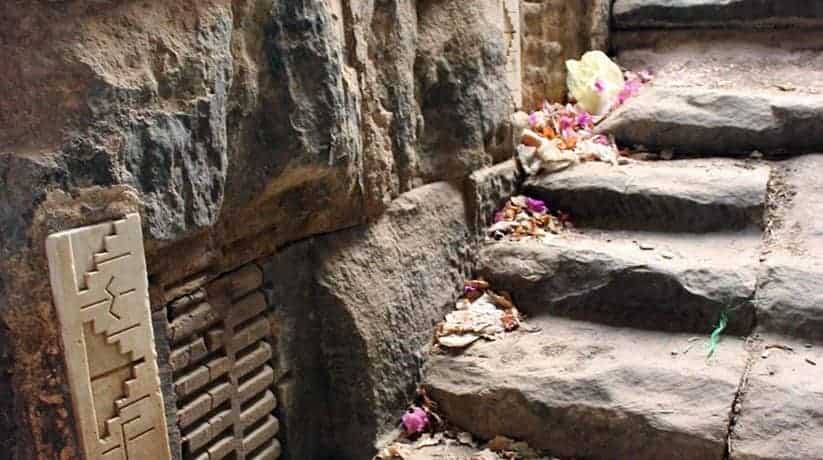
They also announce the expected arrival of the summer floods. The simplest design of the Nilometer is the vertical column which submerged in river water. It is with periods which marked and indicate the depth of the water. This simple design found on Roda Island in central Cairo. Though housed in an elaborate stone structure. The second Nilometer design consists of a flight of stairs. It leads to the water, with signs of depth along the walls. The most famous example of this type is Aswan Nilometer. For many Egyptian history, the Fentan was the distinguishing feature of southern Egypt. Therefore, it was the first place to discover the beginning of the annual floods. Kom Ombo Nilometer is a good example with a deep and cylindrical. It also has well and a shovel opens in the perimeter wall. It fact, it located north of Aswan.

Nearby attractions Information, tours and Online Booking

More of Ancient Egypt

More of Egypt attractions
MORE
Al Tahrir Square Cairo Egypt

Al Tahrir Square Cairo

  • Al Tahrir Square Cairo
  • Al Tahrir Square Cairo
  • Al Tahrir Square Cairo
  • Al Tahrir Square Cairo
  • Al Tahrir Square Cairo
  • Al Tahrir Square Cairo

Al Tahrir Square Cairo Egypt tours, booking, prices, reviews

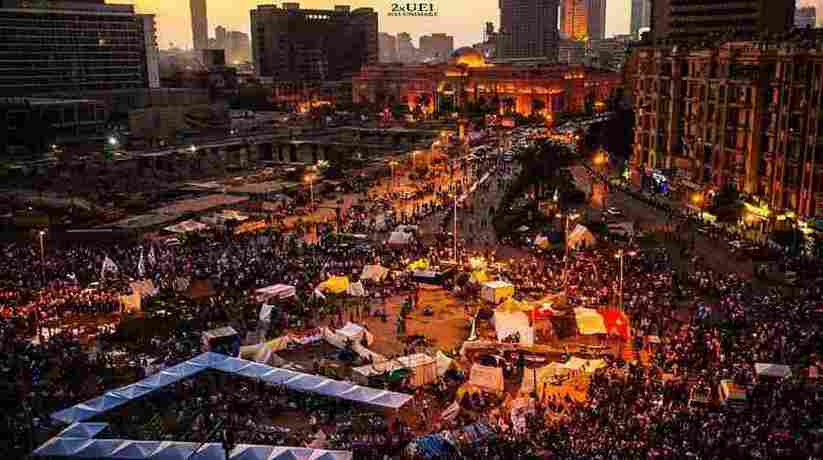
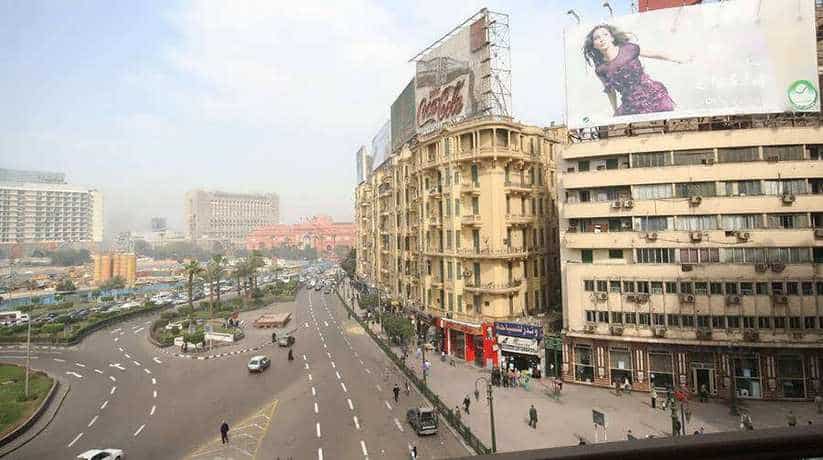
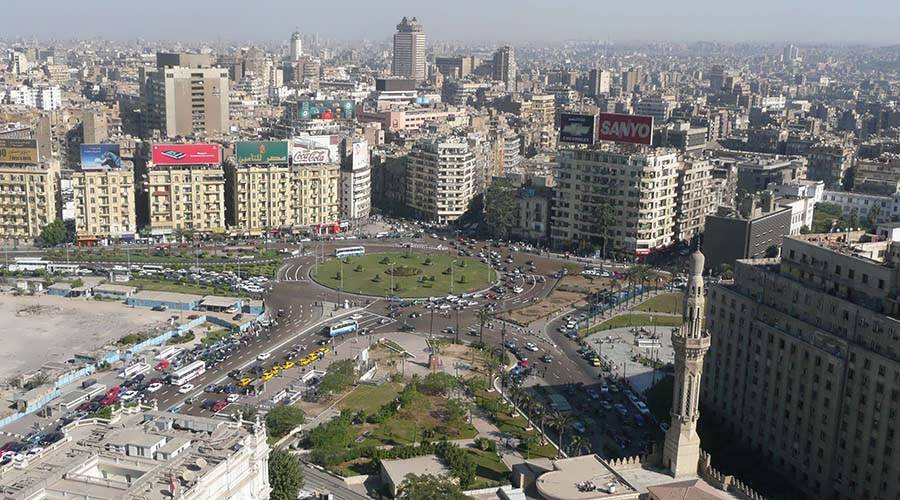
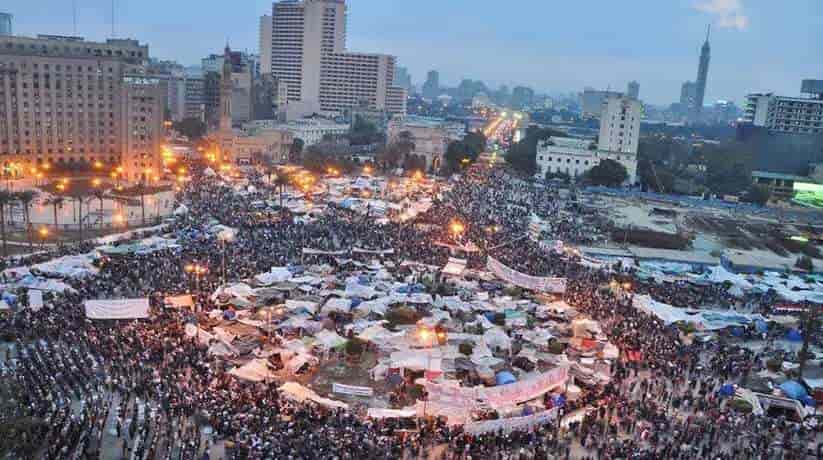
Al Tahrir Square Cairo Egypt means the Liberation Square. In fact, it called “Ismailia Square”. It located downtown of Cairo in Egypt. Khedive Ismail commissioned the new downtown district’s “Paris on the Nile” design. It was in 19th century. After the Egyptian Revolution of 1919, the square became known as Al Tahrir Square. In fact, the square not renamed until the Egyptian Revolution of 1952. The revolution changed Egypt from a constitutional monarchy into a republic. The square was a focal point for the Egyptian Revolution of 2011. Furthermore, at the center of Al Tahrir Square is a large and busy traffic circle.

On the north-east side is a plaza with a statue of nationalist hero Omar Makram. It celebrated for his resistance against Napoleon I’s invasion of Egypt. Behind it is Omar Makram mosque. Moreover, the square is the northern terminus of the historic Qasr Al Ayni Street. It is the western terminus of Talaat Harb Street. Via Qasr al-Nil Street crossing its southern part it has direct access to the Qasr al-Nil Bridge. The area around Al Tahrir Square Egypt includes the Egyptian Museum. It also includes The House of Folklore. Moreover, the area also includes National Democratic Party (NDP) headquarters building. Al Tahrir Square in Cairo Egypt includes the Mogamma government building. It also includes and the Headquarters of the Arab League building.

Further details about Al Tahrir Square Cairo Egypt:

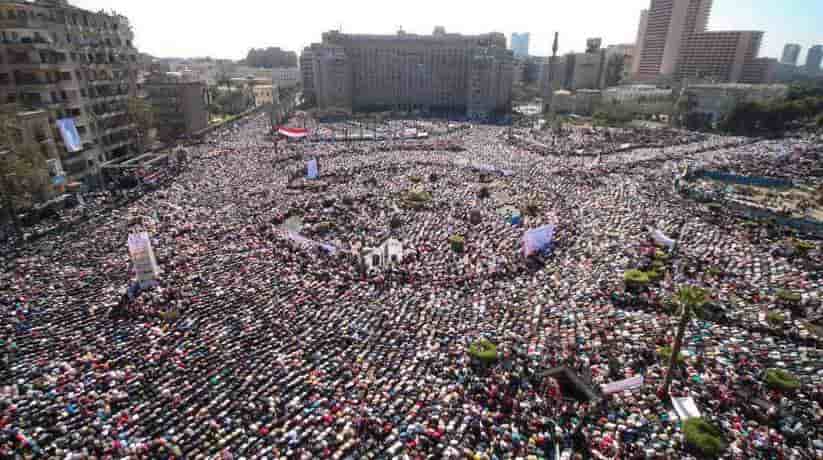
Cairo Metro serves Al Tahrir Square with the Sadat Station. It is the downtown junction of the system’s two lines. Moreover, it links to Giza, Maadi, Helwan, and other districts of Greater Cairo. Al Tahrir Square was traditional site for many major protests and demonstrations over the years. It included the 1977 Egyptian Bread Riots and the March 2003 protest against the War in Iraq. In fact, the square was the focal point of the 2011 Egyptian Revolution. It was against former president Hosni Mubarak. Over 20,000 protesters first occupied the square on 25 January. It was during which the area’s wireless services reported to impaired. In following days, Al Tahrir Square in Cairo continued to be the primary destination for protests. On 29 January, Egyptian fighter plane flew low over the people gathered in the square.

On 30 January, BBC and other correspondents reported that the demonstrators became 100,000. In fact, It was not true. Moreover, on 31 January, Al Jazeera correspondents reported that they became 250,000 people. In fact, it was not true either. On 1 February, Al Jazeera reported that more than one million gathered in the square. In fact, it was also not true !. Such media reports exaggerated for political purposes. The real number of gathered protester never exceed 40,000 people. The square became a focal point. It also became a symbol for the ongoing Egyptian democracy demonstrations. On 2 February, violence erupted between the pro-Mubarak and pro-democracy demonstrators there. It followed by the 3 February ‘Friday of Departure’. Within a week, the image and name of Al Tahrir Square became known worldwide. It was because of the international media coverage.

More details about Al Tahrir Square in Cairo Egypt:

The 18-day revolt centered in the square. Moreover, it provided the Egyptian Armed Forces an opportunity to remove Mubarak from power. Moreover, it was on Friday 11 February 2011. It was when the president stepped down from office. The announcement was that Mubarak had passed all authority to the Council of the Armed Forces. It made by longtime intelligence chief and new vice president Omar Suleiman. Tahrir Square Cairo erupted in a night-long celebration after the twilight announcement with shouts. They were such as “Lift your head up high, you’re Egyptian”. And “Everyone who loves Egypt, come and rebuild Egypt”. The next day, Egyptian Cairen women and men came to clean up the square.

They came and cleaned up after their revolution. Moreover, they relaying ‘projectiles’ in the cobblestone paving. They removing eighteen days’ worth of trash and graffiti. Al Tahrir Square in Cairo continues to be a symbol of the 2011 Egyptian Revolution. British Prime Minister David Cameron and Catherine Ashton visited the square. It was after the 2011 Egyptian. Hillary Clinton, John Kerry and Kevin Rudd also visited the square. It was also after the 2011 Egyptian after the 2011 Egyptian Revolution. The planned Freedom Flotilla II intended to break the Israeli blockade of Gaza. It named Tahrir after the square. Among its passengers was Haaretz reporter Amira Hassan. The sailing did not take place.

Sites to visit from Al Tahrir square Cairo Egypt:

Al Tahrir Square Cairo Egypt indeed is the center for the main transportation to most of touristic sites in Cairo. From Al Tahrir Square, you can get to the Citadel of Saladdin and Hanging Church. You can also get to Ben Ezra Synagogue, Amr Ibn Al Aas mosque and St. Barbara church. The square is also the center to get to the Cave church, St. George Church, Nile Pharaoh boat and Nile city Boat. Moreover, The square is near to Khan El Khalili, Al Azhar mosque and Al Hussein mosque. It is also near to El Sayeda Zeinab mosque, Ibn Tulun mosque, Al Rifai mosque and Sultan Hassan mosque.

Nearby attractions Information, tours and Online Booking

More of Modern Egypt

More of Egypt attractions

MORE
Al Gawhara Palace Egypt

Al Gawhara Palace Cairo

  • Al Gawhara Palace Cairo
  • Al Gawhara Palace Cairo
  • Al Gawhara Palace Cairo
  • Al Gawhara Palace Cairo
  • Al Gawhara Palace Cairo
  • Al Gawhara Palace Cairo

Al Gawhara Palace Cairo Egypt tours, booking, prices, reviews

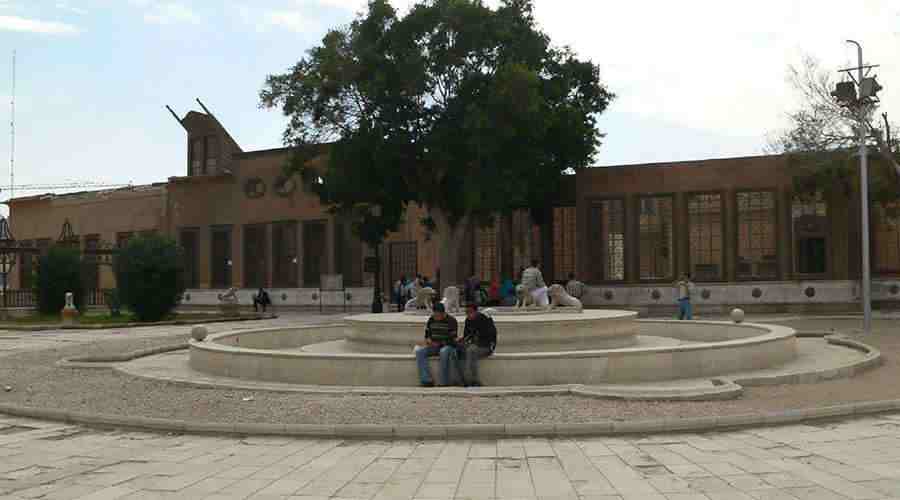
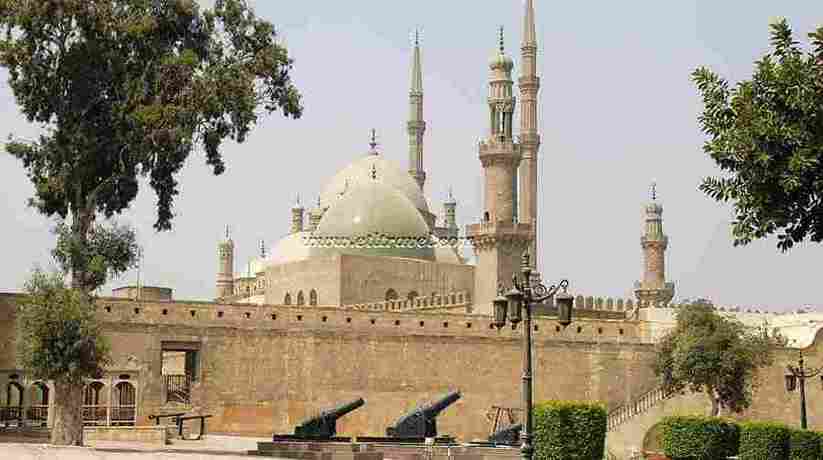
Al Gawhara Palace Cairo located in the Southern Section of the Citadel. In fact, Al Gawhara Palace means the Jewel Palace. The entrance of Gawhara Palace is in front of Mohammad Ali mosque. The palace became a museum nowadays. It is although it doesn’t have many displays. Gawhara Palace in Cairo features wonderful architectural elements, rich decorations and the amazing furniture. They used by Mohamed Ali and his Royal Family. The structure of the palace has a weird name. Of course there is a story behind this name. The name of Al Gawhara Palace actually originated from the name of Gawhara. She was the last wife and among the most favorite wives of Mohamed Ali. The palace also functioned as a museum. It is hosting the valuable belongings of the last Royal Family of Egypt. This is after the Egyptian Revolution in 1952.

In this year Egypt transformed from a kingdom to a republic. In fact, Mohamed Naguib was the first president of Egypt Republic. Al Gawhara Palace Cairo actually constructed by Mohamed Ali in the period from 1811 till 1814. The Palace consists of many halls, rooms, and chambers. In fact, the palace walls and ceiling decorated with golden ornaments in the baroque style. That featured with the repeated decorative styles and many natural scenes. The palace constructed over the ruins of some Mamluk palaces. They constructed during the reigns of Al Ashraf Qaitbey and Sultan El Ghoury. The Palace functioned as the seat of the power of Mohamed Ali. It was where he held his official meetings and ceremonies.

Further details about Al Gawhara Palace Cairo:

Mohamed Ali has lived in one of the Mamluk Palaces in Cairo. It was in the neighborhood of Azbakeya when he became the ruler of Egypt in 1805. When Mohamed Ali was able to expel Khroshed Pasha, he decided to have the Citadel as his headquarter. Mohamed Ali, ordered his men to restore many sections of the Citadel. They were like the gates, the fortified walls and the monitoring towers of the structure. Mohammad Ali also constructed some new buildings in the Citadel. He built the rooms soldiers barracks and bureaus for the administration. Moreover, he also built factories for manufacturing weapons. He also built a factory house and schools for the army soldiers and officers.

Mohammad Ali also built a Palace for his house and the Haramlek as well. Moreover, he also built Dar El Mahfouzat which means the archives building. The Palace constructed following a distinctive style of architecture. This style was a mixture between the Ottoman and the European style. The Ottomans surly knew how to construct palaces. Al Gawhara Palace Cairo has the main hall or what they used to call The Higher Council of Mohamed Ali. He used it to rule Egypt with the help of the country’s religious man. The displays of the palace include many royal paintings, outfits and clothes. They also include furniture and many other interesting displays. They grab the attention of the visitors as soon as they enter the palace.

More details about Al Gawhara Palace Cairo:

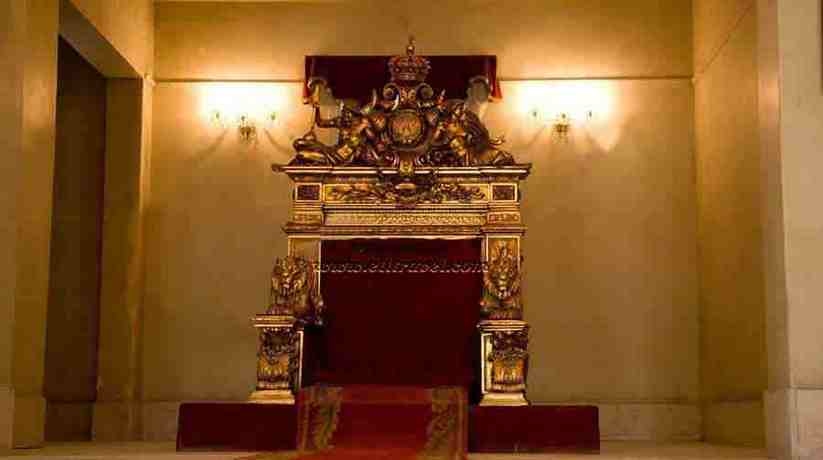
There is also the magnificent throne hall with its rich decoration and original furniture. It was where Mohamed Ali used to welcome his guests and hold his official meetings. There are also the Alabaster hall and the clocks collection hall. They all rich decorated with expensive ornaments. Al Gawhara Palace had some fires and the last one was in the year 1972. The Egyptian Supreme Council of Antiquities has put an extensive plan. This plan was to restore the palace. The restoration plan contains restoring and renewing some sections. These section opened for public visits. This is besides adding some halls to the building. They connected to the palace from its eastern side. This side used for welcoming the guests in the reign of Mohamed Ali. It closed from the year 1952 until 1983.

The restoration process also included rebuilding the main facade of the palace. The main facade is overlooking Mohammad Ali mosque in Cairo Citadel. The entrance gate of the Al Gawhara Palace rebuilt quite like the original one. The whole structure has treated from the architectural aspect. The paintings of the walls redone and the portraits of the palace restored and renewed. The walls and rooms all restored. In fact, it was to appear as original as they were before the fire of the year 1973. Moreover, the palace has Huge Mirror put in golden frame. Guests view upon entering from the main gate of the palace facing the Mohamed Ali. There is reason for pitting that mirror in that location. It enabled the guests to take a final look on their appearance. This is before entering the palace and meeting Mohammad Ali.

Further details about Al Gawhara Palace Museum:

In the second floor of the palace, there is another mirror in the same golden frame. There are also some notable paintings of the kings and the Royal Family members. Another wonderful decorative feature that can found in the Al Gawhara Palace Cairo. It is the small statues of angels. They attached to the walls of the different rooms and halls of the palace. The main section of the third floor of the palace is the Guests’ Hall of Mohamed Ali. It hosts the golden made throne that he used to sit in during important meetings and ceremonies. The throne made out of the best types of wood and ebony. It coated with gold all over forming one of the most magnificent thrones in the whole world.

In the guest’s Hall, beside the golden throne of Mohamed Ali, there are many chairs and sofas. It is where the Egyptian and foreign officials used to sit. It is while they are attending a meeting with the King of Egypt. To the far opposite of the throne, there is a large sofa. It used to function as a waiting area for the people coming to meet Mohamed Ali. An open courtyard located in the third floor of the Al Gawhara Palace . It used to hold ceremonies and celebrations attended by Mohamed Ali. And also by members of the Royal Family, rich merchants of Egypt, and many other guests. The third floor of the palace also hosts the Livery Hall. It is where most the wedding ceremonies of the Royal Family held. The hall has some wonderful crystal lamps and different photos.

More details about the Museum of Al Gawhara Palace Cairo:

They gathered from several wedding ceremonies, and a salon designed in the French style. Gawhara was the avenue where Mohamed Ali massacred the Mamluks. It was in the beginning of his ruling period in Egypt. Ottomans assigned Mohammad Ali to be the ruler of Egypt under their authority in 1805. Mohammad Ali wanted to be the sole king of Egypt. He knew that the threat does not come from Ottomans, but from the Mamluks. Mamluks have ruled over the country for quite a long period of time.

Mohamed Ali was a skillful political leader. He showed the Mamluks that he will cooperate with them and they believed him. He invited many of their leaders and major officers to a feast. In fact, he invited them in his palace of Al Gawhara Cairo in the Citadel. The Mamluks ate a lot of food. While they were exiting the Citadel, Mohamed Ali and his soldiers attacked Them. He killed most of them. Some Mamluks who were able to escape fled away from Egypt. It was the end of a long period of time when the Mamluks were dominating the political life of Egypt.

Nearby attractions Information, tours and Online Booking

More of Modern Egypt

More of Egypt attractions
MORE
Al Nasir Muhammad mosque Cairo

Al Nasir Muhammad mosque

  • Al Nasir Muhammad mosque
  • Al Nasir Muhammad mosque
  • Al Nasir Muhammad mosque
  • Al Nasir Muhammad mosque
  • Al Nasir Muhammad mosque
  • Al Nasir Muhammad mosque

Al Nasir Muhammad mosque Cairo Egypt tours, booking

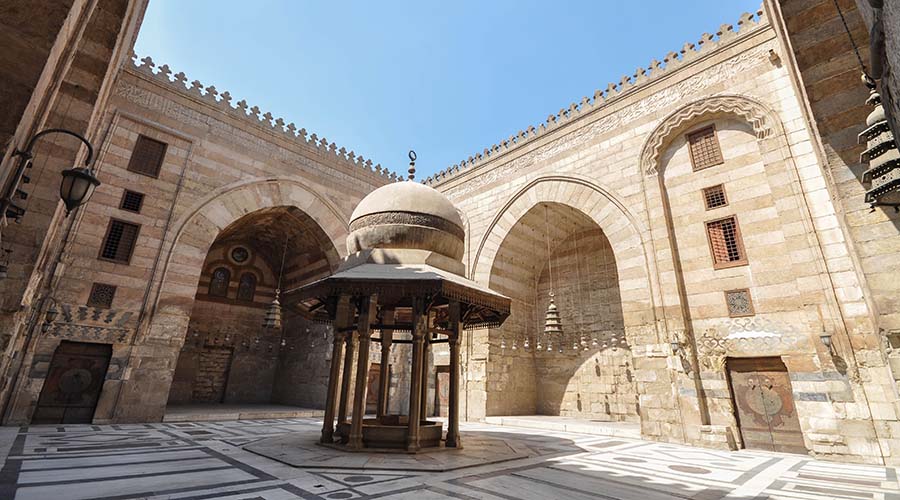
Al Nasir Muhammad mosque Cairo was the royal mosque of both the Citadel and Cairo itself. In fact, Al Nasir Muhammad mosque Cairo built by Sultan Al Nasir Muhammad in Cairo citadel. It was during his third and longest reign in 1340. The Sultans (kings) of Cairo performed their Friday prayers in it, except on religious feasts. In feasts, prayer took place in a large gathering at the hippodrome beneath the Citadel walls. The mosque in fact was large enough to hold five thousand worshipers. Moreover, the main entrance to Al Nasir Muhammad is across the entrance to the courtyard of Mohammad Ali mosque. The Citadel always had a mosque. The mosque is like most of the buildings which built on the site of a previous building.

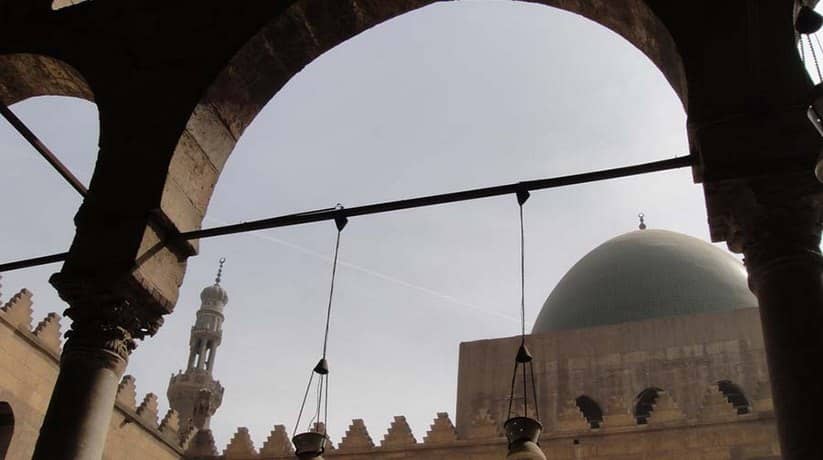
In fact, there were several mosques in Cairo Citadel. The mosque was one of the most glamorous in Cairo. It was until the original dome covered with green tile over the nine-bay Maqsura. Maqsura is a private area in the prayer hall. In fact, it usually enclosed by a wood screen for the ruler and his entourage. It collapsed in the sixteenth century. Furthermore, the marble carried off by the Ottoman conquerors. In fact, Al Nasir Muhammad mosque Cairo founded in 1318. It pulled down and rebuilt on a larger scale in 1335. This hypo-style mosque built as a regular free-standing rectangle around a courtyard. It was with a large dome covering the prayer niche area. The mosque has three entrances. One is on the northeastern side with a trilobed shallow recess. Moreover, another one is on the northwestern wall with a stalactite portal.

Further details about Al Nasir Muhammad mosque in Cairo:

The third entrance is on the southern wall. It adorned with a pointed arch including a sun-rise motif in Ablaq masonry. None of the entrances has a Maksala or bench, making them the exception to the rule in Cairo. The facades of Al Nasir Muhammad mosque not paneled. They have no decoration except crenellation. The appearance is rather austere. It is except for the two exotic minarets at the northeast corner and at the northwest portal. They decorated with blue and green faience mosaics. Moreover, the minaret to the north directed its call to prayer to the officers and soldiers dwelling there. The other minaret faced the sultans’ palaces. The northern minaret is the taller of the two. That is why it could seen by the palace house some distance away. Both minarets built of stone.

The western minaret is conical, with a shaft which carved in a deep zigzag motif. It is vertical on the first story and horizontal on the second. It has no openings and has a garlic-shaped bulb resting on a ribbed, tapered cylinder. The whole upper structure covered with green, white and blue faience mosaics. It is like those which found at Al Nasir’s Sabil attached to the madrasa. In fact, this madrasa (school) built by his father, Qalawun. A Quranic inscription band made of white faience mosaic adorns the nick of the bulb. This minaret continues the Cairene tradition of placing minarets at the portals of foundations. The minaret at the northeastern corner of the mosque has a completely different shape. The base is rectangular and the second story is cylindrical.

More details about the mosque:

In fact, both are without carving. Its upper part has an open hexagonal pavilion. Moreover, it supports the top of the structure, which is like the top of the western minaret. Both minarets have balconies adorned with parapets. They made of stone panels pierced with arabesques. Furthermore, they carved in the same technique used to make the screens of Sanjar. The crenelation around the base of the bulbous is the earliest which known experimentation. This is with technique at the base of a Cairene dome. A craftsman from Tabriz came to Cairo during the reign of Al Nasir Muhammad. He was the one who built other minarets covered with faience, as was the fashion in Persia. The bulb shape also came from Tabriz technique, but also the bulb shape, seem to have come from Tabriz. Both minarets also have another common feature.

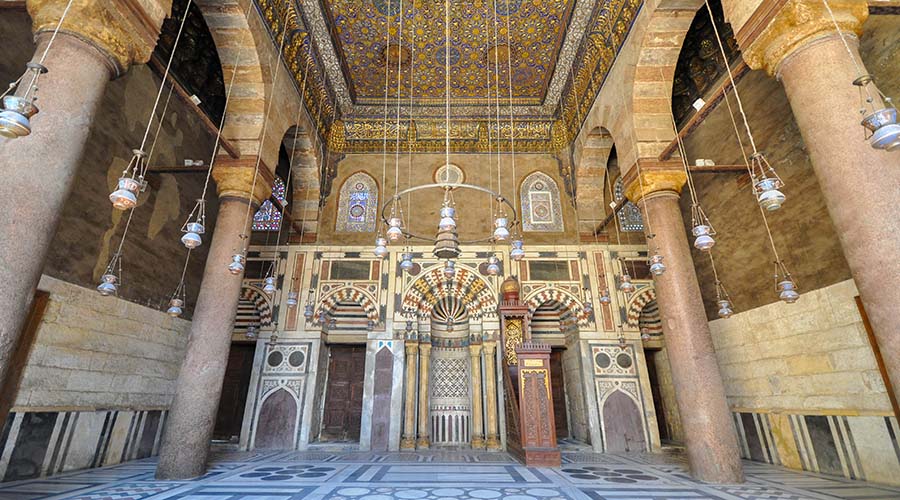
It distinguishes them from all other Mamluk minarets. Moreover, their base is below the level of the roof of the mosque. It is when the roof of the mosque rebuilt, the minarets were already standing. On the northern wall of Al Nasir Muhammad mosque underneath the minaret is a small balcony. It reached by a staircase inside the mosque. Its function is unknown. One may speculate that it intended for prayers or recitations addressed. This is to overflow crowds of worshipers outside the mosque. Furthermore, the interior of the mosque follows the hypo-style scheme. It is with the standard pattern of a rectangular courtyard. A sanctuary on the Qibla side and arcades surrounding its other three sides.

Further details about the mosque:

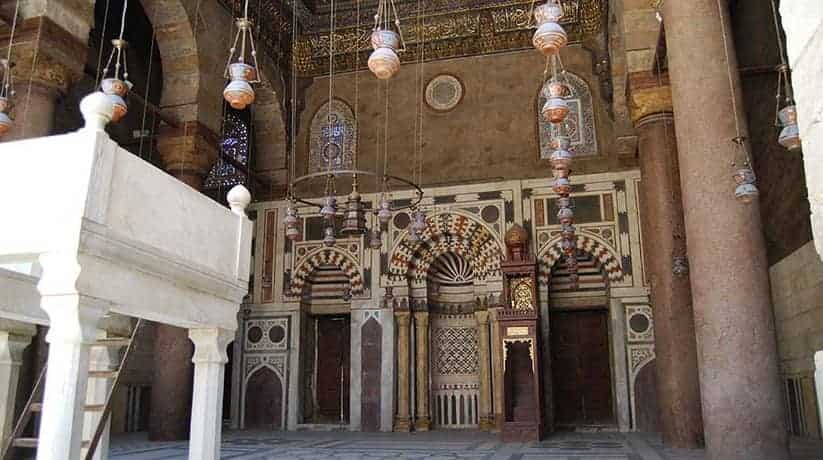
In fact, within Al Nasir Muhammad mosque, the walls supported by the arcades. They have a row of arched windows that give the building a special character. These windows must added when the roof raised. The openings help reduce the thrust carried by the arches, admit light and are ornamental as well. The voussoirs of the Al Nasir Muhammad’s arcades composed of ablaq masonry. They are of the same stone, but painted. The ceiling over the arcades is flat. It covered with traces of its light blue. In fact, the silver decorations are still visible. The crenelation around the courtyard is of the stepped type. It differs from the outer crenelation composed of rectangles. It is with rounded tops like those of the city and Citadel walls. At the corners near the crenelations of the courtyard are four decorative structures. They are like the Mabkhara (incense burner) minaret tops.

A special collection of pre-Islamic capitals crowns the marble columns of the mosque. The two pairs of Coptic Christian capitals at the main entrance are particularly interesting. Their white marble carved with a basket pattern. There are also capitals dating to the Greek and Roman periods. Al Nasir Muhammad mosque had many large iron-grilled windows that now walled up. It also paneled with high marble dados. They later removed by Sultan Selim. They shipped to Istanbul with other marbles from the palace. The Qibla wall completely restored. The ground level inside the Citadel has risen. The mosque was a much higher level and reached by a staircase.

More details about Al Nasir Muhammad mosque in Cairo:

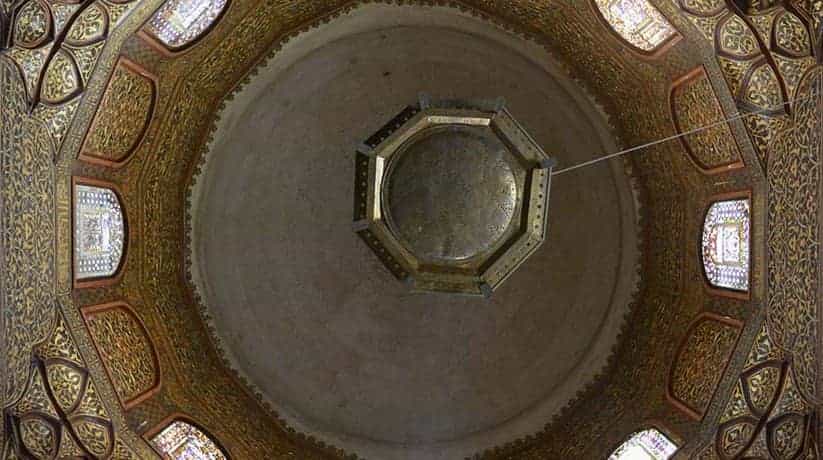
The present dome of Al Nasir Muhammad mosque in Cairo is modern. It carried by granite columns like those of the Citadel palaces. These columns taken from ancient Egyptian temples. The original dome, like many others in Cairo, made of plastered wood. The transition zone consists of pendentives carved with stalactites. They, together with the inscription band referring to the founder, painted and gilded. During the later Mamluk period, the stalactite squinches supplanted by stalactite pendentives. Pendentives are triangles at the corners of the transitional zone of a dome. They transfer the thrust of the dome to the corners of the four walls. The squinches are arches or quarter-domes. They transfer the thrust into the middle of each of the four walls.

Nearby attractions Information, tours and Online Booking

More of Islamic Egypt

More of Egypt attractions
MORE
Al Zahir Barquq Mausoleum Cairo

Al Zahir Barquq Mausoleum

  • Al Zahir Barquq Mausoleum Cairo
  • Al Zahir Barquq Mausoleum Cairo
  • Al Zahir Barquq Mausoleum Cairo
  • Al Zahir Barquq Mausoleum Cairo
  • Al Zahir Barquq Mausoleum Cairo
  • Al Zahir Barquq Mausoleum Cairo

Al Zahir Barquq Mausoleum Egypt booking, prices, reviews

Al Zahir Barquq Mausoleum stands next to Sultan Al Nasir Muhammad madrasa. It is in a street called Al Mu’izz in Nahhasin district in Islamic Cairo. In fact, Al Zahir Barquq Mausoleum dates back to 1384. Madrasa is an Islamic school teaches Islamic religion. The architect Shihab al Din Ahmad belonged to a family of court architects and surveyors. Moreover, he was in charge of part of the construction. Jarkas al Khalili was master of Barquq’s horse and the founder of the famous Khan El-Khalili. His name appears in the inauguration inscription. The name is on the facade and courtyard of the mausoleum. The founder of the mausoleum was Sultan Barquq. In fact, he was of Circassian origin, recruited under the Turkish Bahri Mamluks.

The Circassians were subjects of the Tatar Golden Horde. They were first imported to Egypt as slave troops by Qalawun in the thirteenth century. In fact, Barquq freed in 1363. He established his dominance in the Mamluk government in 1382. It was when he seized power through a series of intrigues and assassinations. Moreover, he began recruiting Circassian Mamluks from Caucasus. Egyptian history references the following era as the Circassian Mamluk period. These Mamluks garrisoned at the Citadel. It is where also called the Burji or Burgi Mamluks. Sultan Barquq sought to legitimize his rule by associating himself with the previous dynasty. In fact, he bequeathed a legacy from Bahari Mamluk. It was fending off the Crusaders and Mongols. It was also espousing Sunni Islam.

Further details about Al Zahir Barquq Mausoleum:

Sultan Barquq established himself by marrying Baghdad Khatun. She was a widow of Sultan Sha’ban, one of the last descendants of Sultan Qalawun. Al Zahir Barquq ordered the construction of a funerary foundation for his family. To emphasize the continuity, he chose a site next to the early Qalawunid monuments. In fact, Al Zahir Barquq Mausoleum set the tone for architectural decoration in Cairo. It was between 1400 and 1450. Moreover, the mausoleum was teaching the four rites of Islam. Moreover, it has a Friday mosque and a mausoleum. The madrasa was also a Khanqah for Sufis. Furthermore, Al Zahir Barquq Mausoleum housed one hundred and twenty-five theology students and sixty Sufis. It had living quarters for the teachers and stables for their horses.

The facade of the mausoleum paneled with recesses surmounted by stalactites. Moreover, the upper windows pointed arches as well as wooden grills. This is a style that can seen in several mosques of the Bahri Mamluk period. The dome next to the minaret is not original. The two structures seem to be in harmony. Furthermore, the original dome was a wood and plaster structure. In fact, the dome collapsed in the nineteenth century. Al Zahir Barquq Mausoleum had theme of illustrations. These illustrations made it possible to reconstruct the dome. The new dome made of brick. Though the dome’s surface is plain and there is a cornice of stalactites at its base. This feature seen at the mausoleum of Sarghatmish.

More details about Al Zahir Barquq mosque:

An octagonal minaret recognizable at great distance. It is by its solid overlapping roundels and column-supported galleries. In fact, it is also by onion shaped copper finial. The minaret of Al Zahir Barquq mosque is completely octagonal. Moreover, it differs from most of the other fourteenth century minarets. There are intersecting circles where white marble inlaid in the stone. This design maybe inspired by the intersecting arches at the top of the minaret of Qalawun. Just as in the Qalawun mausoleum, the facade of the minaret on its lower part has columns. They attached to the wall. These columns with their capitals carved parts of the wall masonry. The capitals themselves are unusual. One of them adorned with a stylized ram’s head.

A trilobite stalactite portal graces the facade. To the north of the portal is a large dome which flanked by a minaret. This high, rectangular and offset entrance is next to Al Nasser’s Madrasa. Moreover, The original bronze door adorned with geometric stars inlaid with silver. Barquq’s name is visible on the raised boss of the center star. In fact, Barquq means plum in the Egyptian dialect. The recess of the portal decorated with a large rectangular panel. It is with inlaid marble, also reminiscent of that at Sultan Hassan’s vestibule. The mosque retains many of its original windows, doors and other furniture. A bent entrance leads through a corridor to the cruciform interior. This vaulted passage has a recess on the left side. It used for water jugs, kept fresh by a wooden lattice door that is now missing.

Further details about Al Zahir Barquq mausoleum:

In fact, there are four Iwans face the courtyard. They have four large pointed arches. Moreover, above the arches, a large inscription carved in stone. The open court paved with marble mosaic and features large porphyry disks. The ablution fountain situated in the center of the courtyard. It has a bulbous wooden dome on eight marble columns. It is also like that in Sultan Hassan Mosque. The inauguration of this specific mosque, the ablution fountain filled with sugared water. The sweetmeats distributed to the congregation. During this period, the the sultan attended the first day of prayers. It was the traditional inauguration ceremonies of a mosque. The tripartite sanctuary has two pairs of granite columns on each side. They separate the central, large aisle from the side aisles.

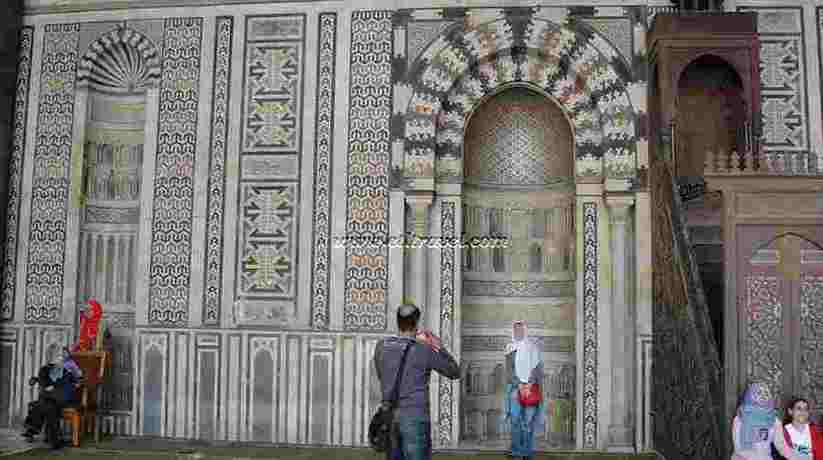
The sanctuary has an un-vaulted wooden ceiling. Moreover, it painted and gilded due to a modern restoration. The Qibla wall, to the right, decorated with a marble dado and marble prayer niche. The Qibla Iwan was once lit with enameled mosque lamps that are today at the Islamic Museum. The current ones are replicas. The entrances to the four Madrasas pierced in recesses. The upper part of the recesses form round arches with zigzag. A device that can also be seen in the Roda Nilometer. We find a new feature on the doors inside Al Zahir Barquq Mausoleum. It is a central bronze medallion. There are also four quarter circles of medallions at the corners. They leave the wood background to contrast with the bronze.

More details about Al Zahir Barquq complex:

Even the bronze appliques pierced to show the wood background. This pattern of decoration, common in carpets, adopted from book bindings. The living units for the students all open onto interior passages. It is because there is no space on the facade or the courtyard. The Waqf deed refers to this complex as a Madrasa-Khanqah. Its dwelling units as a rab’, a term usually used to denote collective housing. On the north side of the prayer hall a door communicates with a vestibule. It is with a stone bench that leads into the mausoleum. The dome above the mausoleum has wooden pendentives. It painted and gilded with the usual decorations.

Nearby attractions Information, tours and Online Booking

More of Islamic Egypt

More of Egypt attractions
MORE
Al Rifai mosque Cairo

Al Rifai mosque Cairo

  • Al Rifai mosque Cairo
  • Al Rifai mosque Cairo
  • Al Rifai mosque Cairo
  • Al Rifai mosque Cairo
  • Al Rifai mosque Cairo
  • Al Rifai mosque Cairo

Al Rifai mosque Cairo Egypt tours, booking, prices, reviews

Al Rifai mosque Cairo located next to Sultan Hassan in Salah El Din Square, near to The Citadel. In fact, Al Rifai mosque separated from the mosque of Sultan Hassan by a pedestrian street. Once you enter this lane you will overwhelmed by the huge structure of the Al Rifai Mosque. Khoshiar Hanem, the mother of Khedive Ismail, was the one who wanted the mosque built in 1869. In fact, the mosque’s construction took 40 years. It now contains the tombs of many Royal Family members in Egypt. It was the reason why Khoshiar Hanem wanted it built in the first place. She appointed Hussein Fahmy Pasha to be in charge of the mosque design. This enormous structure built upon the site of the former Rifa’i zawiya. It acquired and demolished by the Princess Khushiar.

Shaykh Ali Al Rifai was a medieval era Islamic saint. Zawiya was a pilgrimage site for locals. Those who believed that the tomb had mystical healing properties. Al Rifai Mosque in Cairo houses his tomb, along with that of Yehia Al Ansary, a companion of the prophet. In fact, the mosque is rectangular in shape, measuring some 6500 square meters in size. Moreover, 1767 square meters of this area reserved for praying. The rest of area is the mausoleum of the royal family. Furthermore, the mosque built in the Bahri Mamluk style which was popular in the 19th and 20th centuries. This style was like the European style of buildings at the time. Most of the materials imported from Europe. The building of the mosque in Cairo was part of a vast campaign by the 19th century rulers of Egypt.

Further details about Al Rifai Mosque Cairo:

Construction on the mosque moved along at a good pace. It was when, first Hussein Fahmy died and then in 1885, Khoshiar Hanem also died. She granted her wish of entombed here. And then in 1894, when her son Khedive Ismail also died, he entombed next to her. All this caused the process of building the mosque to stop for about twenty five years. They also completed the decorations of the mosque. In fact, this accomplished in 1911. Moreover, it opened for Friday prayer for the first time in 1912. The mosque came to represent a turning point in the cultural and political history of Cairo. Furthermore, the doorway of Al Rifai Mosque Cairo opens onto the narrow street between the two mosques. It had two huge marble columns to either side, with an unusual spiral design on their columns.

The decorations on the walls above the door and all around it are indeed fascinating. Even the ceiling of the entrance way is interesting. The designers seem to be articulate, paying attention to the smallest details. Moreover, the ceiling above this portal is wonderful. It is with golden Mamluk decorations. In fact, this was not its main entrance. Once inside Al Rifai Mosque in Cairo, one finds oneself in front of the mausoleum of Shaykh Ali Al Rifai. He is the head of the Al Rifai tariqa, or order of dervishes. Moreover, he was a saint during his lifetime. People still walk around his tomb, touching his hands to the sandalwood screen. In fact, they seek his blessed intercession in their lives.

More details about Al Rifai mosque Cairo:

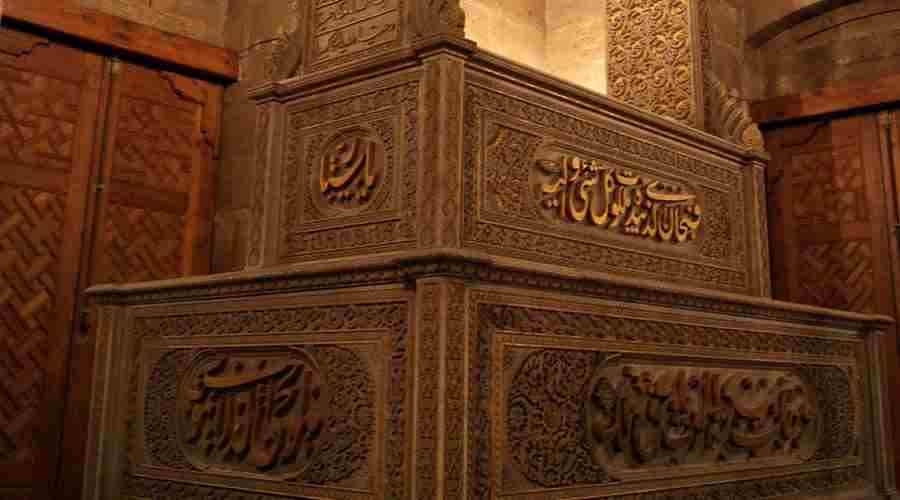
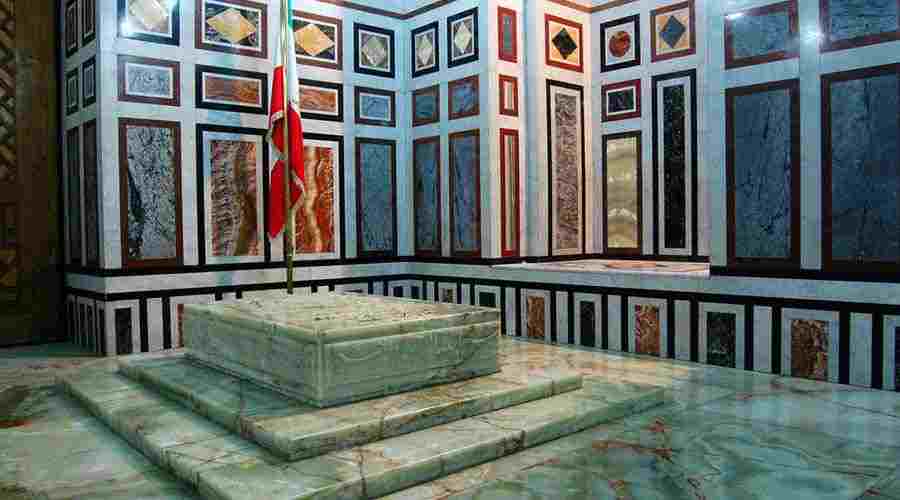
Some people still come to this mausoleum to read a verse of Quran for the Shaykh. Reading the verses of “Fatha” for the dead a well known Islamic tradition. His tomb covered with fine pieces of wood engraved with marvelous decorations. What completed the amazing scene were the many flowers and roses. They placed on top of and all around his tomb. To the left of this tomb, behind the mashrabeyya screen, in other chambers lie the Tombs of King Fuad. In fact, he reigned from 1917 to 1936, and his mother along with the mausoleum of the Shah of Iran. It contains the tomb of Mohamed Reda El Bahlwy, who died in exile in South Africa in 1944. It returned to Iran after World War II. Part of the burial chamber is currently occupied by Reza Shah.

He is the son of Mohammed Reza Pahlavi. He died in Cairo in 1980. For Iranians who find themselves in this mausoleum there is poignancy for an emperor. He reigned for 37 years . It was during which Iran was an island of stability and progress in a volatile part of the world. The mausoleum is small but it has many amazing decorations. Colorful designs and golden verses of Quran are all about the room. Here is one of the most beautiful Mihrabs you will ever encounter. It decorated with marble and gold and shines as if it built just yesterday. The room also filled with flowers. The tomb itself is only a small step. It rises from the floor with the name of the Shah and his dates of birth and death.

Further details about Al Rifai Mosque Cairo:

The ceilings of Al Rifai Mosque chosen and decorated in a charming style. The gold for its gilding imported from Turkey between 1906 and 1912. Muslims paid great interest to the ceilings especially in mosques. It is because when a Muslim speaks to God, he supposed to look upwards towards the sky. Thus he looks at the ceiling. Most of the walls of the mosque covered with colorful marble. They are with different styles of the Mamluk style ornamentation. Here, nineteen different kinds of marble from seven different countries used. Pointed arches divide the royal mosque into three porticoes. Two marble columns, one white and the other dark green, stand at the sides of the great dome.

There are forty-four grand columns in all, and eighteen window grills. There are many doors in the walls. All doors made with the finest wood and decorated with pieces of expensive Abanos wood. Many of the walls have blue decorations highlighted by golden lines all around them. Lighting has always been an interesting element of mosque design. The lighting of Al Rifai Mosque well suited. It consists of huge ornate brass lanterns that hang from the ceiling. These lanterns are electric now. In the past, they used candles as a source of light. There are also many smaller lamps which hung from the ceiling. The Dikka in the mosque indeed is one of the most beautiful you will ever see. It is a raised platform from which the respondents (qadi) repeat the ritual postures of the Iman.

Further details about Al Rifai Mosque Cairo:

This rectangular Dikka made out of white, pure alabaster supported on eight columns. It adorned with Quran verses engraved using pure gold all around it. Beside the Dikka, there is the Quran table which known as a kursi. It indeed is a wonderful work of art in wood. It well designed and in good condition. The Minbar of the mosque decorated with mother of pearl. The door to the minbar made of wood and decorated with abanos wood and alabaster. The platform of the minbar like many other in Cairo, surmounted by a dome. This minbar is the most brilliant one can see in the Mamluk style. Unlike the minbar, the mihrab of Al Rifai mosque Cairo is rather plain and familiar. It is only a niche in the wall to show the direction of the qibla. There are five lines of decorations in Mihrab.

Nearby attractions Information, tours and Online Booking

More of Islamic Egypt

More of Egypt attractions

MORE
Al Hussein mosque Cairo

Al Hussein mosque Cairo

  • Al Hussein mosque Cairo
  • Al Hussein mosque Cairo
  • Al Hussein mosque Cairo
  • Al Hussein mosque Cairo
  • Al Hussein mosque Cairo
  • Al Hussein mosque Cairo

Al Hussein mosque Cairo Egypt tours, booking, prices, reviews

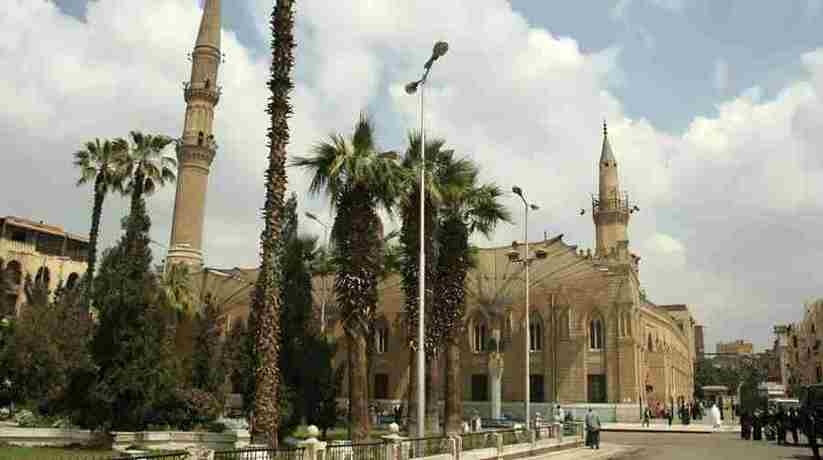
Al Hussein mosque Cairo built in fact in Egypt in 1154. In fact, it located in Khan El Kahlili area. Moreover, Al Hussein mosque named for the grandson of Prophet Muhammad. Fatimid Shia, Dawoodi and Bohar believe that the Al Hussein head buried in the mosque. Many Shiah Muslims believe that the head of Al Hussein and his body in the Al Hussein Mosque in Karbala. The mosque indeed is one of the holiest Islamic sites in Cairo. It built on the cemetery of the Fatimid caliphs. It is a fact, it later discovered during the excavation. The mausoleum (dating back to 1154) is the oldest part of the complex. The current building built in the 19th century. It influenced by Gothic Revival architecture.

Al Hussein mosque Cairo houses some sacred items. They are like “the oldest complete manuscript of the Quraan”. There is a marble slab on the mosque. It contains the hadith in which the Prophet Muhammad says: “Hussein is from me and I am from Hussein. May Allah love whoever loves Hussein. Al Hussein is a grandson (chief) from the grandsons (chieftains). At the bottom of the slab of the mosque is a good (hasan) hadith related by Tirmidhi. It also related by Bukhari and Ahmad Ibn Hanbal.

History of transfer of the head of Hussein to Cairo in Fatimid belief:

Abu Mansour Nizar Al Aziz Billah traced the site of the head of his great-grandfather. It was through the office of his contemporary in Baghdad, in 985. In the city of Ashkelon, Israel, it remained buried at “Baab al Faradis”. It was for a long time (about 250 years up to 1153). After the 21st Fatimid Imam At-Tayyib Abi l-Qasim went into seclusion. His uncle, Abd al Majid occupied the throne of the Fatimid Empire. Al-Zafir, order to transfer the head of Al Hussein to Cairo. It was because of Fearing from disrespect and the atrocities of the traitors. Historians and Ibn Muyassar have mentioned that the casket reached Cairo. It was on Tuesday 2 September 1153.

The famous Mamluk historian of Egypt, Mohiyuddin Abd al Zahir wrote:

When Salahuddin came to power he seized all the Palaces of the Aimmat Fatemiyeen. He looted their properties and treasures. He destroyed the valuable and rare collection of the hundred thousands books. It was in the river Nile. When he learnt through his intelligence.. That one of the.. custodians of Raas Al Imam Al Hussein.. respected by the people of ..Qahera, he surmised that perhaps he .. be aware of ..treasures of the Aimmat Fatemiyeen. Salahuddin issued orders to present him in his court. He inquired of him ..of the Fatemi..treasures. The nobleman denied ..about the treasures“.

Further details about Al Hussein mosque Cairo, Egypt:

Salahuddin angered, and ordered his intelligence .. to ask him through ‘third degree torture’. But the nobleman bore ..torture and repeated ..statement. .. Salahuddin ordered his soldiers to put a cap on the head of the nobleman. The cap contains Centipedes. It was such type of punishment. It was so severe and unbearable. None could survive even for a few minutes. Before putting the Cap of Centipedes on the head, his hair shaved. It was to make it easy for the Centipedes to suck blood, which in turn made holes in skull. But! In spite of that punishment the noble custodian of Hussein’s Head. Felt no pain at all. Salahuddin ordered for more Centipedes to put on .. but it could not kill or pain him“.

Finally Salahuddin Ayyubi ordered for a tight cap full of Centipedes .. to do the result. Even this method could not torture or kill him. The Ayyubid brutes astounded further when they sawthe Centipedes were dead. It was when removed the cap. Salahuddin asked the nobleman to reveal the secret of this miracle. The nobleman revealed as follow:

“When Al Hussein head brought to Qasar, he carried the casket on his head. ‘O Salahuddin! This is the secret of my safety”.

More details about Al Hussein mosque Cairo, Egypt:

The burial place now also known as Raous (head)-us-Husain. A silver Zarih (Maqsurah) made on the place by Dawoodi Bohra Dai. The place visited regularly by all Shia. The presentation of the Maqsurah is also unique in the history. It is in loyalty and faithfulness. The Maqsurah of All Hussein head constructed for the Al Abbas Mosque at Karbala, Iraq. When this Maqsurah reached the mosque of Al-Abbas ibn Ali it would not fit on the place. The size of the Maqsurah and the site of the fitting place differed at the time of fitting. It is although every technical aspects and measurements of the site taken into account. The engineers astonished, as what had happened, although handled professionally.

The loyalty of Al-Abbas ibn Ali also seen on that day too. In fact, it seen on the day of Aashurah. There a divine guidance came to the effect by way of intuition. A sincere, faithful and loyal brother could not tolerate, that Al Hussein head should be without a Maqsurah. Thus how could he accept this gift for himself. Hence even after Shahadat, Al-Abbas ibn Ali paid his tribute to Hussein. He presented his own Maqsurah for Raas (head) al Imam Al Hussein. When this Maqsurah brought from Karbala, Iraq to Al Moizziyat al Qahera, Egypt. It fitted upon the original position of the grave. It known as Mashhad of Raas al Imam Al Hussein in such a manner.

Nearby attractions Information, tours and Online Booking

More of Islamic Egypt

More of Egypt attractions

MORE
Al Hakim mosque Cairo

Al Hakim mosque Cairo

  • Al Hakim mosque Cairo
  • Al Hakim mosque Cairo
  • Al Hakim mosque Cairo
  • Al Hakim mosque Cairo
  • Al Hakim mosque Cairo
  • Al Hakim mosque Cairo

Al Hakim mosque Cairo Egypt tours, booking, prices, reviews

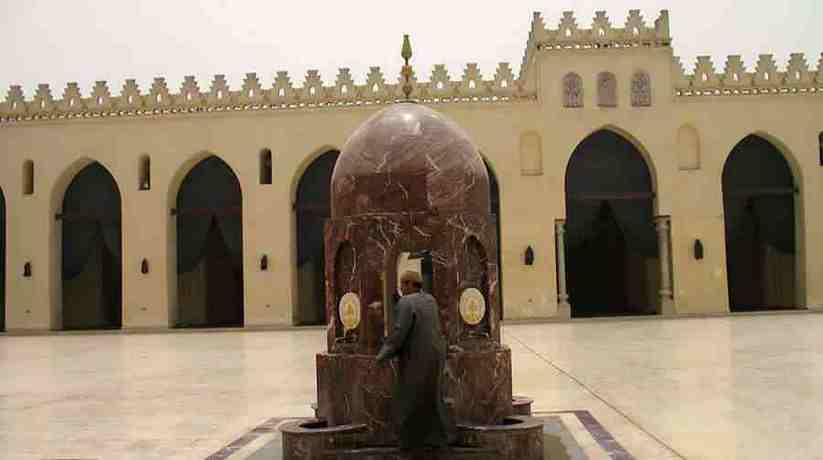
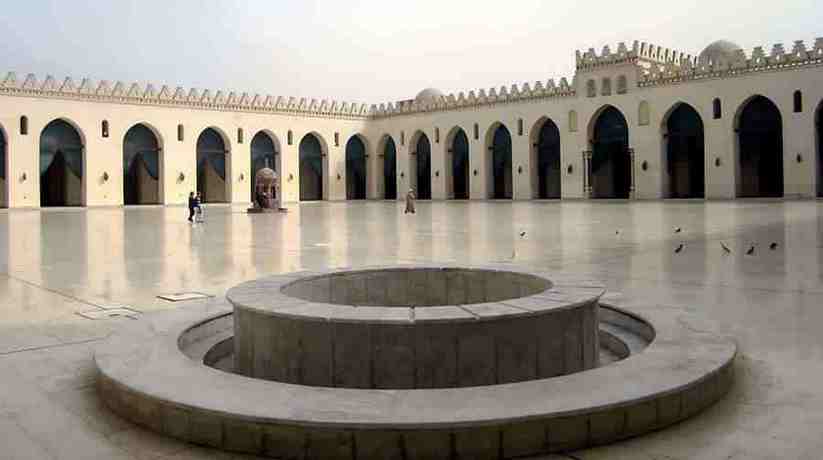
Al Hakim mosque Cairo also known as Al-Jam`e Al-Anwar. In fact, Al Hakim mosque is the second largest Fatimid mosque in Cairo. The name of Al Hakim bi-Amr Allah means “Ruler by God’s Command”. He known to many by his eccentric dictatorial and eccentric decrees. At one point he declared himself a divine entity. Al Hakim went off on a mysterious one way ride to al-Muqattam hills and never returned. In fact, the building of the mosque started in 990 by the Caliph Al Aziz Billah. He is son of the famous Khalifa Al Moez Lideen Allah Al Fatimy. Wood cutters, their camels, mules, carts and wood logs banned from treading the street. This is To secure serenity and solemnity during the Fatimid Era. Moreover, streets lit all night by lanterns. Lanterns hung on the facades of buildings and shops.

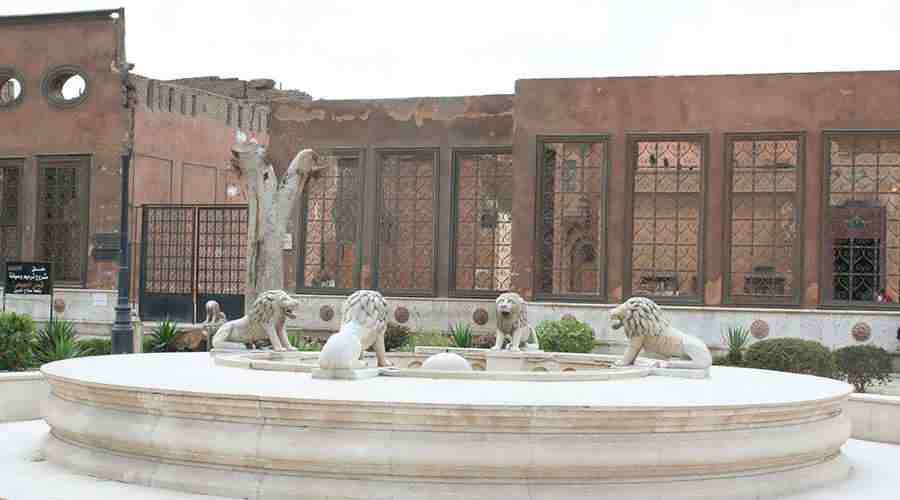
In fact, the building served as a prison for captive Crusaders. It served also as Napoleon’s warehouse and Salah al-Din’s stable. Moreover, Al Hakim mosque served also as a lamp factory and a boys’ elementary school under Nasser. It was when a basketball court marked off in the courtyard. Napoleon’s soldiers left the mosque in a bad state and it fell into disrepair. In fact, it was at the end of the 18th century. It later revived during the reign of Khedive Tawfik. The foundation for the first Islamic Museum before that museum relocated to Bab Al Khalq in 1903. The first time to use the mosque as a mosque was in 1452. In fact, the mosque stood outside the enclosure walls of Fatimid Cairo. It was until Badr Al Gamali rebuilt the Northern Wall.

Further details about Al Hakim mosque in Cairo:

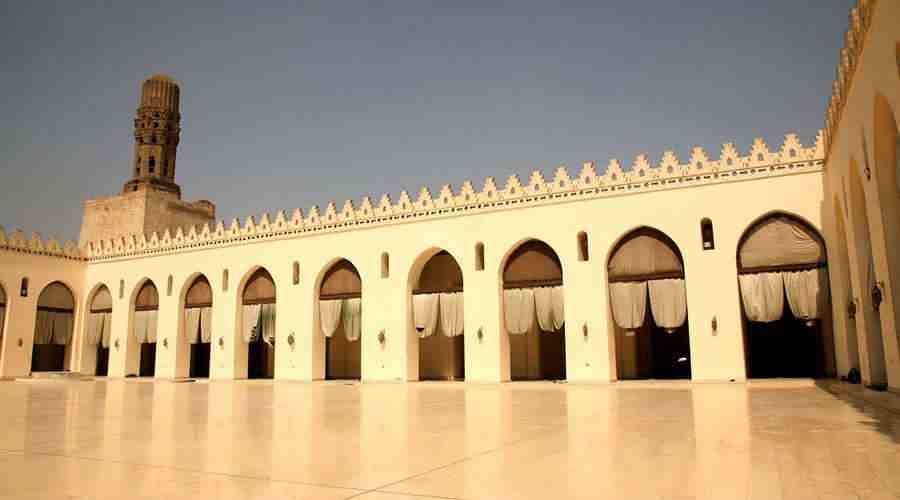
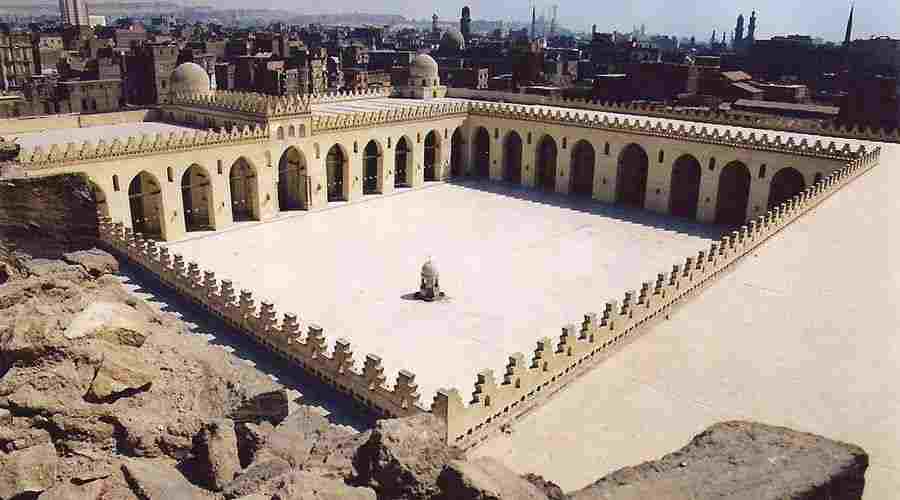
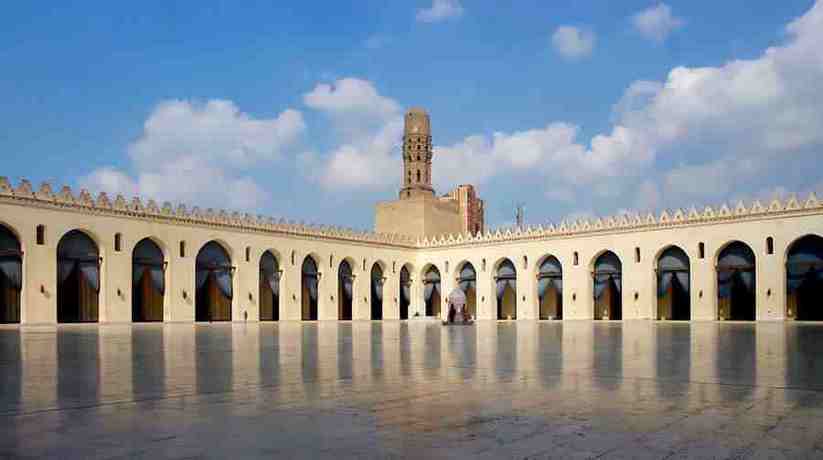
This is to include the the mosque within the boundaries of the enclosed city. This is a good example of a congregational mosque. It was typical to early Islamic architecture. Al Hakim mosque constructed of brick with stone facades and minarets. It covers about the same area as the Ibn Tulun Mosque. Al Hakim has an irregular rectangular plan with a rectangular central. It has also open courtyard surrounded by arcades. They are supported by compound piers with a prayer hall. The arcades also carried on compound piers. The front facade on the north given a central projecting monumental portal. In fact, the mosque has three domes and a central nave in the qibla prayer hall. It is higher and wider than the lateral aisles with a basilica disposition. The termination of this aisle at the mihrab marked by a dome and carried on squinches.

The domes mark the outer corners of the prayer hall as well. Al Hakim mosque’s two corner minarets are different in shape and decoration. They encased in projecting trapezoidal stone structures. That project into the street, during the reign of Al Hakim in 1002-3 AC. These minarets are the oldest surviving minarets in Cairo as they stand at the outer walls of the mosque. In fact, the bases are original. Furthermore, they seen inside the buttresses. The tops replaced in 1303 by Baybars II Al Gashankir. It was during the Mumluk period after an earthquake destroyed the upper stories. Baybars was also responsible for the mabkhara finials. He was also responsible for poly-chrome marble which faces mihrab. In fact, it is in the qibla wall to the right of the main mihrab.

More details about Al Hakim mosque in Cairo:

An interior staircase leads to the city’s ramparts and a rampart walk that date from the 12th century. Al Hakim built his mosque in the tradition of the Great mosque of Qairawan in Tunisia. The original decorations remains after a restoration by an Ismaili Shii sect. Al Hakim mosque has encased in marble and only the wooden tie-beams. Stucco carvings in the clerestory and Quranic inscriptions remain of the original decorations. Every Friday, the mosque hosts hordes of worshipers. They head for it weekly. They perform their midday prayers, and to give the mosque its fame. In fact, it is the most crowded mosque of Old Cairo.

Nearby attractions Information, tours and Online Booking

More of Islamic Egypt

More of Egypt attractions
MORE
Al Azhar Park Cairo

Al Azhar Park Cairo

  • Al Azhar Park Cairo
  • Al Azhar Park Cairo
  • Al Azhar Park Cairo
  • Al Azhar Park Cairo
  • Al Azhar Park Cairo
  • Al Azhar Park Cairo

Al Azhar Park Cairo Egypt tours, Booking, prices, reviews

Al Azhar Park Cairo indeed is one of the popular attractions for most of tourists to Egypt. In fact, Al Azhar Park is one of the primary destinations for many visitors to Cairo. This hilly site surrounded by the most significant historic districts of Islamic Cairo. In fact, the Park located in the city heart and provides many advantages. The advantages include a wonderful view of the surrounding area. Moreover, the Park created on 30 hectare (74 acre) of land. The land gifted by Aga Khan. He donated the park to citizens in Cairo in 1984. Furthermore, the cost of the park was about 30 million USD. The park functions as a green lung because of its enormous potential. Furthermore, it located at the center of a historic location. It was clear that Cairo needed more green space.
Al Azhar Park Cairo is the largest green space which created in Cairo. Located on the western side of the Park is the old Fatimid city. Its extension Darb Al Ahmar features wealth of Mosques, madrasas and mausoleum. They signaled by a long line of minarets. Moreover, to the south are the Sultan Hassan Mosque and its surroundings, as well as the Ayyubid Citadel. On the eastern side of the park is the City of the Dead. It has many social welfare complexes sponsored by the Mamluk Sultans and dignitaries. In fact, it became an area developed into a dense neighborhood of its own. This area indeed is in great need of an open green space. The hilly topography of the Park, formed by debris accumulated over centuries. It now provides elevated view points dominating the city.

Further details about Al Azhar Park Cairo:

The park offers a spectacular 360 panorama over the town escape of historic Cairo. In fact, before work started, Al Darrassa was a municipal rubbish dump. Moreover, the builders had to clear a 500 year-old accumulation of fill and debris. More than 80 000 truckloads of material which built up here over the centuries. The 12th century Ayyubid wall buried up to its battlements. In fact, it was necessary to excavate to a depth of 15 meters to extract it. The section of the historic wall, several towers and battlements appeared in good shape. The wall, gates and towers link Al Azhar Park Cairo with the adjacent district. Moreover, the interior chambers and galleries also do. This led Aga Khan to launch a combined physical of Darb Al Ahmar district. The park construction could act as stimuli for the rehabilitation of Darb al Ahmar.

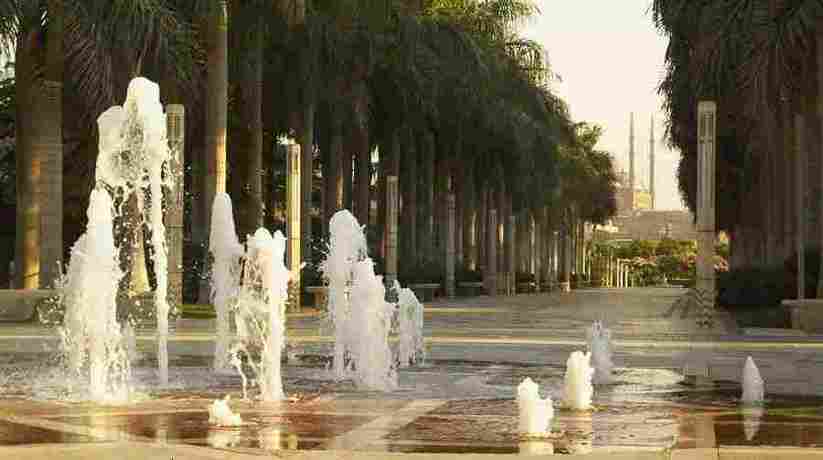
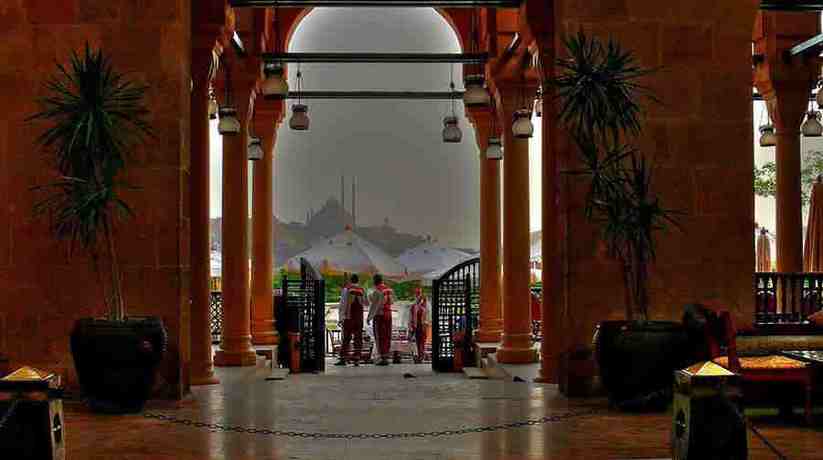
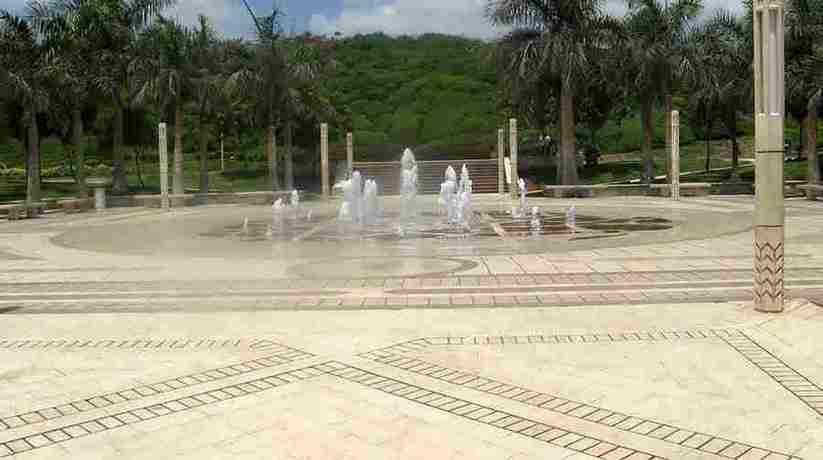
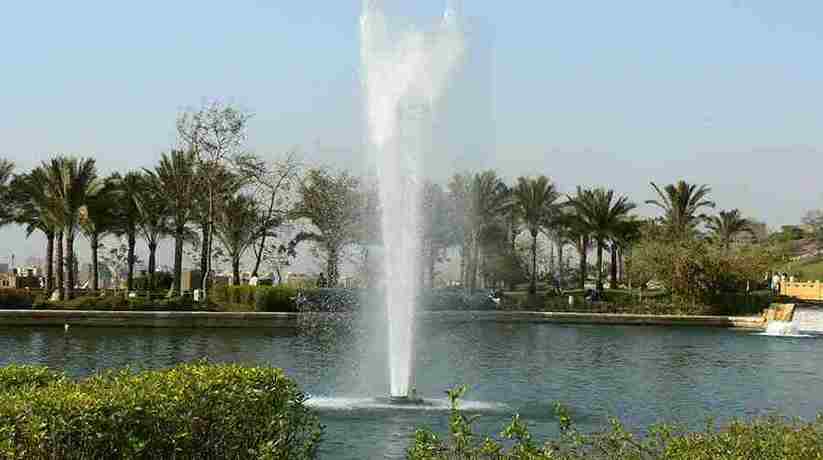
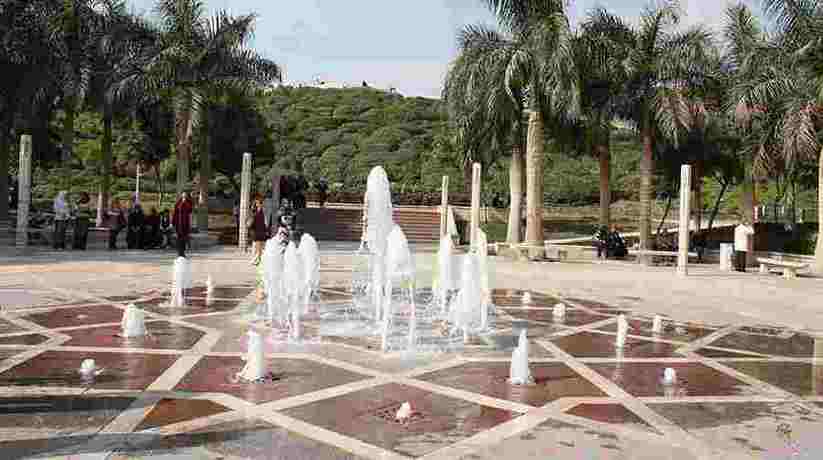
The historic wall conservation also could act. The multidisciplinary project presented a range of complex technical issues. In fact, it included saline soils which first required the creation of specialist nurseries. This is to identify and grow the best plants and trees for the soil, terrain and climate. Over two million plants and trees propagated. Over 655,000 planted in Al Azhar Park Cairo features shaded walkways, a children play area and a museum. Moreover, it also features a stunning hilltop restaurant and lakeside cafe. Furthermore, it designed around a courtyard with a small traditional fountain at its center. A graceful shaded area leads to a terrace. It has a magnificent panoramic view of the Citadel, and then down towards a formal garden.

More details about Al Azhar Park Cairo:

Here the marble columns are real, and much of the stonework done by hand. There is also the Lakeside cafe, which breathtaking. In fact, it designed by Serge Santelli. The cluster of white pavilions floats on a lake. Moreover, it breathes new life into traditional Islamic architecture. Furthermore, it exudes an exhilarating feeling of lightness, joy and serenity. With its wooden screens and surrounding citrus groves, it extends into the park itself. The cuisine at Lakeside is Lebanese. Formal and linear promenade runs along a straight. It descends from the Hilltop restaurant through the center of the central water tank top. It continues 250 meters southward on axis with the Citadel complex to the south.

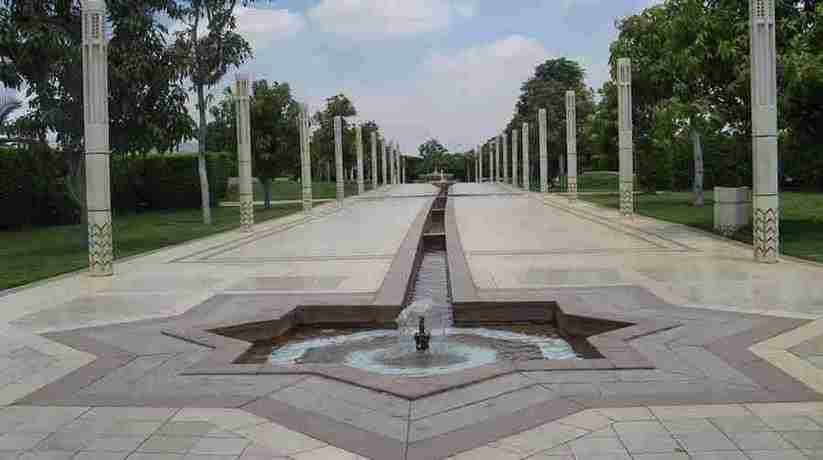
This processional path measures eight meters wide. It flanks on both sides by two rows of royal palms and parallel side paths. Furthermore, it is with lateral niches for seating. The outer zones of the plain feature an orchard. It provides shade, a stimulating variety of flowering and fruit trees. It also provides further room to stroll. The main promenade and series of formal gardens anchored at each end. This is by the hilltop restaurant and lakeside pavilion. It provides internal landmarks for the Park. Water features provide an extra and traditional theme from Islamic gardens. It tie this central pathway together along its entire length. Water fountains, pools, and confined water channels dispersed. They lead, to the freer form of the lake in the south meadow.

Further details about Al Azhar Park Cairo:

A continuous pathway carved into the hillside at mid height between the walkway. It is along the Historic Wall and the summits of the hills. It provides lateral access at points to the eastern half.  The western hillside will covered with flowering and succulent plants with luxuriant tones. Al Azhar Park vegetation includes dry and succulent plants on the western slopes. It also features lush and grassy meadows with shade trees. The native Egyptian plants establish a new benchmark for park spaces in the region. The Trust has initiated a range of community based urban upgrading projects.

It contribute to the improvement of living conditions around Al Azhar Park Cairo. It is by providing the local people with cultural, social, economic, and institutional support. These included the restoration of the Umm Sultan Shaaban Mosque. It includes also Khayrbak Complex. Besides the rehabilitation of the Darb Shoughlan School. It currently used as a combination community and visitors center. Micro credit loans that has enabled residents to open small businesses to support themselves. In fact, the Park offers a new vantage point and spectacular views of Cairo’s treasures. Draws foreign tourists and the inhabitants of Cairo alike to the once neglected area.

Nearby attractions Information, tours and Online Booking

More of Egypt Fun & Leisure

More of Egypt’s attractions
MORE
error: Copyright © www.etltravel.com !