Activities in Islamic Egypt

Things to Do

Egypt Mosques

Egypt Mosques

  • Egypt Mosques
  • Egypt Mosques
  • Egypt Mosques
  • Egypt Mosques
  • Egypt Mosques
  • Egypt Mosques
  • Egypt Mosques
  • Egypt Mosques
  • Egypt Mosques

Egypt mosques information, list, tours and online booking

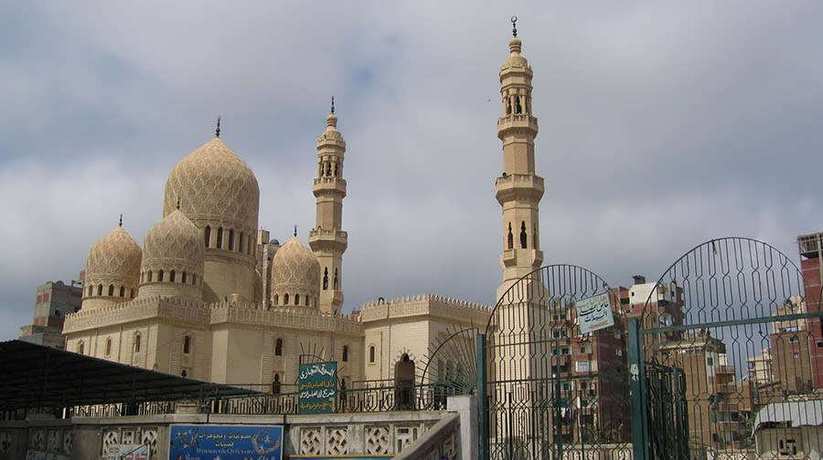
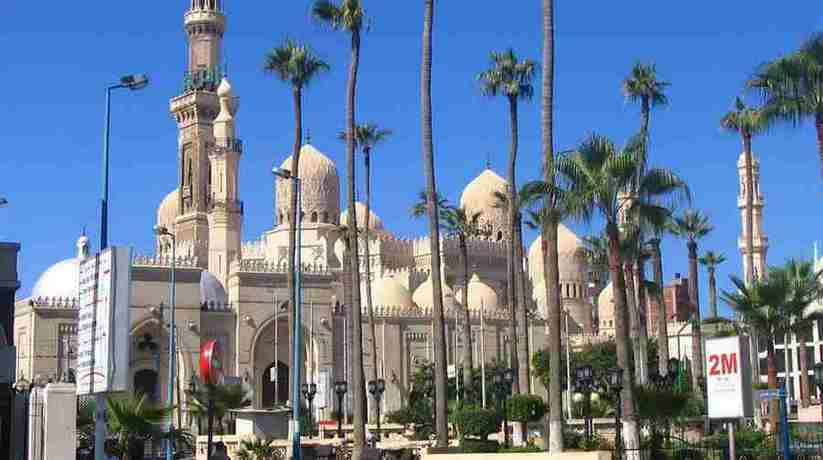
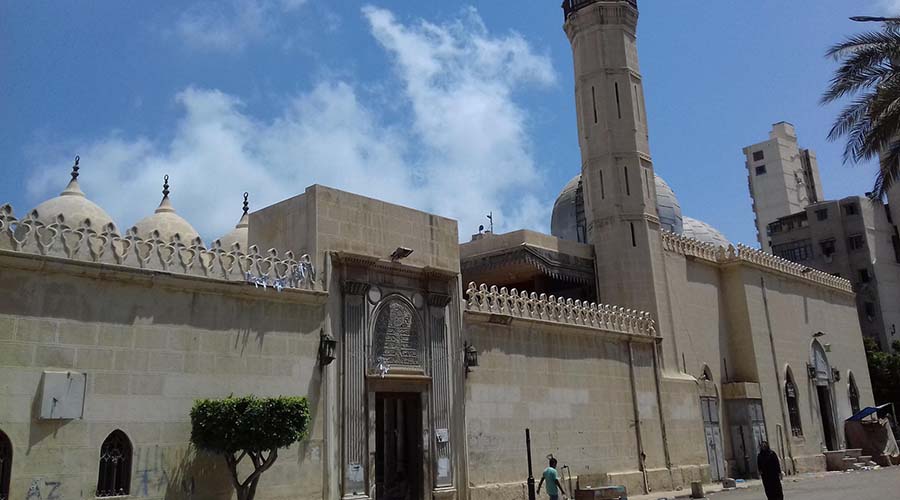
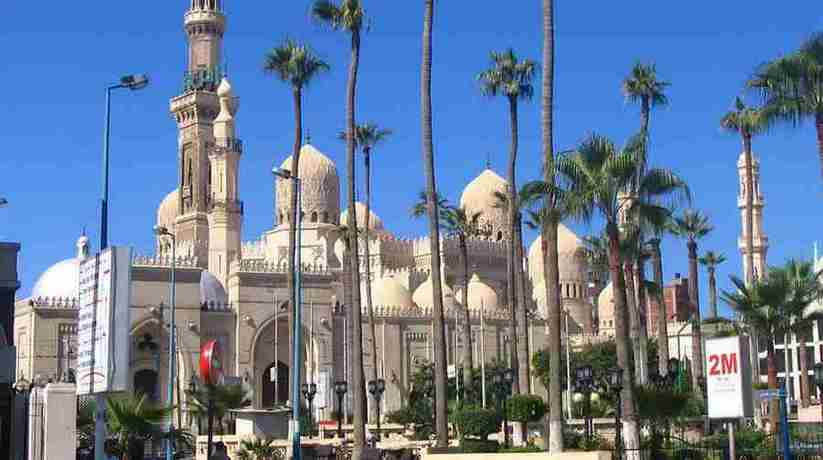
Egypt mosques include a huge number of mosques all over Egypt, stretched from Abu Simbel to Marsa Matrouh. Al-Mursi Abu Al-Abbas is Alexandria’s largest mosque; with a cream colored façade, four great domes, arabesque designs and a high minaret, the mosque is a beautiful sight. The mosque was built in 1775 to commemorate the life of an Andalusian Sheikh that was buried on the site. It is one of the most visited mosques on the Mediterranean Sea coast. “For verily a lover is deaf to those who advise him”, so goes one of the early lines of Qasidat Al-Burda (Poem of the Cloak) written by the poet Imam Busiri, who died in 1296 AD. The poem became so famous that it is still recited today by believers from Yemen to Morocco.

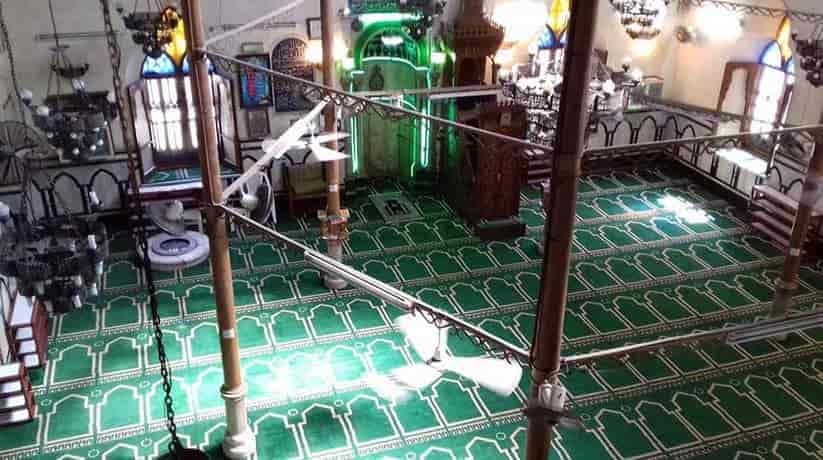
The Mosque & Tomb of Imam Busiri in the Anfushi district of Alexandria have recently been restored and play an important part in the life of the city, attracting visitors from around the world. The mosques features beautiful mural calligraphy which includes 94 verses of Qasidat Al-Burda inscribed in Ta’liq script as well as Quranic verses. Is Alexander the Great buried in the Nabi Daniel Mosque in Alexandria?. To explore this still unsolved mystery, ride a bus to Masr station and walk south on Nabi Daniel Street, close to the intersection of the ancient Via Canopica and R5 Street until you reach Nabi Daniel Mosque. There are two different accounts of the mosque’s namesake. In the first, the mosque is named after the Biblical prophet Daniel whose life story is based in large part on the accounts of the Old Testament but incorporates many aspects of Alexander the Great.

More information about Egypt Mosques:

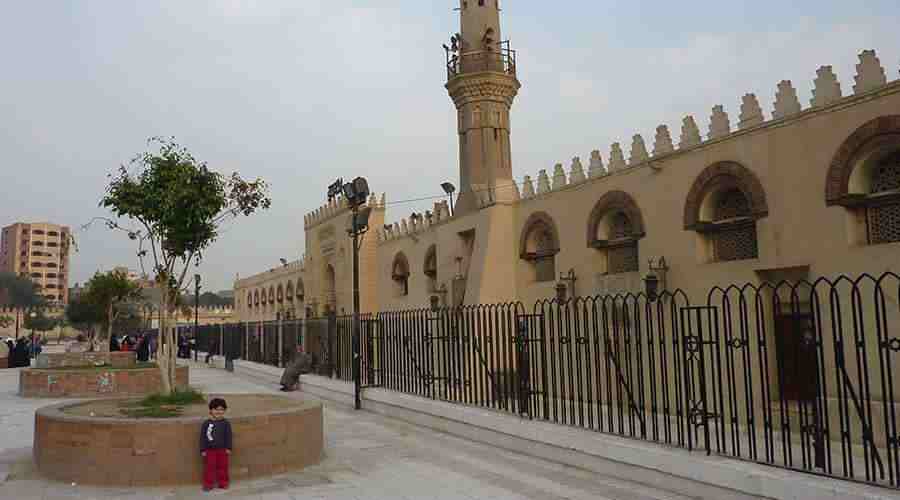
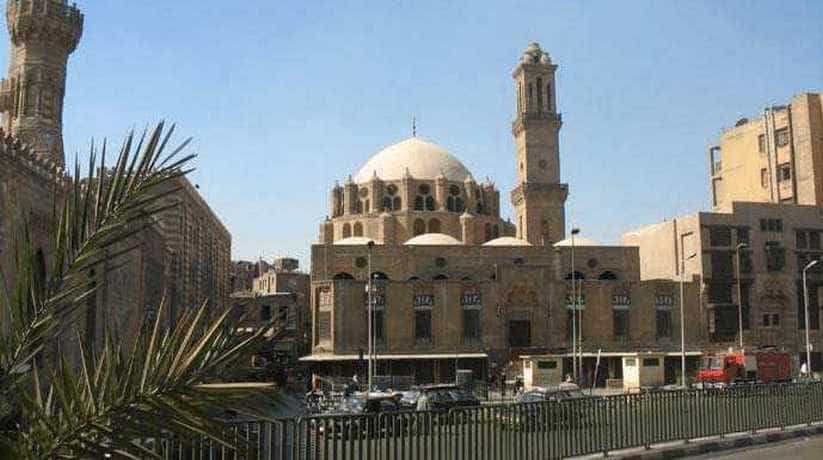
The Macedonian king founded the city of Alexandria and was buried in a golden sarcophagus at the site of the mosque. Alternatively, the mosque may have been named after a Kurd, Sheikh Mohammad Daniel who came to Alexandria from Mosul in the 15th century. The present Mosque of Nabi Daniel was built at the end of the 18th century on the site of a 4th century roman temple and restored in 1823 by Mohamed Ali. A rather small mosque, Al Aqmar Mosque makes up for its size with its architectural and historical significance. Located near Al-Qalawun Complex, Al-Aqmar is one of the only remaining Fatimid mosques in Cairo. This was the first mosque in Cairo to have a decorated façade, and also the first to have its plan made to accommodate the street plan.

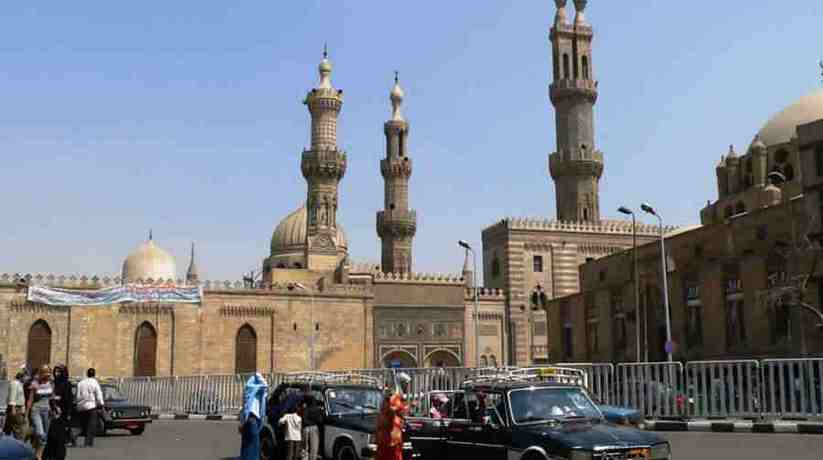
Take in the intricate and delicate carvings and patterns on the walls, façade, and minaret of this truly beautiful mosque built in 1125. Located at the heart of Islamic Cairo, Al-Azhar complex & mosque and university, does not only house the oldest university in the world but it is also the place where the graduation black gowns originated from. The costume worn by students all around the world during their graduation seems to have been inspired by the flowing robes of the Islamic Scholars “graduating” from Al-Azhar. The University is now distributed between different buildings, but the mosque, founded by Jawhar al-Siqilly, the Fatimid conqueror of Egypt, in 970 is still a true marvel and a not-to-be-missed attraction while visiting Cairo.

Further information about the topic:

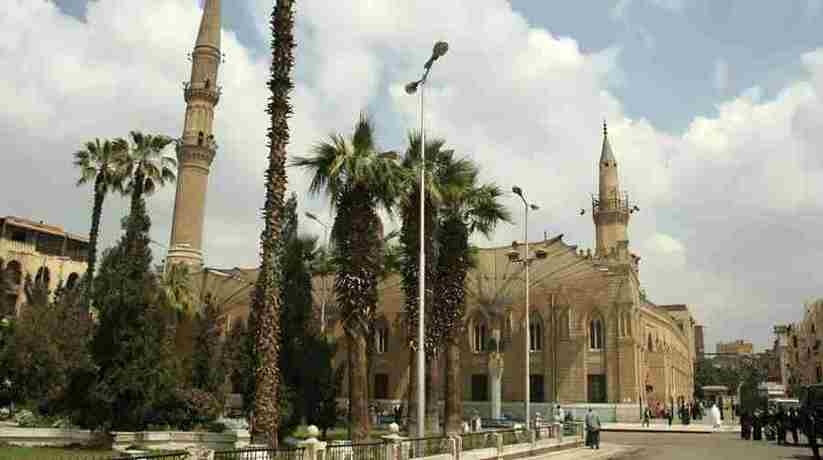
Located near Bab Al-Futuh , at the beginning of Al-Mo’ez Street, you’ll find one of the largest Fatimid mosques in Cairo, the Al-Hakim Mosque. A famously eccentric caliph, Al-Hakim Bi-Amr Allah, ordered its construction in 990 AD. Towards the end of his reign, he disappeared without a trace at the age of 36. The mosque has since then been used as a warehouse and an elementary school before being reconverted into a mosque in 1980. Located near the famous Khan El-Khalili Bazaars in Cairo and – as it was discovered during works on the mosque’s foundations in the 1900’s – on the remains of the Fatimid Caliphs cemetery in Cairo, Al-Hussein Mosque is considered as one of the holiest mosques in Egypt. It is usually the sanctuary where the Egyptian president and other dignitaries pray on special occasions.

Located near Bab Zuweila in Cairo, there Al-Mu’ayyad Mosque which has an interesting story. The founder, a Mamluk sultan, was imprisoned and suffered greatly in this particular place; he vowed that if he ever came to power he would transform the prison into a school and mosque where intellectuals would come to study. After regaining his freedom, he did just that, turning the prison into one of the most beautiful and expensive mosques and madrasas to be built in Cairo. Marble in all its colours was brought from different locations and used to adorn the walls, ceiling, and floors in designs that will make you gape at their beauty. Al-Rifai Mosque is one of Cairo’s largest mosques. It took 43 years to build this beautiful sanctuary that combines different Islamic architectural styles.

More details about Egypt Mosques:

Located in “Midan Al-Qalaa” or the Citadel Square, it faces the Mosque-Madrassa of Sultan Hassan which it rivals in size and grandeur. This Mosque is the resting place of many members of the Egyptian Royal Family, including the last king, King Farouk. The last Shah of Iran has also been buried in this mosque in 1980. Built in 642 AD with palm trunks and fronds, it was the first mosque erected in Egypt and all Africa. The location of the mosque was determined by the general of the Muslim Army Amr Ibn Al-‘As who had pitched his tent at that very same place when he conquered the land. The capital of Islamic Egypt Al-Fustat was then built around this spot. There are approximately 200 columns in the mosque taken from different sites, and the wide and quiet spaces offer a sanctuary from the bustle of Cairo.

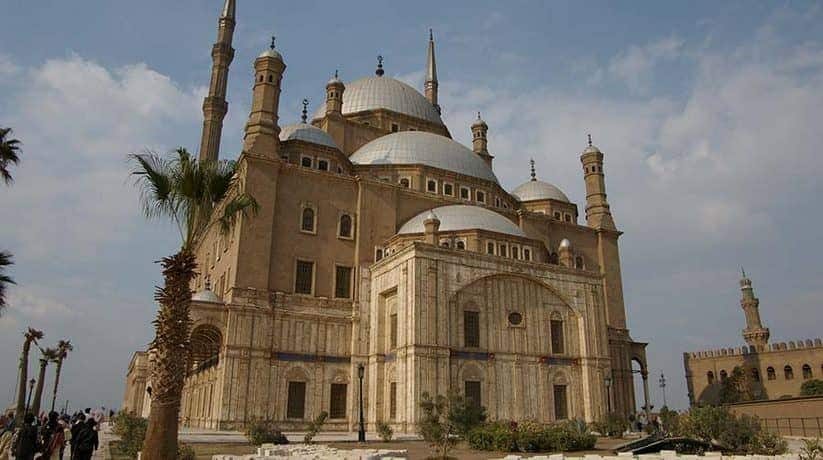
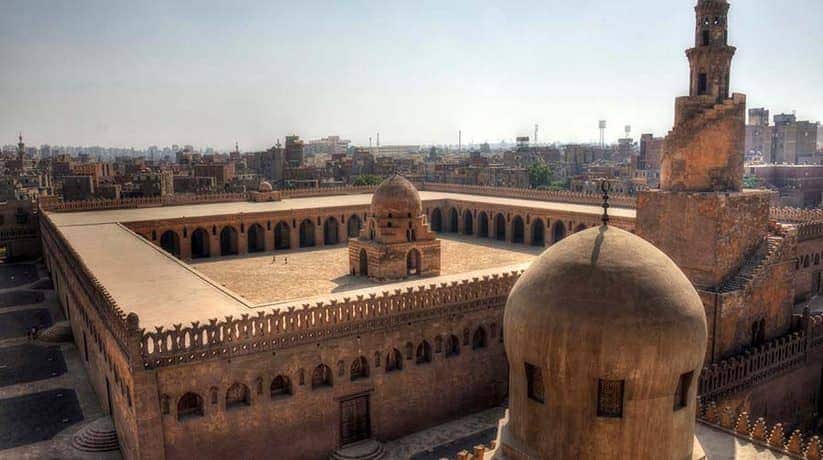
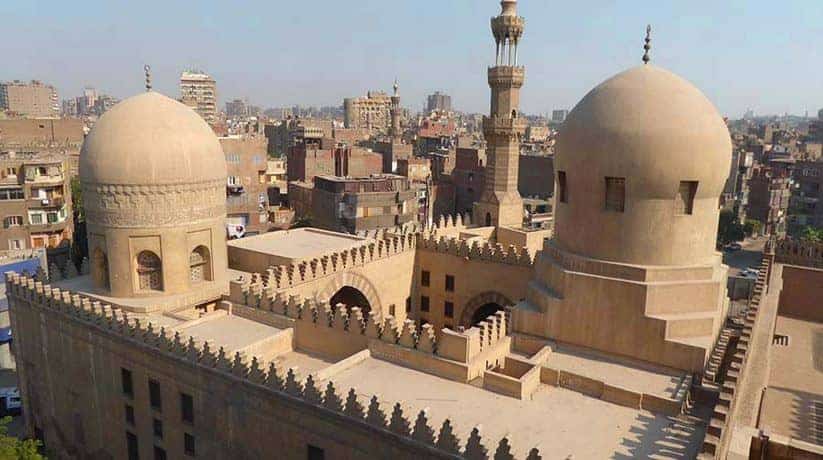
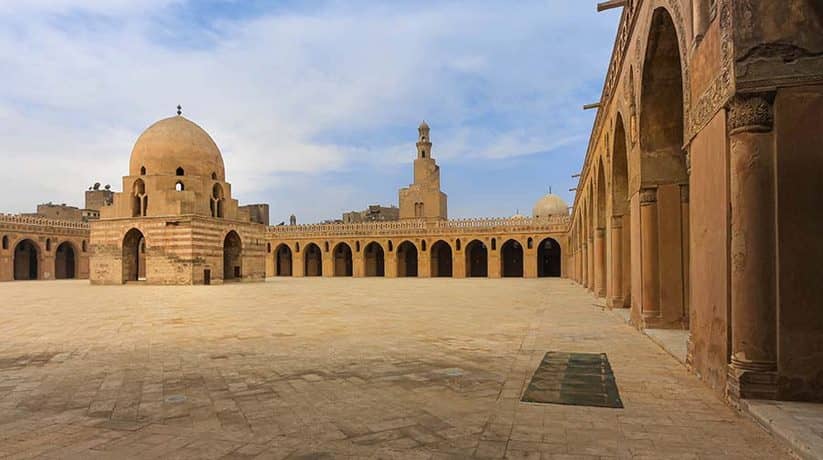
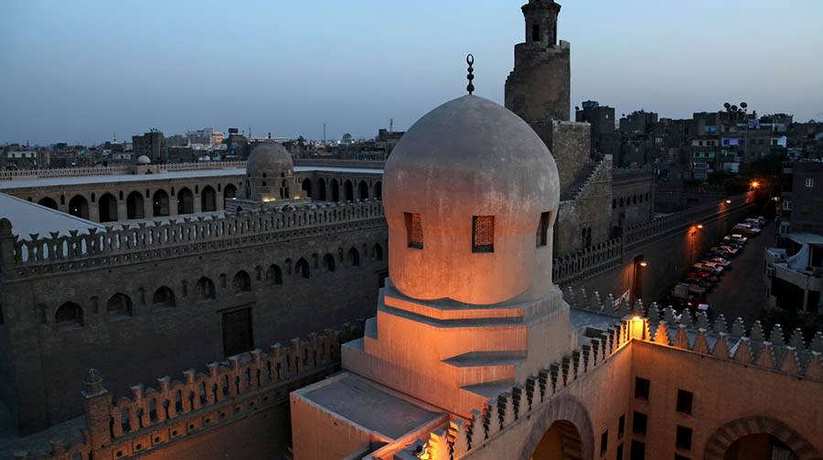
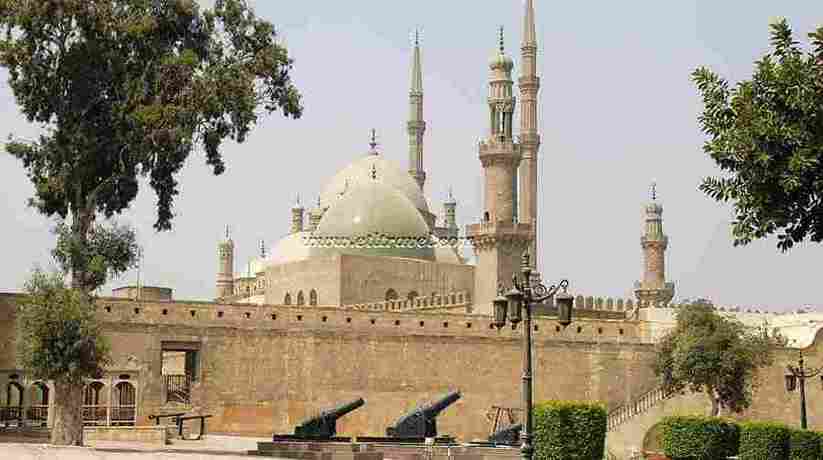
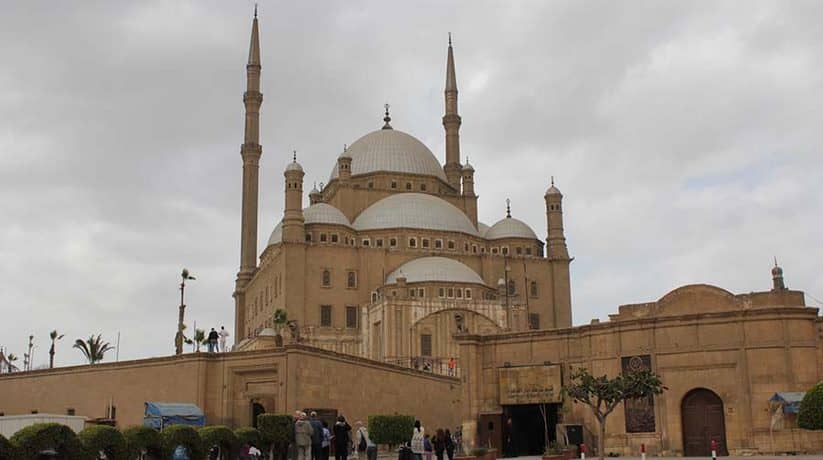
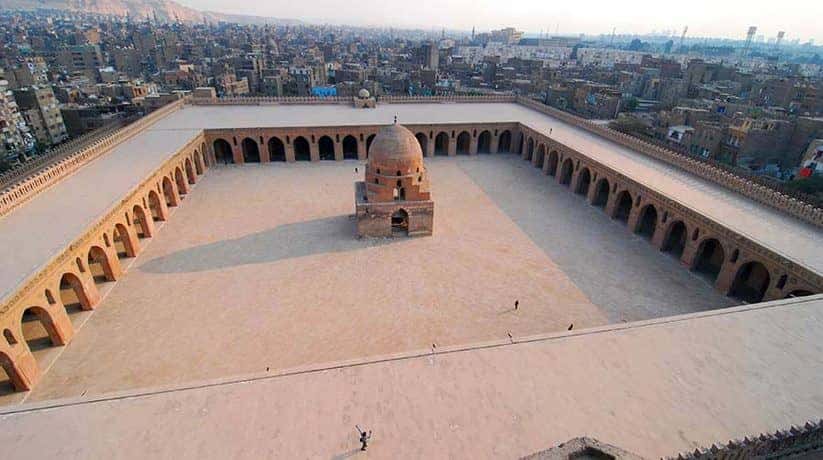
Amr Ibn Al-As Mosque is a part of what is commonly known today as the “Multi-Religious Compound” in Cairo, an area that is home to very old places of worship pertaining to the three monotheistic religions: Islam, Christianity, and Judaism. Looking more like a fortress with its imposing wall full of beautiful crenulations, the Mosque of Ibn Tulun is believed to be the oldest mosque in Cairo, and the city’s largest mosque in terms of land area, which covers no less than 26.300 sq. m. Standing among beautifully decorated arches in the vast courtyard, the mosque was built by Ibn Tulun in the 9th century and served as the center of the Tulun Dynasty capital. Visiting Cairo, you will easily locate Mohammad Ali Mosque, due to its prominent features: its dome rises up to 52 meters high and two east side minarets reach not less than 84 meters.

Further details about Egypt Mosques:

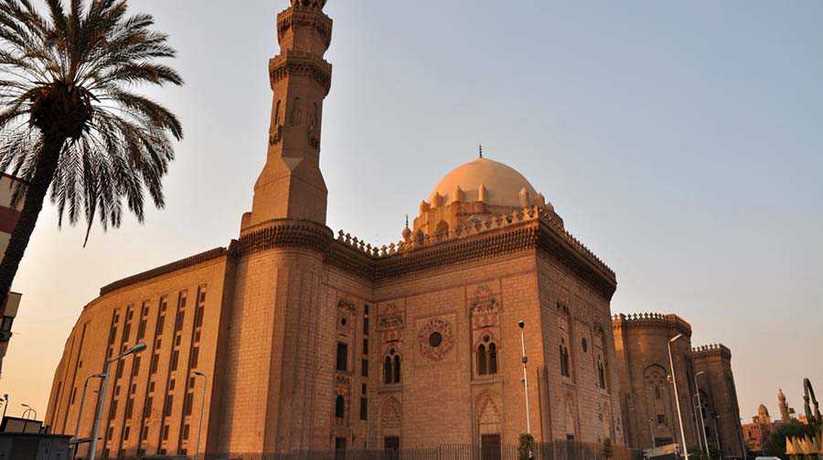
While wandering around the mosque, you will soon discover why it also holds the name of the “Alabaster Mosque.” Its interior and exterior walls are amazingly coated with alabaster to the height of 11 meters. The Mohammed Ali Mosque crowns the Citadel of Salah el-Din in Cairo. It was built between 1830 and 1848 by the architect Yousef Bushnak and upon Mohamed Ali Pasha’s request. The Mosque-Madrassa of Sultan Hassan is regarded as the finest piece of early-Mamluk architecture era in Cairo, an age of architectural splendor. Story has it that the construction of this complex was a tedious and tragic process. In fact, it was built between 1356 and 1363 by the Sultan Hassan who was murdered shortly before the mosque was completed.

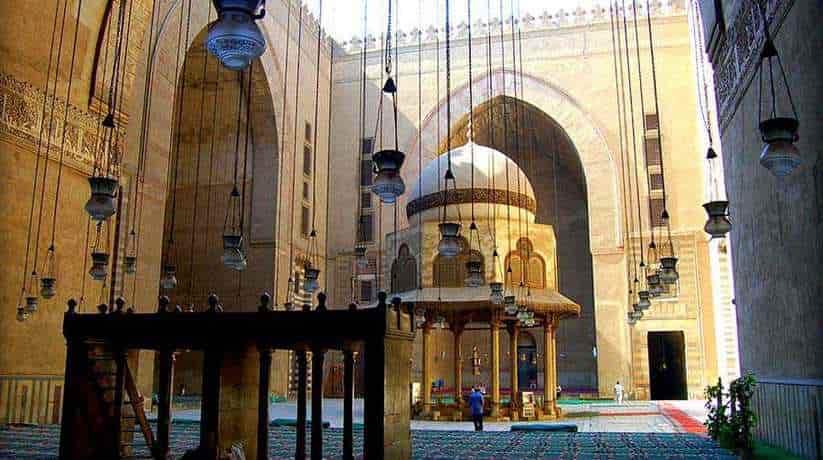
Sultan Hassan’s Madrassa & Mosque was built out of huge blocks of stone. Due to its tremendous height, this mosque soon became a symbol of the culmination of all the architectural power developed throughout a century of Mamluk rule. When arriving to the mosque, your eyes will be immediately drawn upward into the blue sky. And as you lower your head, you will witness the most amazingly patterned mosaic-paved courtyard, unprecedented in Cairo. Only a glimpse of the splendor you’ll gaze at inside.
Egypt Mosques list:

Abu Al Dahab mosque Cairo
+View details
Egypt Nile cruises and hotels
Al Aqmar mosque Cairo
+View details
Egypt Nile cruises and hotels
Al Azhar mosque Cairo
+View details
Egypt Nile cruises and hotels
Al Ghouri complex Cairo
+View details
Egypt Nile cruises and hotels
Al Hakim mosque Cairo
+View details
Egypt Nile cruises and hotels
Al Hussein mosque Cairo
+View details
Egypt Nile cruises and hotels
Load more

MORE
Egypt Islamic Museums

Egypt Islamic Museums

  • Egypt Islamic Museums
  • Egypt Islamic Museums
  • Egypt Islamic Museums
  • Egypt Islamic Museums
  • Egypt Islamic Museums
  • Egypt Islamic Museums

Egypt Islamic Museums information, tours, prices and online booking

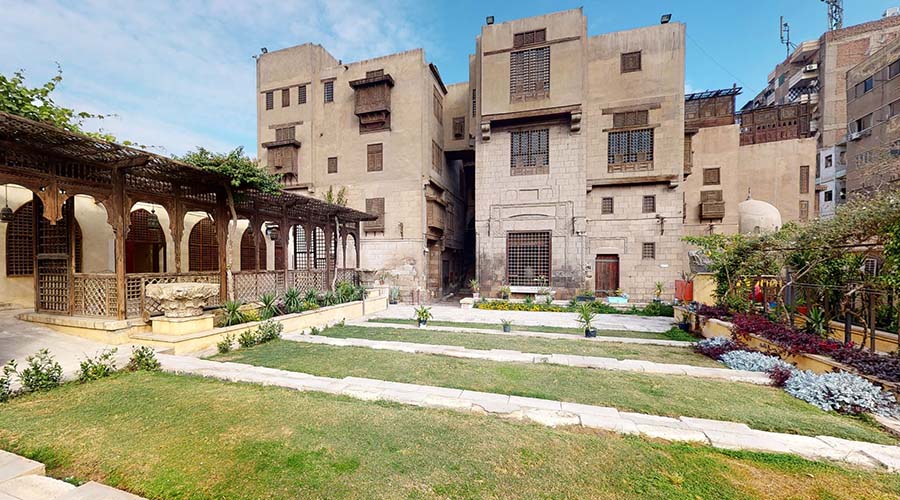
Egypt Islamic Museums include in fact only two museums located in Cairo. The Gayer Anderson Museum in Cairo is a must-see on your exploration tour of Islamic Cairo. It consists of an amazing patchwork of Islamic styles and artefacts packed into two wonderful ancient residences: Beit el-Kiridiliya (1632) and Beit Amna Bent Salim (1540). The museum was founded by a British major, John Gayer-Anderson, an army doctor who restored and furnished the two residences between 1935 and 1942, filling them with antiquities, artwork, furniture, glassware, crystal, carpets, silks and embroidered Arab costumes.

The museum Complex host a Sabil. It offers fresh water to the public. This feature is difficult to find among historical houses in Egypt. Sabil is a religious structure which is in a mosque or a mausoleum. It is to provide people with their needs of water. Finding a Sabil within a residential house is rare in the Islamic architecture. The Sabil of the Gayer Anderson museum located in the right hand side section of the ground floor. It is with a window, opens on the street. It is from which the servant working in the Sabil used to give the water to the people. The room of the Sabil made out of stones. The ceiling contains some remarkable geometric decorations with bright colors.

More details about the topic:

The Sahn or the open courtyard of the museum has a semi irregular shape. It is with a white marble fountain in the middle. In fact, the Sahn is the heart of the house with all the floors. Moreover, the sections of the house open at the Sahn. They don’t open towards the exterior of the house. This architectural design of Gayer Anderson museum Cairo was common for many reasons. The first is to provide a sense of privacy especially to the ladies of the house. The second is to protect the house against dust and dirt making the air inside the house cleaner and fresher.

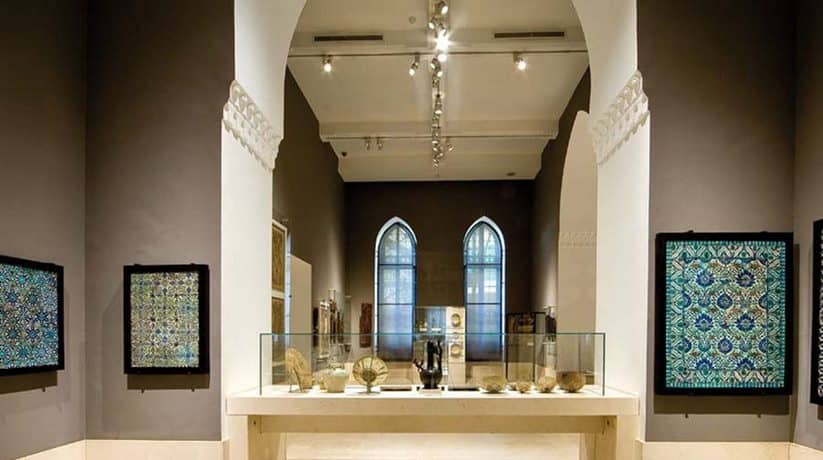
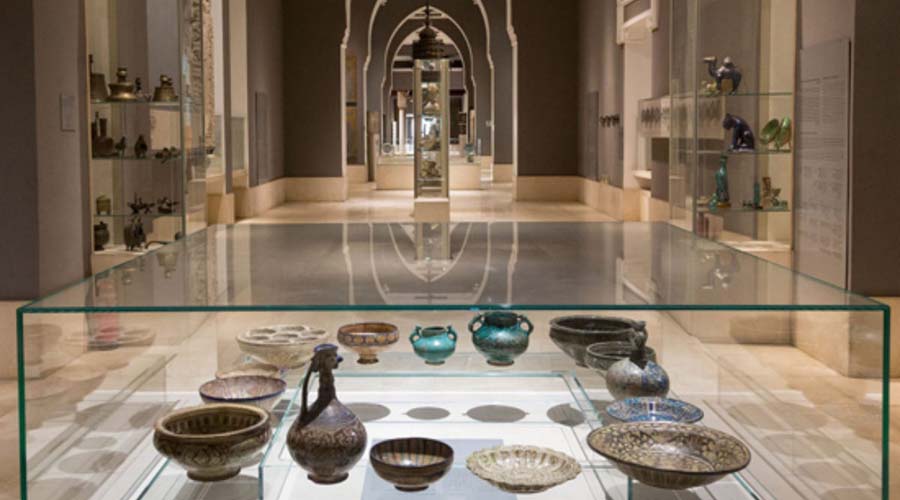
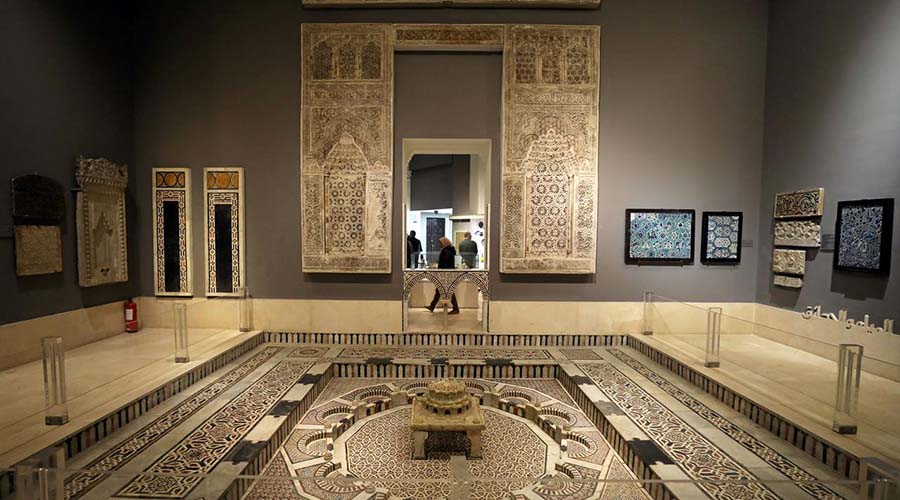
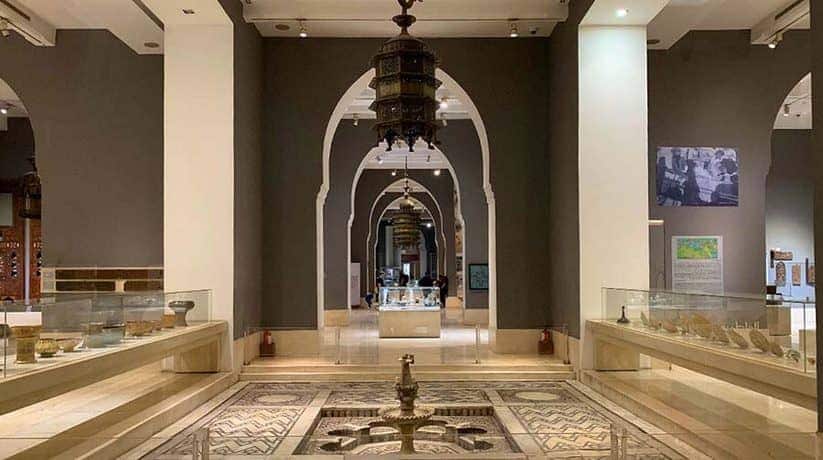
Islamic Art Museum which displays over 10,000 articles dating back to the Islamic era in Egypt, is one place you haven’t to miss while you are in Cairo. Marvel at the giant carved wooden doors or the tiny, intricate copper sculptures. With exhibitions from every Islamic period in Egypt, it covers the Fatimids, the Mamluks, the Abbassids, the Ummayads, the Ottomans, and the Ayyubbids dynasties.

Further details about the Egypt Islamic Museums:

In 1899 the foundations laid for the present larger building in Bab Al-Khalq area of Cairo. In fact, the Islamic Art Museum building designed by Alfonso Manescalo. It completed in 1902 in new Mamluk style. Moreover, the museum upper story housing the National Library. The old museum in Al Hakim demolished in the 1970, during refurbishment of the mosque there. Islamic Art Museum faces Historic Cairo. It has two entrances. One on the north-eastern side and the other on the south-eastern side. A beautiful garden with a fountain once led to the first entrance but later removed. The entrance on Port Said Street features a luxurious facade. It is rich with decorations and recesses. They inspired by Islamic architecture in Egypt from various periods.

Islamic Art Museum is a two-stores building. The lower one contains the exhibition halls. The upper floor contains the general stores. The basement contains a store connected with the Restoration Section. On January 24th, 2014 a car bomb attack targeting the Cairo police headquarters. It caused considerable damage to the Museum. In fact, it destroyed many artifacts. It estimated that 20-30% of the artifacts will need restoration. The blast also damaged the buildings facade. It erased intricate designs in the Islamic style. The Egyptian National Library and Archives in the same building also affected.

Egypt Islamic Museums Highlights:

Gayer Anderson Museum Cairo
+View details
Egypt Nile cruises and hotels
Islamic Art Museum Cairo
+View details
Egypt Nile cruises and hotels

MORE
El Sayeda Zeinab mosque Cairo

El Sayeda Zeinab mosque

  • El Sayeda Zeinab mosque Cairo
  • El Sayeda Zeinab mosque Cairo
  • El Sayeda Zeinab mosque Cairo
  • El Sayeda Zeinab mosque Cairo
  • El Sayeda Zeinab mosque Cairo
  • El Sayeda Zeinab mosque Cairo
  • El Sayeda Zeinab mosque Cairo

El Sayeda Zeinab mosque Cairo Egypt tours, booking, prices

El Sayeda Zeinab mosque Cairo stands in the heart of a square named after El Sayeda Zeinab. She is the grand daughter of the Prophet. May Prayers and Peace be upon him. El Sayeda is an Arabic word means The Lady. The lady Zeinab is also the youngest daughter of both the Lady Fatima and her cousin Ali Ibn Abi Taleb. In fact,  the Lady Fatima is the Prophet’s daughter. The Lady Zeinab is the sister of the two Imams Al Hassan and Al Hussein. In fact, El Sayeda Zeinab mosque Cairo set up shortly after her arrival to Egypt. It was on the appearance of the new crescent moon of Shaaban. Moreover, it is the eighth month of the Hegira calendar. It was in the year 680 AD.

In fact, the Lady Zeinab first arrived to the small village of Al Abassah. It is in Al Sharkia govern-orate, east of Delta. Maslama Al Ansary was on the head of the gathering of well-wishers. Moreover, he was the governor of Egypt in that time. She later settled down at Al Fustat city. Al Fustat was the first Islamic capital of Egypt. The Lady Zeinab became the guest of Maslama. After less than a year of her arrival to Egypt she passed away. It was on the evening of 14th of Ragab 62 AH. Ragab is 7th month of the Islamic calendar. According to her will, she buried in the same place where she had lived for about eleven months. Sayyeda Zeinab mausoleum built close to the northern flank of Maslama house. It overlooks the River Nile bay near Sayeda Zeinab square.

Further details about El Sayeda Zeinab mosque Cairo:

In the course of time Moslama’s house and the adjacent buildings crumbled away. It was except of her mausoleum. It remained intact due to continuous repairs by princes, higher-ranking officials and religious leaders. In fact, the mausoleum orated by domes, niches and inscriptions of Arabic calligraphy. Moreover, the first innovations of El Sayyeda Zeinab mosque Cairo took place during the reign of Ibn Tulun. Sultans Al Mo’ez and Al Hakim allotted land endowments to preserve the mosque. In the sixth century after the Hijra, Sultan Al Adel Ayoub repaired El Sayyeda Zeinab mosque Cairo. He also built a smaller mosque next to it. The Mameluke Prince Abdul Rahman Katkhuda reconstructed the mosque. He furnished it with a toilet for ablutions. In 1201 A.H.

The mausoleum repaired and glided with a layer of yellow copper. Furthermore, El Sayeda Zeinab mosque Cairo area expanded to cover three thousand square meters. In 1315 A.H, the mosque re-built next the mausoleum. It was during the reign of Khedive Tawfik. In 1946 A.D King Farouk repaired the mosque and the mausoleum as well. In fact, king Farouk was the last monarch in Mohamed Ali’s dynasty. During the era of President Gamal Abdul Nasser, the mosque expanded to cover an area of 4000 meters. In fact, the mosque again expanded during President Mubarak. It covers 18000 meter with a capacity of 15000 worshipers.

More details about El Sayeda Zeinab mosque Cairo:

In fact, the main facade of the mosque looks over El Sayeda Zeinab square. Moreover, it has three gateways leading to the mosque. In the western facade there is a special gate for women leading to the Mausoleum. The minaret stands high to the left of this section. The inside ceiling covering the whole area of the mosque erected on columns made of white marble. A light shaft stands over the section located in front of the old niche. As for the mausoleum it lies to the west of El Sayeda Zeinab mosque Cairo. It surrounded by a compartment glided with yellow golden copper and topped with a dome.

Nearby attractions Information, tours and Online Booking

More of Islamic Egypt

More of Egypt attractions

MORE
Muhammad Ali mosque

Muhammad Ali mosque Cairo

  • Muhammad Ali mosque
  • Muhammad Ali mosque
  • Muhammad Ali mosque
  • Muhammad Ali mosque
  • Muhammad Ali mosque
  • Muhammad Ali mosque

Muhammad Ali mosque Cairo Egypt tours, prices, booking

Muhammad Ali mosque Cairo Egypt is the most popular Islamic mosque among tourists. Moreover, it is one of the most ancient mosques in Cairo. The mosque is also one of the most historic mosques because of its grandeur and its location in Saladin Citadel. In fact, Muhammad Ali mosque Cairo also sometimes referred to as the Alabaster Mosque Cairo. This is because of its extensive use of marble on some of the exterior walls and other surfaces. The mosque is the largest such structure built during the first half of the 19th century. It is more impressive at a distance than close up. Its artistic merit is questionable. Furthermore, the mosque is an unparalleled contribution to the skyline of Cairo. It is visible high atop the Citadel grounds.

In fact, Muhammad Ali Mosque Cairo has a great dome and towering minarets. They give Cairo Citadel indeed a romantic and oriental quality. It makes up for any shortcomings in its detail. The mosque is the first feature which catches ones eyes at the fortress. Moreover, Muhammad Ali tore down the remains of Mamluk palaces and their dependencies. Mamluk palaces luckily described only a short time before by Napoleon’s scholars. They were the most impressive buildings in Cairo. It was despite of their condition which dilapidated . In fact, some ten meters of rubble filled in. It was to build the mosque on top of the preexisting structures. Muhammad Ali, who was more eager to build modern factories than religious foundations. In fact, he erected this mosque, where he buried, as a monument to himself.

Further details about Muhammad Ali mosque Cairo Egypt:

Muhammad Ali mosque Cairo is also an imperial mosque which challenged those of Istanbul. Salah al-Din, many centuries earlier, abolished all traces of Fatimid power and status. He refused to live in their palaces. Moreover, he dismantled and parceled them out to his courtiers. Muhammad Ali did the same. He destroyed all traces of the Mamluk palaces from Egypt. It was the reason that here no royal palace left from these periods in Egypt. In fact, Muhammad Ali was viceroy and king of Egypt, as well as the founder of Egypt’s modern era. He achieved a radical break with all traditional characteristics of Cairo architecture. It was from the Mamluk to the late Ottoman period. The mosque became a symbol of the city. The mosque of Muhammad Ali is the most visible of Islamic monuments in Cairo.

Muhammad Ali acted of Istanbul. He came closer to that of Istanbul than ever before in the architecture style. It included even its Western, and particularly French, influence. He came close to take the Ottoman Empire as his own. Moreover, he set out in Cairo to abandon the oriental Middle Ages. He built a city that would surpass Istanbul. The planning of Muhammad Ali mosque Cairo assigned to Muhammad Ali’s French architect. He was Pascal Coste. Pascal Coste wanted to build the mosque in the local Mamluk style. Muhammad Ali changed his mind and hired a Greek architect, Yusuf Bushnaq. That was to design the mosque on a plan like Sultan Ahmad mosque in Istanbul. In fact, the mosque built between 1830 and 1848. The long time it took to complete may be due to its size.

More details about the mosque of Muhammad Ali Cairo Egypt:

Muhammad Ali mosque Cairo combined with its prominent location and its profile of domes. They flanked by a pair of slender high minarets, contribute to its prestige. The Egyptians themselves place a great deal of pride in this monument. Moreover, the pencil shaped minarets are over eighty meters high. They stand on bases only three meters wide. In fact, the architecture of the mosque is Ottoman. The domes are relative to their width, higher and less squat than those in Istanbul. The complex consists of two parts. The mosque proper to the east and the open courtyard (or Sahn) to the west. The plan of the mosque is a central dome which carried on four piers. The spherical pendentives, flanked by four half-domes, and four smaller domes on each corner. There is also a dome that separates the Mihrab ceiling from the Qibla wall.
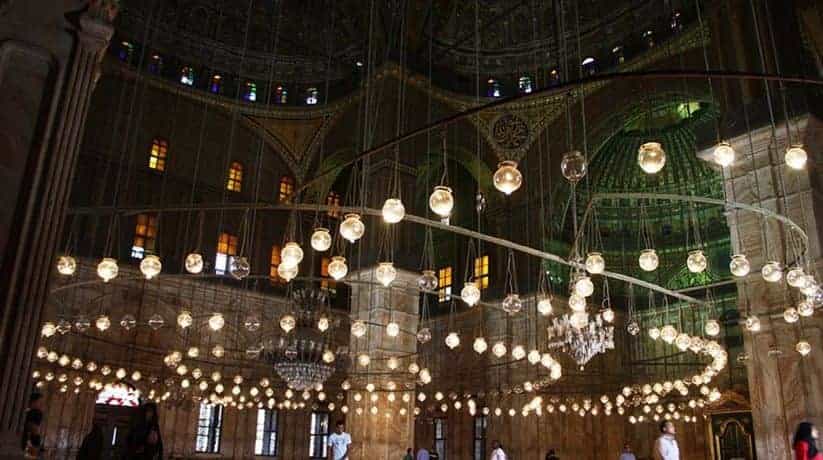
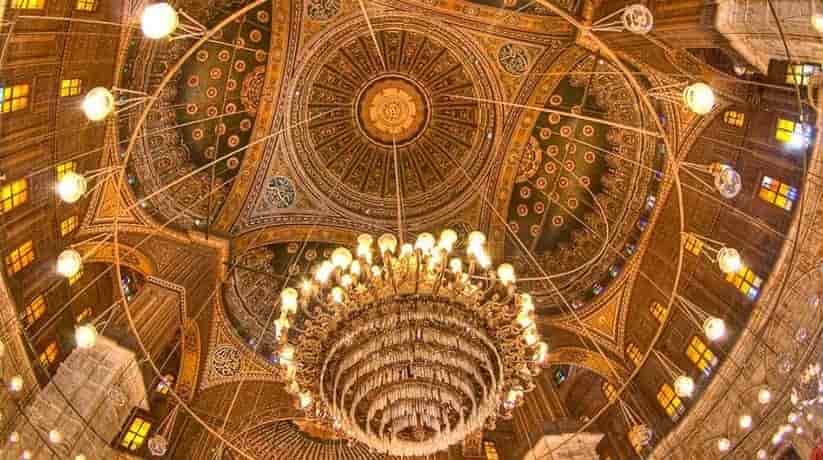
Measuring 41 meters square, the interior is impressive because of its size. It shows the wonderful arrangement of mass and space. It is characteristic of Istanbul Mosques. The main, high dome of Muhammad Ali mosque Cairo soars 52 meters high, with a diameter of 21 meters. The grandeur of this single, large chamber enhanced by the circle of small lamps. It hung in the middle of the praying area, and just above the main dome of the mosque. Other smaller lamps, many of them more modern, hung elsewhere in the mosque. They creating a spectacle of light that is grand in its own right. Within the mosque are two minbars, or pulpits. The larger one of wood decorated with gilt ornament, and is original. It said to be one of the largest in Egypt, incorporating significant gold in its decorations.

Further details about Muhammad Ali mosque Cairo Egypt:

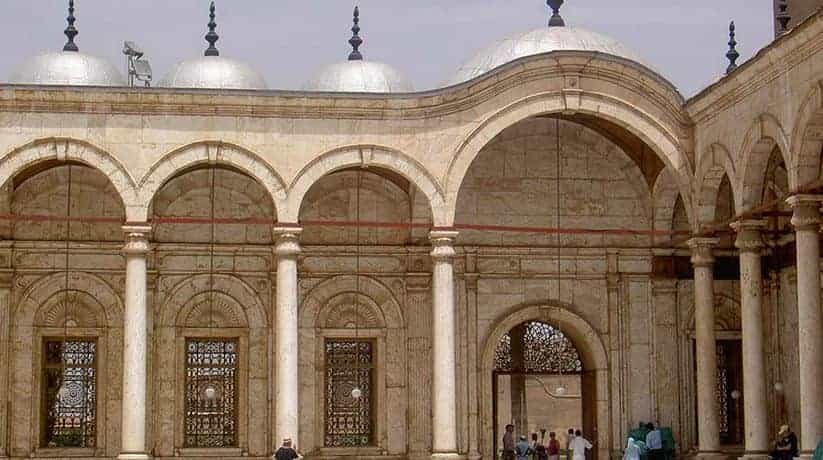
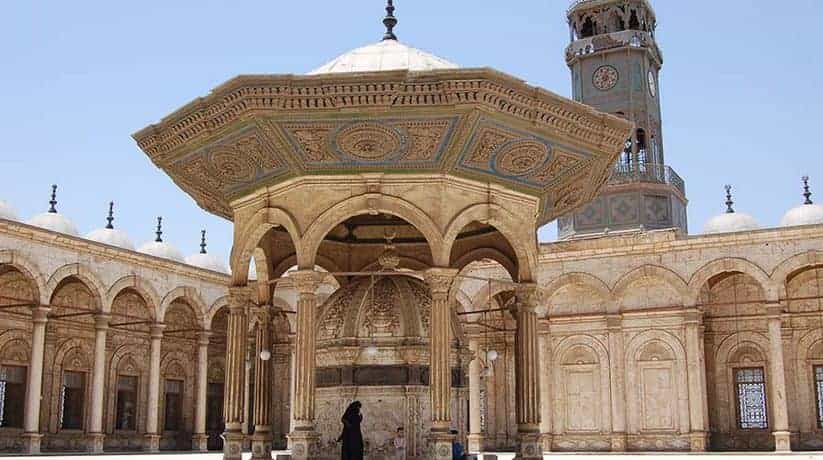
The smaller one of alabaster was a gift from King Faruq, dates back to 1939. The Mihrab, or prayer niche, made of Egyptian marble. Muhammad Ali not interred here. In fact, he buried at Housh el Basha. One of his successors, King Abbas I, had his body moved to this location. Muhammad Ali mosque Cairo has three entrances, on the north, west and east walls. The western entrance opens onto the courtyard. The courtyard surrounded by rounded arcades carrying small domes. It is like the Mosques of Sulayman Pasha and Malika Safiyya. These domes supported by large, though simple marble columns. The courtyard is almost square, measuring 54 by 53 meters. Moreover, the courtyard has a northern and southern entrance from the mosque.

In the middle of the courtyard is a marble ablution fountain. It features a carved wooden roof on columns. The fountain decorated in a style like that of the sabil-kuttab. In fact, it faces the madrasa of al-Nasir on Mu’izz street. That structure built by Ismail Pasha in 1828. The sabil and the upper part of the courtyard facade decorated with small oval wall paintings. On the west wall of the courtyard is an iron clock. It presented to Muhammad Ali by the French King Louis Philippe, with a tea salon on the upper level. Its style is a mixture of Neo-Gothic and oriental elements. In fact, it never worked, and never will. The clock, given as a gift in exchange for the obelisk now in the Palace de la Concorde, Paris. The decoration of the building is alien to Cairene traditions, and in fact, to Islamic art.

More details about the mosque of Muhammad Ali Cairo Egypt:

There are no stalactites, geometric shapes or arabesques. Only the inscription bands continue any type of Islamic tradition. Six large medallions around the dome enclose names. The names are God, Muhammad and the first four Khalifs. The script written over a royal blue. It often adorns windows in Muhammad Ali mosque Cairo. It actually represent verses from the poem, “Al Burda” which written by Imam al Buseiry. Even the marble chosen for decoration is different from that of earlier Mosques. The decorations which not finished until 1857, are at odds. They are with the simplicity of the architectural structure itself. Many tourists and Egyptians themselves find the mosque decorations beautiful. The use of greens, golds and reds appealed to many.

The walls and piers of Muhammad Ali mosque Cairo paneled with alabaster. It is from Beni Suef in Upper Egypt. which is inappropriate for architecture as it deteriorates quickly. A gesture of baroque luxe, unless cleaned, the stone also becomes terribly grimy. In 1931 serious structural deviancy found in the dome. In fact, it had to rebuild. It took two years. Between 1937 and 1939 the decoration renewed. In the middle of the 1980, the whole Citadel complex once again renovated.

Nearby attractions Information, tours and Online Booking

More of Islamic Egypt

More of Egypt attractions

MORE
Nabi Daniel Mosque Alexandria

Nabi Daniel Mosque Alexandria

  • Nabi Daniel Mosque Alexandria
  • Nabi Daniel Mosque Alexandria
  • Nabi Daniel Mosque Alexandria
  • Nabi Daniel Mosque Alexandria
  • Nabi Daniel Mosque Alexandria
  • Nabi Daniel Mosque Alexandria

Nabi Daniel mosque Alexandria Egypt tours, prices, booking

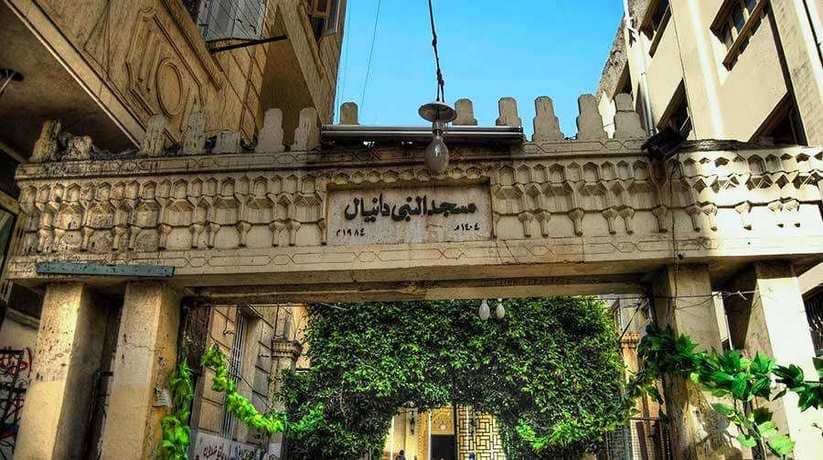
Nabi Daniel mosque Alexandria Egypt located in Nabi Daniel street in Moharram Bek in Alexandria. In fact, Nabi Daniel is not popular among the Muslims globally. The present Nabi Daniel mosque Alexandria built at the end of the 18th century. It restored in 1823 by Muhammad Ali. A smaller shrine preexisted on the site. It maybe was the mosque of Dzoul Karnein – the Sire with the two horns -. In fact, the mosque contains the remains of the scholar and venerated teacher Prophet Daniel. It also has his companion Sidi Lokman el Hakim, a religious story teller. The Arab legend of the Prophet Daniel appeared during the 9th century.
He told by two astronomers: Mohammad Ibn Kathir el Farghani and Abou Ma’shar. It mentioned that “a young Jew, Daniel persecuted and chased from Syria. It was by the idolaters whom he tried to convert. Moreover, an old man appeared in a dream urging him to go to war. The war was against the infidels and promising victory over all Asia. In fact, Nabi Daniel acquired many followers in Egypt. It is where he sought refuge and built Alexandria. Obeying what the old man ordered him in his dream, he made war against the infidels. After a successful expedition, he returned to Alexandria and died of old age. Furthermore, his body placed in a golden sarcophagus inlaid with precious stones. But the Jews stole it to mint coins and replaced it with a stone sarcophagus”.

Further details about Nabi Daniel mosque Alexandria Egypt:

Vassili Grigorovich Barskij, visited Alexandria in 1727 and 1730. In fact, he was Russian monk. He made a plan of the city. Near the Kom el Dekka mound, he drew a small Mohammedan shrine. It could be the predecessor of the Nabi Daniel mosque Alexandria. We cannot refer to his written description of the city. Barskij’s work only translated and only fragments studied. Moreover, the Danish Captain Norden visited the town in 1737, but tried in vain to find the tomb of Alexander. James Bruce looked for the tomb of the Great Macedonian. It was 30 years later in 1768. He asking the Arabs, the Jews, the Greeks and others, but none were able to show him the location”. At the end of the 18th century, Sestrini shown the sarcophagus in the Attarine mosque.
Moreover, Archimandrite Konstantios tried without success to locate Alexander’s Mausoleum in 1803. He was a Russian prelate from Kiev. He noted that he… ” looked in vain for… the tomb of Alexander the Great. It was the tomb of the man whose life’s course was above the faith of common mortals…;”. He stated that “until the 15th century the location known. But now even the tradition of this tomb has lost…”. He added that “beyond any doubt the remains survived under the great masses of the city’s ruins”. Konstantios, in his writing, and Barskij in his plan do not mention either of the Mosques. A new impulse given to the legend of the tomb of Alexander the Great. It was in the middle of the 19th century.

More details about Nabi Daniel mosque Alexandria Egypt:

Looking through the cracks of the planks he saw a body with the head rose lying in a crystal coffin. On the head, there was a golden diadem. Around scattered papyri, scrolls and books. He tried to remain longer in the vault. But he pulled away by one of the monks of the Mosque. In spite of his repeated attempts to return, he forbidden the area of the crypt. Scilitzis made a written report to the Russian Consul. He also did to the Greek Patriarch of Alexandria. Scilitzis read Dion Cassius and had access to the passage under Nabi Daniel mosque. In fcat, he did not tell the truth. In the humid climate of Alexandria, papyri and books survived for over two millennia.
Mahmoud Bey el Falaki was Egyptian astronomer and engineer. He visited the crypts under the Nabi Daniel mosque Alexandria some ten years after Scilitzis. He tried to carry our the difficult task of drawing a map. The map was of the ancient town. In fact, it ordered in 1865 by the Khedive Ismail. From this paved room inclined corridors started out in four different directions. Because of their length and their bad state I could not survey them. The rich quality of the stones used in the construction. Other indications confirmed a belief. It is that these subterranean passages must have led to the tomb of Alexander the Great. El Falaki was not an archaeologist. So we can be skeptical about his conclusions. But one would not question his sincerity and he must considered as a reliable witness.

Further details about Nabi Daniel mosque Alexandria Egypt:

His description raises some questions. Who decided and why, to force El Falaki to suspend his survey of the subterranean passages? Falaki was working for a project sponsored by the reigning Khedive. Why did he not appeal to his powerful patron? Why did he drop his investigation. There was allegation of a discovery. It made in 1879 by a chief mason and the Sheikh of the Nabi Daniel mosque Alexandria. The story was that while doing masonry work in the basement, they entered the vault. They and reached an inclined subterranean passage. They both walked for some distance and could discern some monuments. Monuments made of granite ending with an angular summit.
In fact, the mason wanted to proceed further but the Sheikh ordered him to return. Moreover, the entrance walled up and the mason asked not to reveal that incident. About 6 meters down, finished with marble and granite, one could find at least two other chambers. They are on the north and on the east side of the Nabi Daniel’s crypt. Sidi Luqman el-Hakeem’s crypt is on the right side of the Nabi Daniel’s crypt. It attached to the marbled wall.

Nearby attractions Information, tours and Online Booking

More of Islamic Egypt

More of Egypt attractions

MORE
Khan El Khalili Cairo Egypt

Khan El Khalili Cairo

  • Khan El Khalili Cairo
  • Khan El Khalili Cairo
  • Khan El Khalili Cairo
  • Khan El Khalili Cairo
  • Khan El Khalili Cairo
  • Khan El Khalili Cairo

Khan El Khalili Cairo Egypt tours, prices, booking, reviews

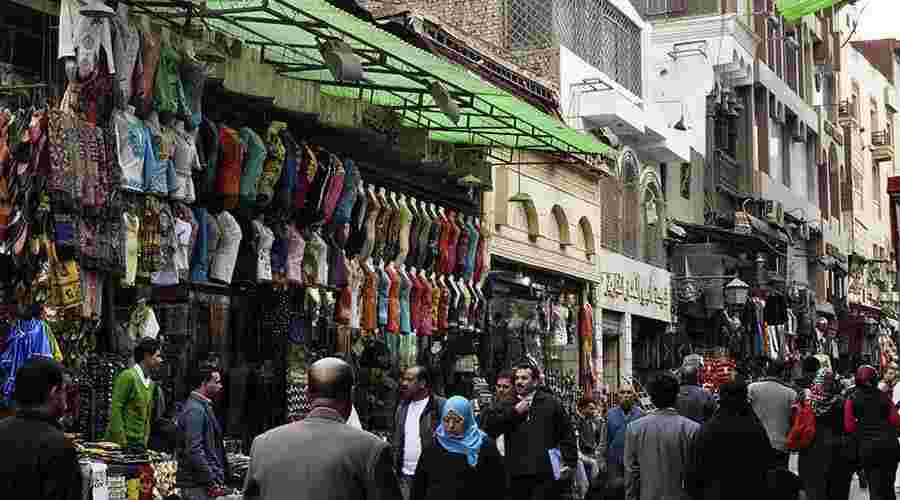
Khan El Khalili Cairo Egypt, once known as the Turkish bazaar during the Ottoman period. In fact, it now usually just called the ‘Khan’. The names of it and the Muski market often used to mean either. Moreover, Khan El Khalili Cairo market built in 1382 by the Emir Djaharks El Khalili. It was in the heart of the Fatimid City. El Khalili Khan Cairo Egypt and Al Muski market to the west comprise one of Cairo’s most important shopping areas. They represent the market tradition which established Cairo as a major center of trade. At the Khan, one will still find foreign merchants. Moreover, the market involved in the spice monopoly controlled by the Mamluks. This encouraged the Europeans to search for new routes to the East. It led Columbus to discover the Americas.
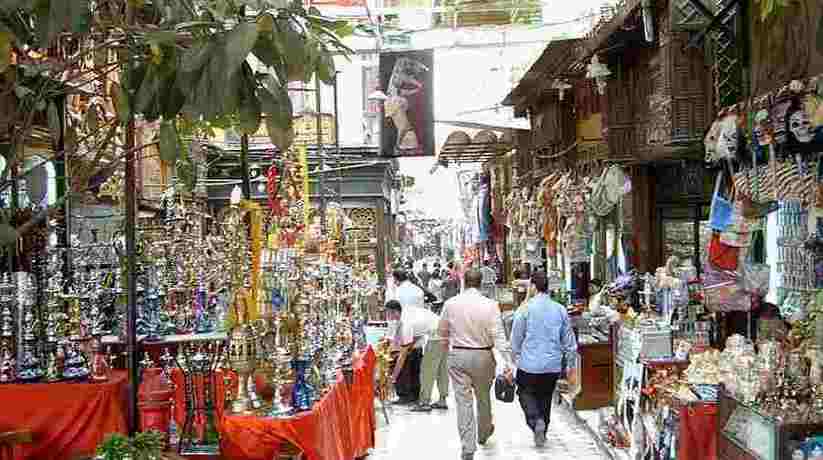
Khan El Khalili Cairo was also a center for subversive groups to raids. It was before the Sultan El Ghouri rebuilt much of the area in the early 16th century. Moreover, it was trade which caused Cairo’s early wealth. It was even from the time of the Babylon fort which was often a settlement of traders. El Khalili Khan Cairo Egypt situated at one corner of a triangle of markets. These markets go south to Bab Zuweila and west to Azbakiyyah. The area bordered on the south by Al-Azhar Street and on the west by the Muski Market. In fact, Al Muski is one of the old original gates guards the entrance to the original courtyard. Moreover, it lies midway down Sikket al-Badistan (street).

Further details about Khan El Khalili Cairo Egypt:

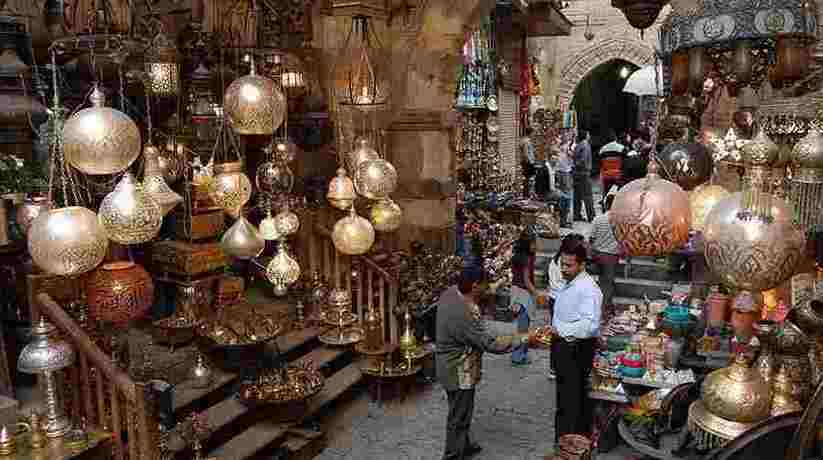
On a narrow street leading off Al Badistand, one will find El Fishawy cafe. It was once a meeting place for local artists. It frequented by the Nobel Award winning Naguib Mahfouz. He is one of Egypt’s most well known authors. There are any number of canvas which cover the streets such as the one pictured to the right. Egyptian buyers generally shop in the area north of Al-Badistan and to the west. It is where prices may be lower. Better deals for gold and silver found west of Kahn El Khalili. It is along the “street of the gold sellers”. It is also further on one will find the Brass and Coppersmith Markets. The Khan in fact is a tourist trap. All manner of souvenirs may purchased there. It goes from statues to ‘personalized’ cartouches to papyrus art.
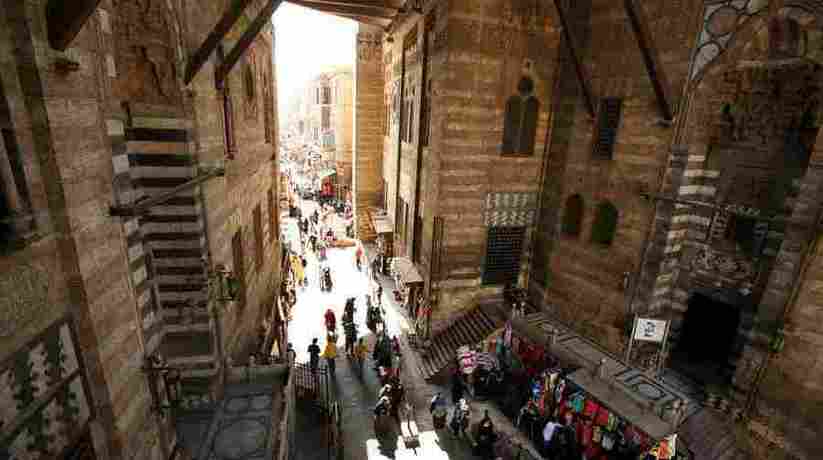
In fact, Khan El Khalili Cairo is the best place to buy souvenirs. This because Khan El Khalil is the best and cheapest place. One discovers that the Egyptians are here as well. They buying their fabrics and clothes, pots, and other ordinary household needs. Step into this world by heading west Muski street from Midan Hussein. Many of the shops for specific goods clustered along specific streets. They are also in specific areas. For example, there is the Coppersmith’s street. This is less true then most guide books would have one believe. Many shops, particularly those catering specifically to tourists have a variety of different products. The Medieval atmospheres of this market and the labyrinth layout of the streets gives a lot of pleasure.

More details:

Cafes, restaurants, shops, large number of vendors and buyers constitute a dynamic panorama of the place. In Khan El Khalili Cairo you can drinking Hibiscus, Karakare or Helba. There are many of the various typical Egyptian beverages is a pleasant experience. For smokers, there is the Shisha, or water pipe which they can try. One can take the opportunity to safely enjoy the walk through the narrow streets of Khan El-Khalili. We strongly recommend visiting this vivid bazaar. Keep in mind that in open traditional markets, the prices not fixed. Remember to bargain (haggle) to get the best price. Khan market is place where art and commerce come together. It gives a unique, remarkable and harmonious experience.

Nearby attractions Information, tours and Online Booking

More of Egypt Fun & Leisure

More of Egypt attractions

MORE
Islamic Art Museum Cairo

Islamic Art Museum Cairo

  • Islamic Art Museum Cairo
  • Islamic Art Museum Cairo
  • Islamic Art Museum Cairo
  • Islamic Art Museum Cairo
  • Islamic Art Museum Cairo
  • Islamic Art Museum Cairo
  • Islamic Art Museum Cairo

Islamic Art Museum Cairo Egypt tours, prices, booking, reviews

Islamic Art Museum Cairo, Egypt, indeed is one of the greatest in the world. In fact, the museum has an exceptional collection of rare woodwork and plaster artifacts. Moreover, the museum also has metal, ceramic, glass, crystal, and textile objects of all periods. They are from all over the Islamic world. In fact, the Museum displays about 2,500 artifacts in 25 galleries. It houses more than 102,000 objects rest in storage. The collection includes indeed rare manuscripts of the Qur’an. They have some calligraphy written in silver ink, on pages with elaborate borders. Moreover, the Islamic Art Museum conducted archaeological excavations in Fustat area. Furthermore, it organized many national and international exhibitions.

The museum closed for renovations in 2003, and re-opened 8 years later, in August 2010. The restoration cost was about ten million USD. Khedive Ismail approved to establish a museum of Arab Art in the Courtyard of Baybars mosque. In fact, it not carried out until 1880. It was when Khedive Tawfiq ordered the Ministry of Endowments to set it up. Julius Franz was an Austrian Scholar of Hungarian Descent. Moreover, he also was the Head of the Technical department at the Awqaf. He suggested that the ruined Mosque of Al Hakim to be a provisional seat for the Museum. It was in 1881. A gallery furnished there in the eastern arcade. It consisting of 111 architectural pieces taken from other monuments.

Further details about Islamic Art Museum Cairo Egypt:

In the same year, Khedive Tawfiq approved the “Committee of Arab Antiquities”. Its duties included running the arab museum and providing it with objects. As a result, the arcades of the mosque filled to overflowing. In 1884, a two-storey structure built in the courtyard. It was to house the collection of 900 objects. In 1887 Max Hertz, also Austro-Hungarian, replaced Julius Franz. He began making many changes. He suggested the name of the Museum back then as the gallery of Arab Antiquities. By 1895 the collection numbered to 1,641. The new building became too crowded. That was why he requested the Awqaf to build a larger Museum.

In 1899 the foundations laid for the present larger building in Bab Al-Khalq area of Cairo. In fact, the Islamic Art Museum building designed by Alfonso Manescalo. It completed in 1902 in new Mamluk style. Moreover, the museum upper story housing the National Library. The old museum in Al Hakim demolished in the 1970, during refurbishment of the mosque there. Islamic Art Museum faces Historic Cairo. It has two entrances. One on the north-eastern side and the other on the south-eastern side. A beautiful garden with a fountain once led to the first entrance but later removed. The entrance on Port Said Street features a luxurious facade. It is rich with decorations and recesses. They inspired by Islamic architecture in Egypt from various periods.

More details about the Islamic Art Museum Cairo Egypt:

Islamic Art Museum is a two-stores building. The lower one contains the exhibition halls. The upper floor contains the general stores. The basement contains a store connected with the Restoration Section. On January 24th, 2014 a car bomb attack targeting the Cairo police headquarters. It caused considerable damage to the Museum. In fact, it destroyed many artifacts. It estimated that 20-30% of the artifacts will need restoration. The blast also damaged the buildings facade. It erased intricate designs in the Islamic style. The Egyptian National Library and Archives in the same building also affected.

Nearby attractions Information, tours and Online Booking

More of Islamic Egypt

More of Egypt attractions

MORE
Ibn Tulun mosque Cairo

Ibn Tulun mosque Cairo

  • Ibn Tulun mosque Cairo
  • Ibn Tulun mosque Cairo
  • Ibn Tulun mosque Cairo
  • Ibn Tulun mosque Cairo
  • Ibn Tulun mosque Cairo
  • Ibn Tulun mosque Cairo

Ibn Tulun mosque Cairo Egypt tours, prices, booking

Ibn Tulun mosque Cairo Egypt is indeed the oldest intact functioning Islamic monument in Cairo. Moreover, it is the third mosque which constructed for the whole community. Furthermore, it is for the congregation which joined together for the Friday noon prayer. Ibn Tulun mosque Cairo indeed is a rare example which preserved of the art. Moreover, it is also an architecture of the classical period of Islam. Ahmed Ibn Tulun born about 835 A.D. He was one of the Turkish commanders in Samarra in Iraq. Moreover, he received his military and theological training in Samarra and Tarsus. His intelligence and courage attracted the attention of the Khalif. In 868, he made proxy for his step-father Bakabak’s governorship of Egypt. He established himself as an independent ruler for the Province. An abortive attempt to remove him encouraged Ahmed to attach Syria.

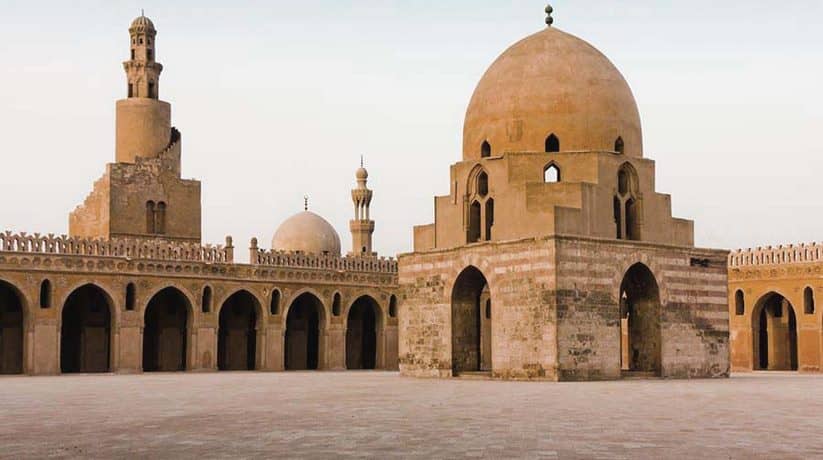
Ahmed Ibn Tulun founded a new Capital called Alqatai around the hill of Gabal Yashkur. It is to the North East of Al Fustat, razing the Christian and the Jewish cemetery. The site chosen for his mosque was an outcrop of rock which called Gabal Yashkur. Indeed, Ibn Tulun Mosque Cairo is one of the biggest mosques in Egypt. The mosque together with the ziyada occupie an area of 6.5 acres. In fact, it is square in shape, measures 162 meter in length and 161 meter in width. Moreover, the area which dedicated for the prayer is rectangular in shape measures about 137 x 118 meter. The mosque designed as open court or central square Sahn (about 92 m) Surrounded by four riwaqs. The riwaq of the qibla contains five arcades. Each of the other riwaqs consists of two arcades.

Further details about Ibn Tulun mosque Cairo Egypt:

The mosque surrounded by Ziyadas ( extension) on three sides. In fact, Ziyada is an enclosed space or precinct. It was to separate the mosque from the markets. It is also to protect the mosque and the prayers from the noise of the street. Moreover, outside Ibn Tulun Mosque Cairo on the Qibla wall, there was a palace. It called Dar El Imarah which means house of the government. In fcat, it destroyed now. Its entrance is near to the Mihrab. Ahmed Ibn Tulun used it to enter to the mosque before leading the prayer. Furthermore, The mosque has 19 doors on 3 sides. Each door corresponding to another door in the ziyadas. There are another three doors which cut in the wall of the quibla. The lintels composed of palm-trunks. They boxed with wood and above a releasing arch.

In fact, some of these doors still keep their original carving. On the right hand central Pier of the third arcade from the Sahn is the Foundation Slate. In fact, it includes the Foundation Inscription. Moreover, it is a rectangular slab of marble ( 1,6 m X 97 cm) which written in Kufic inscription. It contains the verse of El Kursi ( Ayet El Kursi) from the Koran. Furthermore, it contains also the date of 265 A.H. The walls of Ibn Tulun mosque and the Ziyada crowned with crenelation. They are like the paper which cut-outs of human figures with linked arms. In fact, the mosque is square in shape, each of its sides measures about 92 m. The original courtyard not paved. It filled with pebbles as it is today. It is because this space intended for prayer. The Fawarah in the middle of the Sahn is the third one.

More details about Ibn Tulun mosque Cairo Egypt:

The first one was the original which built by Ahmed Ibn Tulun. It gilded and stood on ten columns of marble. The second one was Al Aziz. In fact, it now destroyed. The actual one is the third which built by Sultan Lagin Al Mansoury. It is among some other works he did for Ibn Tulun mosque Cairo. Moreover, it is 14 x 12 meter and it is twenty meter in height. This Fawarah built by the architect Ibn Al Roumyyah. It has a Mameluk design. Moreover, it stands on 4 pointed arches. The zone of transition stepped corners with a window in the uppermost step. Furthermore, three windows of three lights are on each side. The dome is plain without a drum and raised on squinch. The arcades around the courtyard are deeper on the quibla Riwaq. Moreover, the sanctuary side formed by pointed Arches on brick Piers.

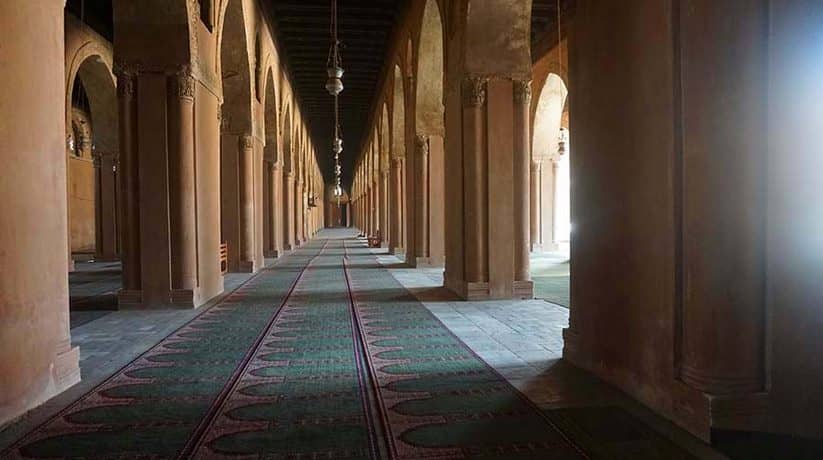
Rosettes and windows form a continuous and simple decoration. Moreover, these arcades supported by piers. Unlike columns. These Piers are rectangular. In fact, they decorated with four masonry-engaged columns. Their capitals have the same bell shape as the bases and both plastered and carved. Furthermore, all the arcades had soffits of curved stucco. They are like those which have restored in the Southern arcade. The Arches of the arcades pointed. They outlined with an edge of carved stucco. They spring from oblong supports rounded at the corners by pilasters or engaged columns. The Qibla Riwak of Ibn Tulun mosque includes 5 aisles deeper than the others. They are parallel to the Prayer niche ( the Mihrab). Each of the other riwaq includes just 2 aisles . This Riwaq actually has 6 prayer niches or mihrabs.

Further details about Ibn Tulun mosque Cairo Egypt:

The main Mihrab is in the middle of the Qibla wall. It is the tallest and the only concave one. The others are flat. It consists of a double pointed arched recess flanked by a pair Byzantine style marble. Its stucco molding and the 2 stucco bosses on each side of the arch are original. The interior decorated in Mameluk style made by the sultan Lajin. The upper decoration of painted wood. Strips of poly-chrome marble, above which is a band of Naskhi inscription. It is in black mosaic on a gold background containing the shahada. The Dikka of the Mouballegh (the bench of the Mouballegh) situated in Riwaq. Al Qibla near the courtyard. It is a wide bench of marble columns which used for communicating the words of the Imam during the prayer.

The ceiling of Ibn Tulun mosque in Cairo, composed of Palm logs boxed in wooden panels. Below the ceiling there are a long band of inscription on sycamore wood. It runs around the whole mosque. It contains verses from the Koran. This frieze is 2 Km in length and it is calculate one fifteenth of the whole holly book. There is a legend that the boards for this inscription left over from the Noah’s Ark. The upper part of Ibn Tulun mosque Cairo wall pierced with pointed arch windows. They flanked with colonnades. The windows alternate on the outside wall within blind niches with a shell conch. There are 128 windows and their arrangements on the walls. They are independent of the arches so that not every arch has a centered window.

More details about Ibn Tulun mosque in Cairo:

The functions of these arched windows of the arched windows are providing light. They also reduce the weight carried by the arches. Creswell attributes only 4 of the windows stucco grills to the Tulunide Period. These of the plain geometrical design. The rest displaying a large variety of more complicated geometrical patterns. They date back to the Fatimide and the Mameluk Periods. The minaret stands on the North side of the Ziyada. A door leads to it. It is an unusual stone structure with an outer staircase and a Mameluk top of the type. In fact, it named Mabkhara. This minaret caused controversy among the Cairo’s Architectural historians. We don’t have enough sources to clear this point or determine its date.

Nearby attractions Information, tours and Online Booking

More of Islamic Egypt

More of Egypt attractions

MORE
Islamic Alexandria Egypt

Islamic Alexandria Egypt

  • Islamic Alexandria Egypt
  • Islamic Alexandria Egypt
  • Islamic Alexandria Egypt
  • Islamic Alexandria Egypt
  • Islamic Alexandria Egypt
  • Islamic Alexandria Egypt
  • Islamic Alexandria Egypt

Islamic Alexandria Egypt tours, prices, booking, reviews

Islamic Alexandria represented by Al Mursi Abu Al Abbas mosque. It is the most historic and most beautiful mosque in Alexandria, Egypt. Al Mursi Abu Al Abbas Mosque built primarily in 1775 over the tomb of a Spanish scholar and saint. Moreover, it stands on Mosque Square overlooking the eastern harbor. Al Mursi Abu Al Abbas born to a wealthy family in the Andalusia region of Spain in 1219. In the wake of increasing Christian control of Spain, he and his family left for Tunisia in 1242. He later went on to Alexandria, a popular destination of many Muslim scholars at the time.

Islamic Alexandria also represented by Imam Al Busiri mosque. It is located in Alexandria. Different biographers present slightly different versions of Imam Al Busiri’s life. It is although certain facts agreed upon by all of North African to the Sanhaji tribe of Morocco. The famous historian al Maqrizi claimed that Imam Al Busiri’s family was from Hammad Citadel in Morocco. Moreover, it was a part of the Banu Habnun tribe.

Further details about Islamic Alexandria:

Islamic Alexandria also represented by Nabi Daniel mosque. It is located in Nabi Daniel street in Moharram Bek in Alexandria. Nabi Daniel is not really popular among the Muslims globally. The present Nabi Daniel mosque built at the end of the 18th century and restored in 1823 by Mohammad Ali. A smaller shrine, probably the mosque of Dzoul Karnein – the Sire with the two horns – preexisted on the site. In fact, the mosque contains the remains of the scholar and venerated teacher Prophet Daniel. It also contains the remains of his companion Sidi Lokman el Hakim, a religious story-teller.

Islamic Alexandria also represented by Qaitbay Fort. It indeed is one of the most important defensive strongholds. In fact, it not only in Egypt, but also along the Mediterranean Sea coast. It formulated an important part of the fortification system of Alexandria in the 15th century A.D. Qaitbay Fort situated at the entrance of the eastern harbor on the eastern point of the Pharos Island. It erected on the exact site of the famous Lighthouse of Alexandria. In fact, the Lighthouse of Alexandria was one of the Seven Wonders of the Ancient World. The lighthouse continued to function until the time of the Arab conquest. And then, several disasters occurred. In fact, he shape of the lighthouse changed to some extent, but it still continued to function.
 

Islamic Alexandria Sites

Al Mursi Abu Al Abbas Mosque
+View details
Egypt Nile cruises and hotels
Imam Al Busiri Mosque
+View details
Egypt Nile cruises and hotels
Nabi Daniel Mosque Alexandria
+View details
Egypt Nile cruises and hotels
Load more

MORE
Imam Al Busiri mosque Alexandria

Imam Al Busiri Mosque

  • Imam Al Busiri mosque Alexandria
  • Imam Al Busiri mosque Alexandria
  • Imam Al Busiri mosque Alexandria
  • Imam Al Busiri mosque Alexandria
  • Imam Al Busiri mosque Alexandria
  • Imam Al Busiri mosque Alexandria

Imam Al Busiri mosque Alexandria Egypt tours, booking, prices

Imam Al Busiri mosque Alexandria located in Alexandria city, Egypt. Different biographers present slightly different versions of Imam Al Busiri’s life. Certain facts agreed upon by all North African to the Sanhaji tribe of Morocco. Historian al Maqrizi claimed that Al Busiri’s family was from Hammad Citadel in Morocco. Furthermore, it was a part of the Banu Habnun tribe. Little known about Imam Al Busiri childhood. It is although scholars surmise that he received the usual education for children of his time. He would have attended a Qur’an school and memorized the entire Qur’an.

Kilani asserts that Imam Al Busiri’s family was poor as he forced to search for work from a young age. Sometime during his youth, he made his way to Cairo, where he pursued his studies. There, he exposed to the important Islamic sciences. They are Arabic language and linguistics. They are also literature, history and the biography of the Prophet Muammad. Even as a young man, Imam Al Busiri began to compose poetry which was not of a religious nature. In 1240 at the age of 30, he composed a poem to petition the King Najm Al Din Al Ayyubi. It was when he failed to allot a generous endowment to Imam Al Busiri mosque Alexandria.

Further details about Imam Al Busiri mosque Alexandria Egypt:

An accomplished poet, he would often recite his poetry and give lessons at mosques in Cairo. Many young poets studied under him. They are such as Athir al-Din Muammad Ibn Yusuf Abu Hayyan al-Andalusi 1325 AC. And Abu al-Fath Ibn Sayyid al-Nas al-Yamari 1334 AC and Izz al-Din b. Jamaah 1335 AC. His best known for the deeply religious are Burdah and the Hamziyyah poems. Imam Al Busiri’s complete diwan is still extant. It includes poetry that reveals the transition from a rough and terse youth. It also include a mature man with a deeply spiritual disposition. Based on his poetry, one can map out his spiritual development. He records his experiences in life, interactions with people, complaints, and insights.

Imam Al Busiri’s short and slender stature led the people ridicule him. It led also to be the source of their jokes. Early on in his career, he wrote a number satire poems. They revealed his feelings about being ridiculed. He also had a hard time accepting criticism from other poets. Moreover, he even wrote a rebuttal of a poet, one Zayn al-Din who had insulted his work. He known to have a harsh tongue. Furthermore, he took pleasure in composing hijaa, or satire, poetry to insult his enemies. The historian al-Shehab Mahmoud wasa contemporary of Imam Al Busiri. He wrote that he was a misanthrope who would attack others with his words. He also added that he had a bad reputation in the courts of princes and viziers.

More details about Imam Al Busiri mosque Alexandria Egypt:

Imam Al Busiri lived in various locations in Cairo and in the Delta region. He worked primarily as a scribe and poet for the local rulers. At one time, a ruler offered him the position of a muhtasib, or market inspector, in Cairo, but he rejected it. From this job offer, we can find out that Imam Al Busiri had a decent knowledge of Islamic law. It is because the job requires a thorough knowledge of Islamic jurisprudence and law. He lived for a long time in the Lower Egypt town of Bilbis 1261-1265 AC. Moreover, he worked there as a scribe and manuscript copyist. He seems to skilled in accounting. That was although al-Maqrizi claimed that he made a lot of mistakes and was not competent in this skill.

Imam Al Busiri interested in religious polemics. He read the Hebrew Bible, New Testament, and religious history of Judaism. He also read Christianity primarily. It was defend Islam and the position of the Prophet Muammad. Some of his colleagues at work were Jewish and Christian. In fact, he known to engage in fiery debates with them. He interested in proving to them that the Gospels did not indicate that Jesus was a god. And that it contained signs of the coming of the Prophet Muammad. He was also concerned with correcting what he believed to be mistakes. It was in the Hebrew Bible that told stories of the prophets and of their sins.

Further details about Imam Al Busiri mosque Alexandria Egypt:

In addition to being a poet, Imam Al Busiri was also a fine calligrapher. He was also a composer of prose, although nothing of his writing or calligraphy is extant. It said at one point, he made a living designing the engravings for tombstones. In an attempt to make money, he also opened a Qur’an school for children in Cairo. But this venture failed and he forced to close it. As for his domestic life, his poems paint a hellish impression of living. It was with his constantly pregnant wife and gaggle of children. He talks of his wife conspiring with his sister-in-law. It was to get him to divorce her by hitting him and pulling out the hairs from his beard. Moreover, he also complains in detail about old age. He also does about his inability to provide his children with enough food and the problem he faced.

In fact, he could not provide his daughter with furnishings for her home for her marriage. Moreover, he spent some time in the central Delta town of al-Mahallah. It was where he was the poet and scribe for the mayor. He received a monthly wage for composing panegyric poems of the ruler. In al-Mahallah, Imam Al Busiri clashed with the local Christian scribes, copyists and poets. He wrote verses complaining of his treatment at their hands. Sometime during his stay in al-Mahallah, it seems he broke his leg. It was on a visit to the public baths and complained bitterly about his leg in many poems.

More details about Imam Al Busiri mosque Alexandria Egypt:

His relation with others was so bad that it reached the point where they wished he would die. Once, when he became very sick, a rumor quickly spread that he had died. Upon recovering from his sickness, he wrote a satirical poem. It was to mock his enemies who spread rumors of his death. The phrase was “I am not the one who would die before them”. I will survive them and weep over their graves. It’s true that I had almost lost my life but the generosity of this vizier gave me a new life.”

Imam Al Busiri had enemies among Jews, Christians and among his coreligionists. In fact, he also had enemies among those closest to him, including his wife. He wrote satirical poems attacking anyone who criticized or insulted him. He recorded each event and rebuttal in a poem. According to al-Maqrizi, Imam Al Busiri would befriend important members of the court. It was such as the vizier Zayn al-Din. al-Zubayr. And would support them no matter if they were just or oppressive rulers. He supported the Mamluk rulers. He wrote zealous panegyric poems . The poems praised Turkish Mamluks that also affronted the local Arab population. The only positive characteristic of Imam Al Busiri recorded by al-Maqrizi. It was that he was generous.

Further details about Imam Al Busiri mosque Alexandria Egypt:

It not known when exactly Imam Al Busiri became a disciple of Al Mursi Abu Al Abbas. It can posited that this happened later on in his life. Itis at least some years before the death of al-Mursi in 1287 AC. Imam Al Busiri seemed to have struggled to follow Sufi principles. He desired to live in isolation from people. In fact, he had a large family and was often unable to feed them due to his poverty. He said “If I were on my own, I like to be a disciple in a Sufi hostel”.

His later poetry consists mainly of panegyric poems praising the Prophet Muhammad. And he bears little similarity to that of his earlier satirical poems. Perhaps after becoming a Sufi disciple, he underwent a spiritual awakening. It seen in the form the Burdah and the accompanying story of its composition. Moreover, it also was from his previous harsh and misanthropic nature. It seems to be conflicting information about Imam Al Busiri ’s life. It seen in the biographies of non-Sufi historians. Furthermore, it also seen from hagiographies written by Sufi scholars. Sufi hagiographies always describe him as an older man with a head of white hair.

More details about Imam Al Busiri mosque Alexandria:

The time line of Imam Al Busiri’s life is not clear. It known that as a grown man, he drawn towards Sufism. He joined the Shadhili order under the guidance of his Shaykh Abu al-Abbas al-Mursi. It was in Alexandria. And which at the time was a center for North African Sufis. At this time, the Shadhili Sufi order was still in its infancy and founded by al-Mursi. Imam Al Busiri was fond of Al Mursi Abu Al Abbas. He studied Sufi thought and practice under him. This background would have a strong influence on his later poetry. He was faithful to his order. He wrote poems full of praise of al-Shadhili and al-Mursi. They were in their spiritual attributes and ranking. Imam Al Busiri was the contemporary of Ibn al-Farid, the great Sufi poet and mystic.

It also said that he was a friend of Ibn Ata Allah Al Sakandari. Al Sakandari is Sufi scholar and jurists. He wrote the famous Hikam, or collection of Sufi aphorisms. It is as well as a spiritual biography of A Shadhili and Al Mursi. In Sufi hagiographies, Imam Al Busiri painted as a saint-like figure. It is the person who had reached the high spiritual station (maqam) of Al Ghawthiyyah Al kubra. They claim that when he walks down the street, the young and old come out to greet him. They also kiss his hand. It said that his bod has emitted a sweet scent. He wore fine clothes, had a head of snow-white hair and humble smile. He was ascetic in his lifestyle. Moreover, he also had a respectable and virtuous character.

Further details about Imam Al Busiri mosque Alexandria Egypt:

Kilani disregards these attributes of Imam Al Busiri based on his readings of his poetry. Imam Al Busiri was indeed an unpleasant person. It was for much of his life until he discovered Sufism. He mended his ways, and reached a high spiritual station. This station respected and acknowledged by his fellow Sufis. Imam Al Busiri’s praise poetry of the Prophet Muhammad divided into two periods. The first from before Imam Al Busiri’s Hajj and the second after his return from the Hajj. Imam Al Busiri did not perform his pilgrimage until at least after 1255 AC. Before going on Hajj, he composed many praise poems. Some of them referred to his longing to visit the tomb of the Prophet.

Upon his arrival to Madinah and Makkah, he composed poems revealing his joy. The joy is at the tomb of his beloved and other places which Prophet visited. Although buried in Alexandria, it not known if Imam Al Busiri spent his last years in Cairo or Alexandria. His official tomb located in Alexandria, there are some dispute about where he buried. Al-Maqrizi recorded that he died in al-Mansuri Hospital in Cairo. Al- Ayyashi is a North African traveler who visited Cairo in 1663 AC. He mentioned that he visited Imam Al Busiri’s tomb in the area of the jurist Imam al-Shafii’s tomb. It located in the southern cemetery of Cairo. Imam Al Busiri indeed buried at the foot of al-Muqattam hills. It is where historians presumably thought the younger poet Imam Al Busiri buried.

Nearby attractions Information, tours and Online Booking

More of Islamic Egypt

More of Egypt attractions

MORE
error: Copyright © www.etltravel.com !