Activities in Nile Valley

Things to Do

Red Pyramid Dahshur Cairo

Red Pyramid Dahshur Cairo

  • Red Pyramid Dahshur Cairo
  • Red Pyramid Dahshur Cairo
  • Red Pyramid Dahshur Cairo
  • Red Pyramid Dahshur Cairo
  • Red Pyramid Dahshur Cairo
  • Red Pyramid Dahshur Cairo

Red Pyramid Dahshur Cairo Egypt tours, prices, booking

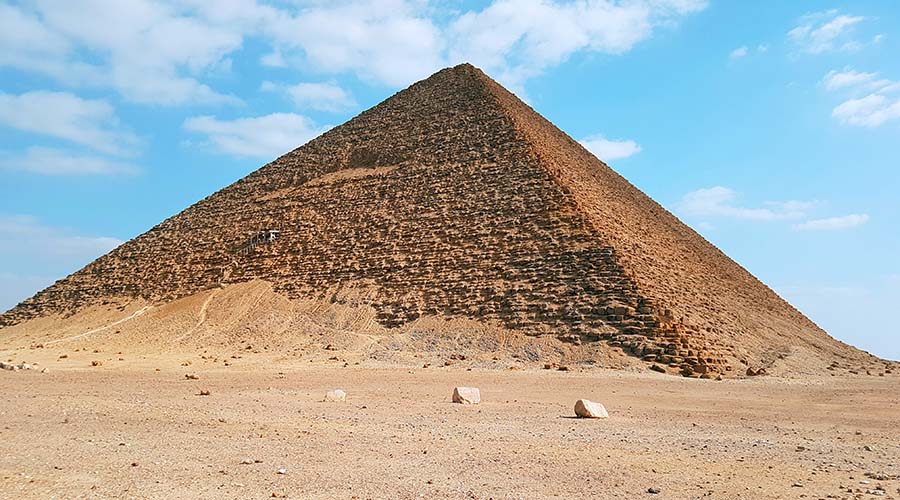
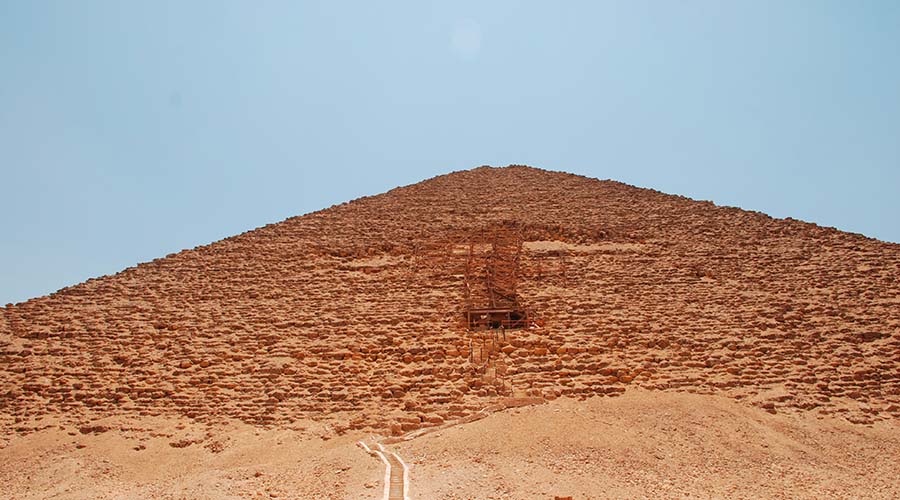
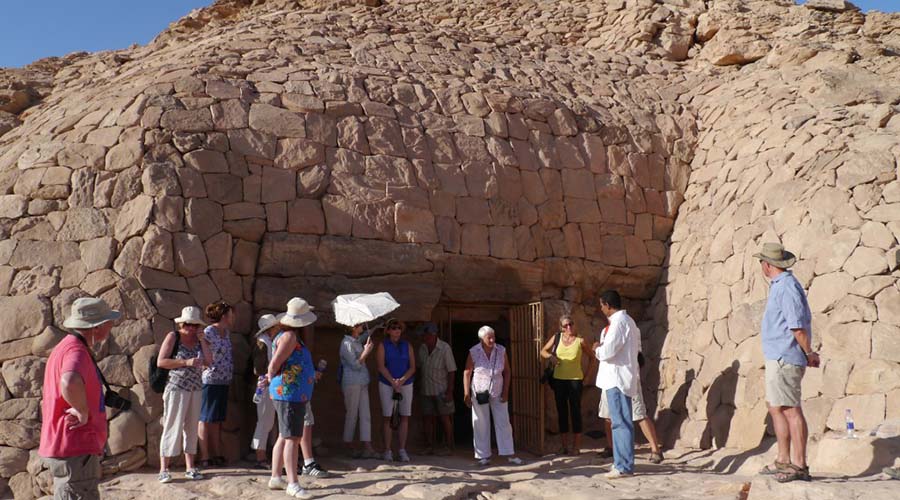
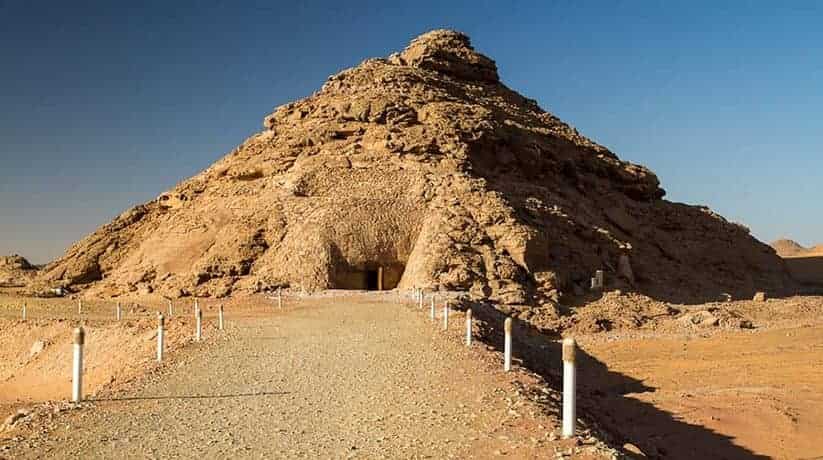
Red Pyramid Dahshur Cairo Egypt has the largest base after Khufu pyramid. It located 40 kilometers south of Cairo. Each side of the pyramid measures 722 feet. Moreover, its sides sloping at 43 degrees 22′. The pyramid is the fourth highest pyramid which built in Egypt. It has 160 layers of stone. In fact, the pyramid was the first successful, true, cased Pyramid which built in Egypt. The pyramid in fact built by Snefru who was Khufus’s father. Moreover, it has no crowds and circus atmosphere like the Giza Plateau. Moreover, it currently entered without limitation. It is only a short drive from Sakkara and only a brief drive from Cairo.

In fact, the Red Pyramid Dahshur gets its name from the reddish limestone which used to build most of its core. Moreover, it also sometimes referred to as the Shining or Northern Pyramid. Several layers of fine white limestone used to lay the pyramid’s foundation. It was the learning from prior mistakes of earlier pyramids. Tura limestone used as casing stone to cover the pyramid. Though some casing still remains, most has removed. Every twentieth casing stone discovered had inscriptions on the back sides. Some inscribed with the cartouche of Snefru. The others had inscriptions in red paint naming the various work crews.

Further details about the Red Pyramid Dahshur Cairo Egypt:

In fact, they are such as the “Green Gang” or the “Western Gang”. Snefru’s cartouche was an important discovery. It was since there are no identifying inscriptions within the pyramid. Perhaps greater importance is the fact that some of the casing dated. It gives clues to how long the pyramid took to build. It is also the sequence of work that took place. According to this, the pyramid begun between 22-29 year of Snefru’s reign. Within four years, 30 percent of Red Pyramid had completed. The entire pyramid finished in about seventeen years.

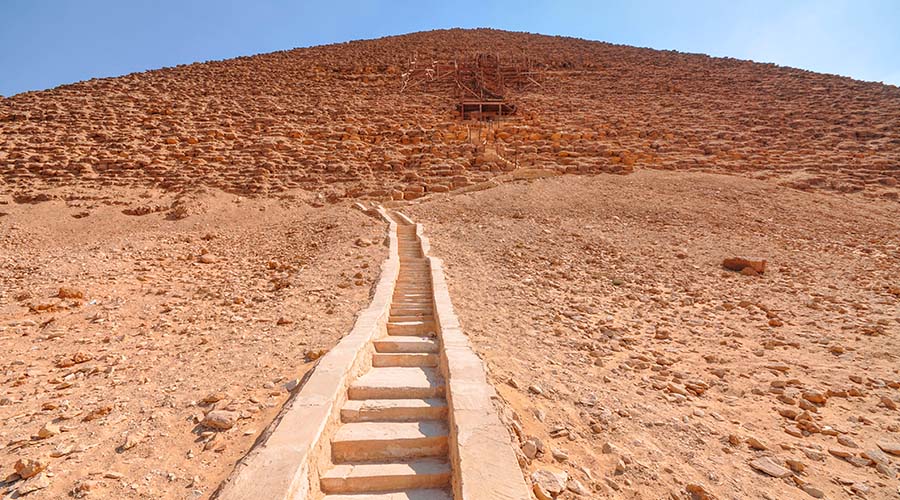
East of the Red Pyramid Dahshur Cairo is what remains of a mortuary temple. Besides to the first capstone (Pyramidion) ever found belonging to an Old Kingdom Pyramid. It recovered in fragments and reconstructed. The mortuary temple itself is significant. It was because Snefru pioneered the east west alignment of Egyptian Temples to match the path of the sun. Like most Egyptian Pyramids, the only entrance is in the north side. Furthermore, it leads to a 206 foot passage descends at an angle of 27 degrees to the first chamber. The first chamber has a cor-belled (step) ceiling with a height of about 40 feet. In fact, all three of the chambers in this pyramid have cor-belled ceilings. They are with between eleven and fourteen layers.

More details about the Red Pyramid Dahshur Cairo Egypt:

Even with some two million tones of stone above, this ceiling design is so strong. In fact, there are no cracks or structural problems even today. Moreover, a short passage on the south side of the first chamber leads to a second chamber. These first two chambers of Red Pyramid Dahshur Cairo located at the ground level. The third chamber is higher. Moreover, it built within the masonry of the pyramid itself. The second chamber is unusual. It lies under the apex of the pyramid, or center point of the pyramid. It is one of the only Pyramids in Egypt to have this design layout. The final chamber has an entrance passageway. It is about 25 feet above the floor of the second chamber. It can accessed by a staircase (of modern construction).

Furthermore, the passageway leads to the final chamber is 23 feet long. Egyptology men believe this final chamber intended to be the actual burial chamber. Moreover, the room is approximately 14 feet by 27 feet. Its cor-belled ceiling rising to a height of 50 feet. The floor has excavated in an unsuccessful attempt to find other passageways.

Nearby attractions Information, tours and Online Booking

More of Ancient Egypt

More of Egypt attractions

MORE
Ramose tomb Luxor Egypt

Ramose tomb Luxor Egypt

  • Ramose tomb Luxor Egypt
  • Ramose tomb Luxor Egypt
  • Ramose tomb Luxor Egypt
  • Ramose tomb Luxor Egypt
  • Ramose tomb Luxor Egypt
  • Ramose tomb Luxor Egypt

Ramose tomb Luxor Egypt TT 55 tours, prices, booking

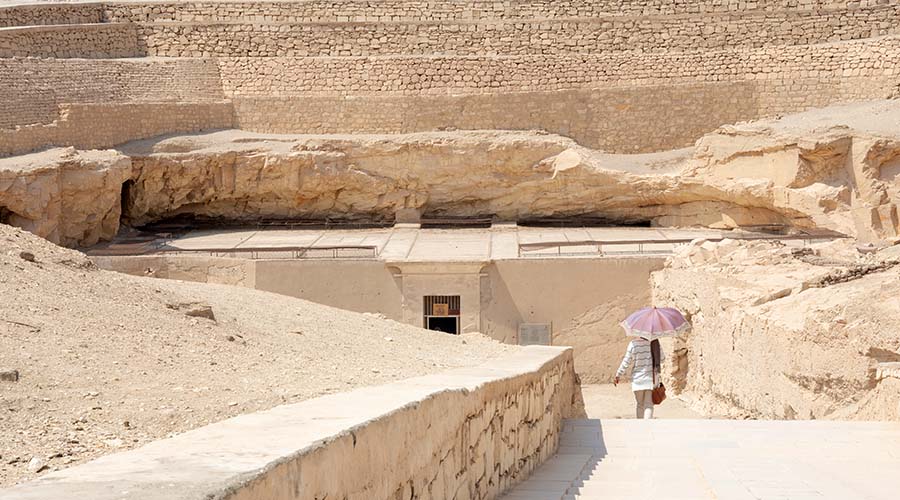
Ramose tomb Luxor Egypt located in the village area of Sheikh Abd el-Qurna. In fact, Ramose was “Governor of the Town” (Thebes) and Vizier during the Dynasty XVIII transition. It was in the reigns of Amenhotep III and IV. Ramose tomb Luxor indeed reflects his important position in the royal court and. Moreover, it represents the change in style towards “Amarna art”. In fact, it is uncertain whether the deceased ever buried in the tomb. Maybe he followed Akhenaten to his new capital Akhetaten. But no tomb has found for Ramose there. The plan of Ramose tomb is a traditional T-shape. It also built on a large scale with some of the most beautiful relief carvings of any Theban tomb. Furthermore, a wide stairway leads down to the courtyard in front of the tomb.

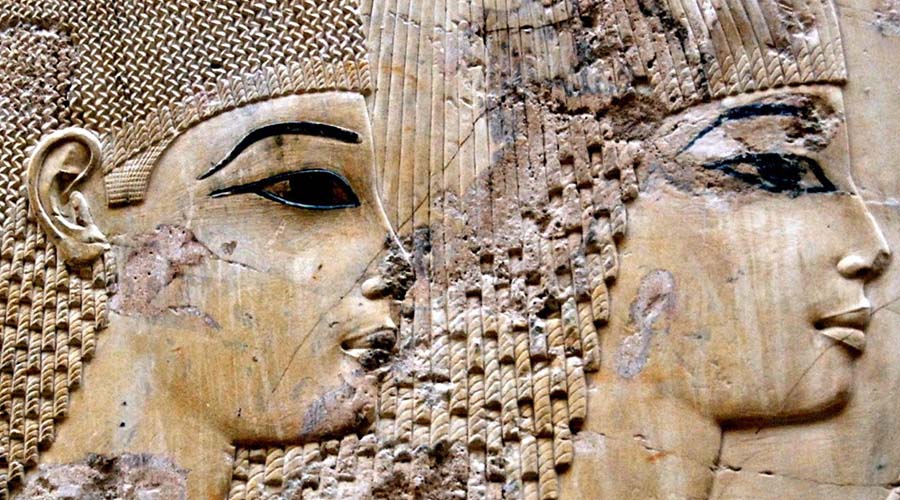
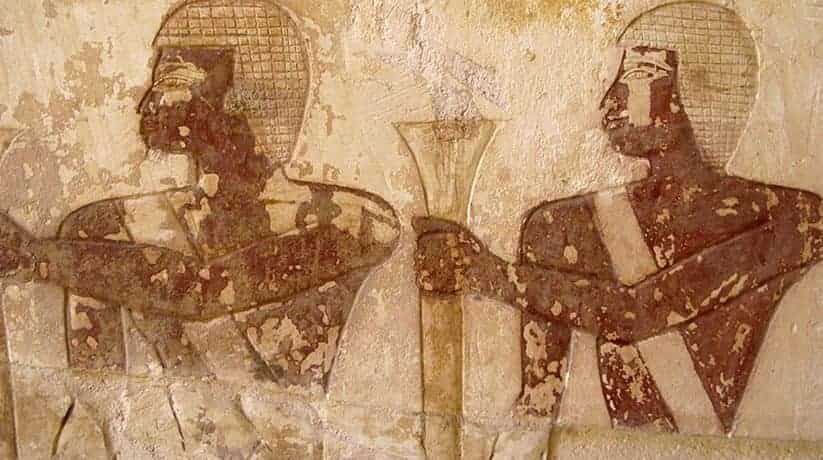
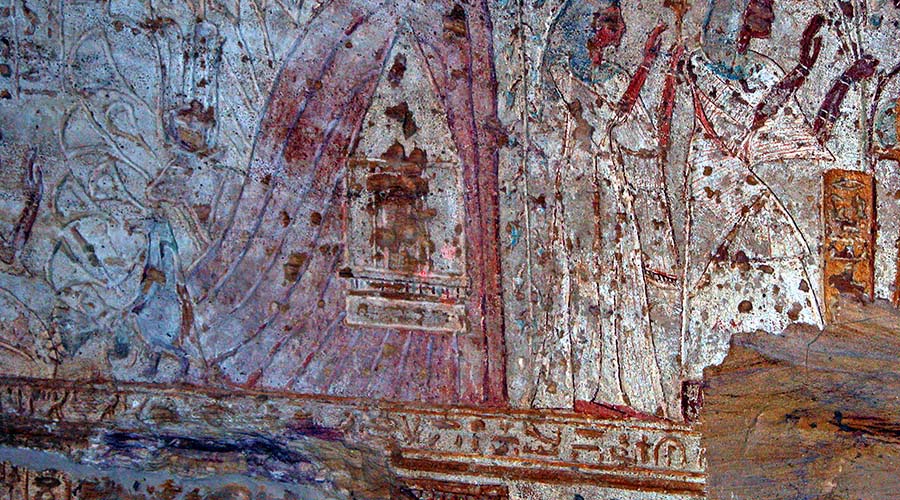
The entrance also leads into a large transverse hall. Ramose tomb Luxor roof once supported by four rows of eight papyrus columns. Some of these have recently restored. There were a great deal of damage to the tomb, specially to the reliefs depicting Akhenaten. In fact, it was because of a collapsed ceiling. Moreover, this contributed to the preservation of the remaining reliefs. The tomb also usurped by another individual at a later date. The wall on the left of the entrance shows Ramose wearing the gown of a vizier. He consecrates offerings to Amun-Re, Re-Horakhty, Atum and Khepri. Moreover, he followed by his attendants. The scenes of the banquet on this wall indeed are beautiful. They also carved with fine detail on limestone. They left uncolored except for the eyes of the figures.

Further details about Ramose tomb Luxor Egypt:

Each guest, some of them the relatives of the deceased, named in the accompanying texts. These say that Ramose married his brother’s daughter, Meryt-Ptah. The end wall on the south side portrays the funeral procession in two long registers. Moreover, the floor at this wall slopes down into the burial shaft below, which is sometimes accessible. In fact, this wall not carved but its paintings show good color and detail of the funerary goods. They transported to Ramose tomb Luxor with the procession of mourners. They move towards the Western Goddess. The canopic jars in their shrine taken with the sarcophagus to the tomb on sleds. Before them is an unusual scene of the ‘teknu’ – a mysterious part of the funerary ritual. There are also many opinions about what the ‘teknu’ was.

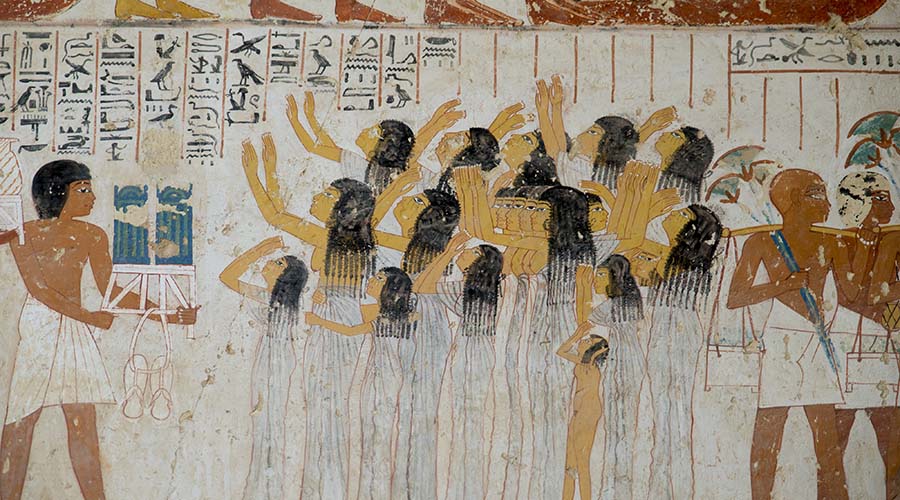
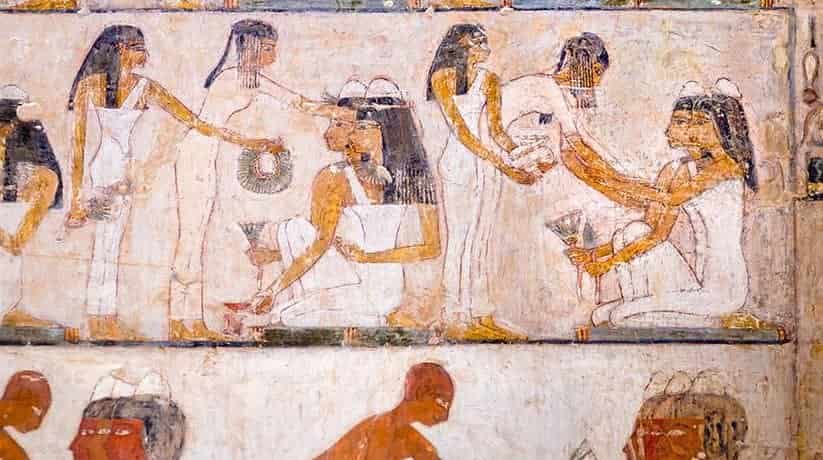
One idea is that it was a priest who wrapped in skins. He transported on a sled in some kind of ritual of rebirth. The others suggest that it was the wrapped internal organs of the deceased. They not placed in canopic jars. The ‘teknu’ in this scene can seen to be the shape of a man crouching, with his feet showing. The second register shows more of the procession with Ramose tomb Luxor furnishings. It also shows burial goods carried to the tomb. A group of mourning women dressed in white robes with their hair loose shown in a well known scene. The scene is at the center of the procession. Furthermore, nine kneeling women wail and cover their heads. It is with ashes and bare chested women. She dressed in yellow and red beat their breasts. Unfortunately the captions for these scenes are incomplete.

More details about Ramose tomb Luxor Egypt:

At the end of the wall the two registers linked together ending before the Western Goddess. It is where the deceased is before his tomb entrance. In fact, the west wall of Ramose tomb Luxor damaged and difficult to recognize. Moreover, it has four unfinished figures of Ramose. The last offering is a bouquet to a king in a kiosk with the traditional nine enemies on its base. The cartouche is that of Amenhotep and the damaged epithet ‘great in his time’. It suggests that the ruler was Amenhotep IV (Akhenaten). Moreover, it portrayed in his earlier years in the formal style of his father Amenhotep III. Behind him sits the goddess Ma’at in the classic style. In the center of the west wall is the entrance to the unfinished inner chamber. It is where Ramose portrayed entering the tomb, with an autobiographical text

On the right of the entrance Ramose seen kneeling prostrated. It is before Amenhotep IV and his queen Nefertiti. They shown in the ‘Window of Appearances’ with the rays of the Aten showering down on them. Moreover, this relief executed in the new style of Amarna art. It also defaced, presumably after Akhenaten’s reign ended. Furthermore, Ramose shown receiving the “Gold of Honor” one of the highest awards in the land. Many courtiers and officials are bowing low before the royal couple. Beyond this scene the wall unfinished. Drawings have sketched in but left uncarved. These show foreign delegates (four Nubians, three Asiatics and a Libyan). They come to pay homage and offer tribute to the king.

Further details about Ramose tomb Luxor Egypt:

In fact, the north wall of Ramose tomb Luxor not decorated. Moreover, the wall to the right of the tomb entrance again decorated with traditional fine reliefs. There is also an Iun-mutef priest. He dressed in a panther skin. It is with a comprehensive list of offerings. They are for the soul of the deceased. Many family members again shown on this wall. There is a statue of Ramose who dressed in his long vizier’s robe. It is with a heart amulet around his neck purified by two priests. In the scene above, Ramose and his wife face three girls holding out sistra and menat. It is to the deceased in another beautiful relief. Next to the entrance Ramose and his wife depicted with offering bringers burning incense.

Entrance to Ramose tomb Luxor:

Ramose tomb opens 8 am to 4 pm in winter. A ticket for Ramose tomb, Userhet tomb and Khaemhet tomb can bought at the ticket office.

Nearby attractions Information, tours and Online Booking

More of Ancient Egypt

More of Egypt attractions
MORE
Pashedu tomb Luxor Egypt

Pashedu tomb Luxor Egypt

  • Pashedu tomb Luxor Egypt
  • Pashedu tomb Luxor Egypt
  • Pashedu tomb Luxor Egypt
  • Pashedu tomb Luxor Egypt
  • Pashedu tomb Luxor Egypt
  • Pashedu tomb Luxor Egypt
  • Pashedu tomb Luxor Egypt

Pashedu tomb Luxor Egypt TT3 tours, prices, booking

Pashedu tomb Luxor Egypt TT 3 closed to the public for long time. The tomb of  Pashedu located in the necropolis of Deir El Medina on the West Bank at Luxor (ancient Thebes). Little known about this individual. He had the title, “Servant in the Place of Truth on the West of Thebes”. In fact, Pashedu tomb Luxor itself dated back to the early years of Ramses II. That is why the deceased began working while Seti I was King. Pashedu’s father, Menna, worked for Amun temple on the East bank. Pashedu was the first member of his family to work with the community at Deir El Medina. Moreover, he was most likely a stonemason who helped clear the passage. It was through the limestone cliffs when tombs built. He maybe later promoted to a foreman of the left side.

Two teams usually built tombs on the west bank. They consist of a left and right work gang. One team worked on the left side of a tomb while a second team worked on its right. In fact, Pashedu married to Nedjembehdet. Together they had many of sons (and possibly daughters). In fact, Pashedu tomb Luxor known and robbed during antiquity. Moreover, the tomb rediscovered in 1834 by Egyptian soldiers who were hunting treasure. Furthermore, a Scottish traveler and artist named Robert Hays happened to be in Luxor at that time. He heard of the discovery, he made drawings within the tomb. Moreover, the tomb indeed is a simple tomb layout. It is with an antechamber and a short corridor leading to a burial chamber. Only the corridor and burial chamber decorated.

Further details about Pashedu tomb Luxor Egypt:

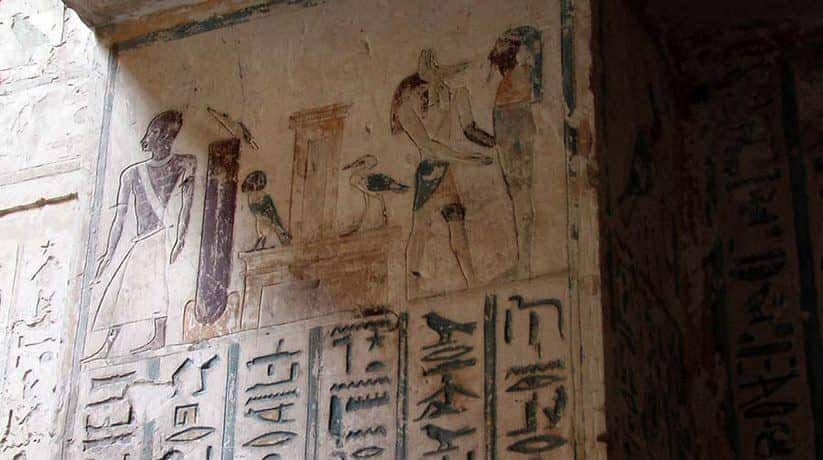
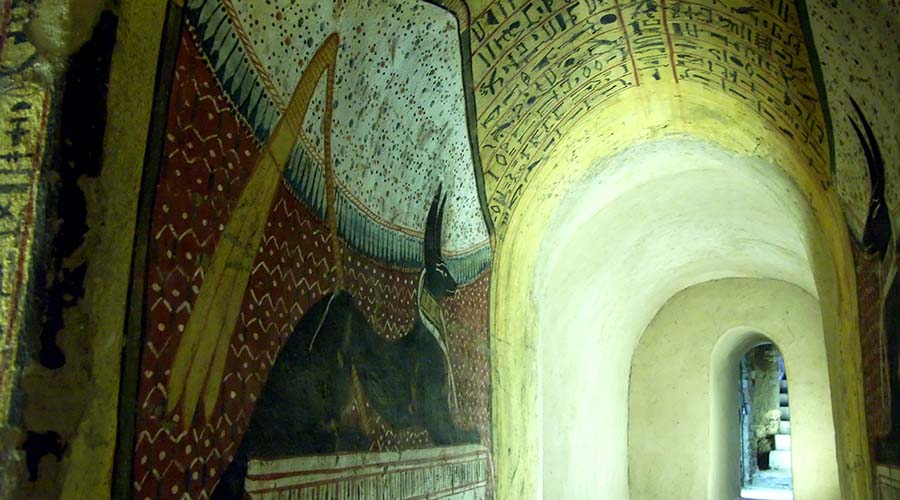
The corridor also has a large painting on either wall. It is of the god, Anubis as a jackal sitting on a pedestal. These two images are mirror reflections of each other. Between Anubis’ hind paws he holds a nekhakha-flail. As we enter the burial chamber, just above the doorway on the front left wall is a small image. It is of the deceased worshiping the goddess Nut in a tree. Moreover, she emerges from the tree trunk and pours a libation over the kneeling Pashedu. The hand raised to catch the water. In three registers, the rest of the lower wall is a scene. It also depicts rows of the deceased’s family in adoration. Furthermore, in the arch above the doorway, we find Pashedu worshiping Sokar-Osiris. It is in the form of a winged falcon on a boat. In Pashedu tomb Luxor, above the god is also an udjat-eye.

Turning the corner, on the long left wall, there is a scene showing Pashedu and his wife. Moreover, it is with their hands which raised in worship of Horus. By there feet are also a son and granddaughter. Note the wax perfume on his wife’s head. Here, passages from the Book of the Dead surround the images of Pashedu and Nedjembehdet. Further down the wall is a fragmentary image of Horus as a falcon. It also surrounded by the text from the Book of the Dead. Images no longer adorn the lower part of the back wall of the burial chamber. Moreover, within the upper arch we find a scene depicting Osiris in full regalia. A deity raises a burning brazier (candles) before him. Behind him are the mountains of the west over. It also shows a udjat-eye holding a second burning brazier.

More details about Pashedu tomb Luxor Egypt:

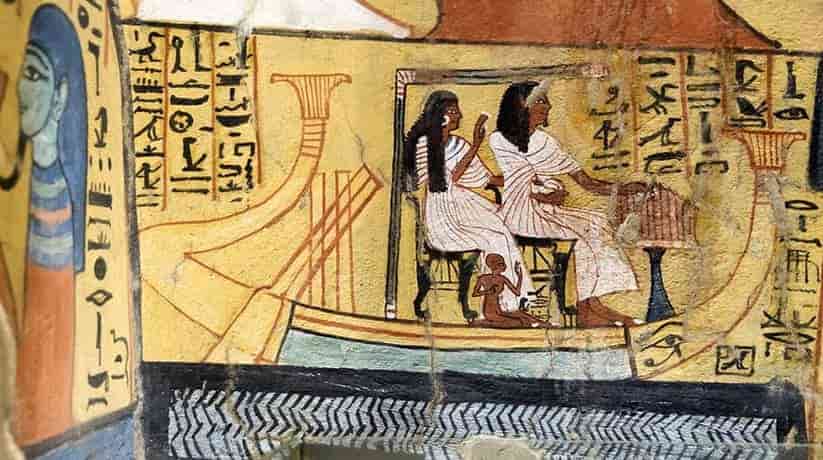
On the left is another falcon (Horus). We find Pashedu kneeling at the foot of the scene in adoration. The first scene at the rear of the right wall is Pashedu and his wife on a boat. Moreover, the child with them is perhaps a granddaughter or may be an unknown daughter. In fact, they make their way west to the land of the dead. Moreover, before them on the boat is a table of offerings. Next, there is a also larger scene. It also shows the deceased and a girl worshiping the gods Re-Harakhty, Atum, Knepri and Ptah. They seated. On the right wall towards the front is of Pashedu worshiping Ptah-Sokar-Osiris.

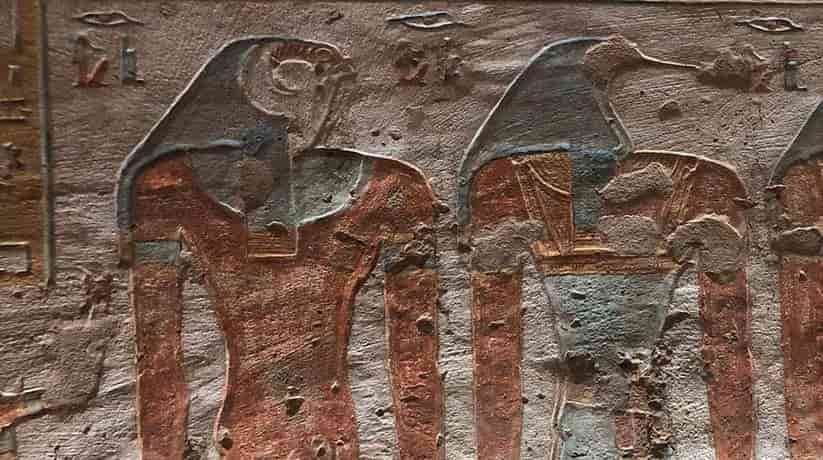
Moreover, on the front right wall of Pashedu tomb Luxor, there is the best known scene in this tomb. Here, Pashedu crouches by a stream in the shade of a palm tree laden with clusters of dates. Chapter 12 of the Book of the Dead describes how the water will quench the fires of the underworld. So, it preserve the deceased from harm. On the right part of the vaulted ceiling we find details a procession of gods. These include, from right, Thoth followed by Hathor and the Re Harakhty. They also include finally Neith. A similar procession of gods adorns the left side of the ceiling.

Entrance to Pashedu tomb Luxor Egypt:

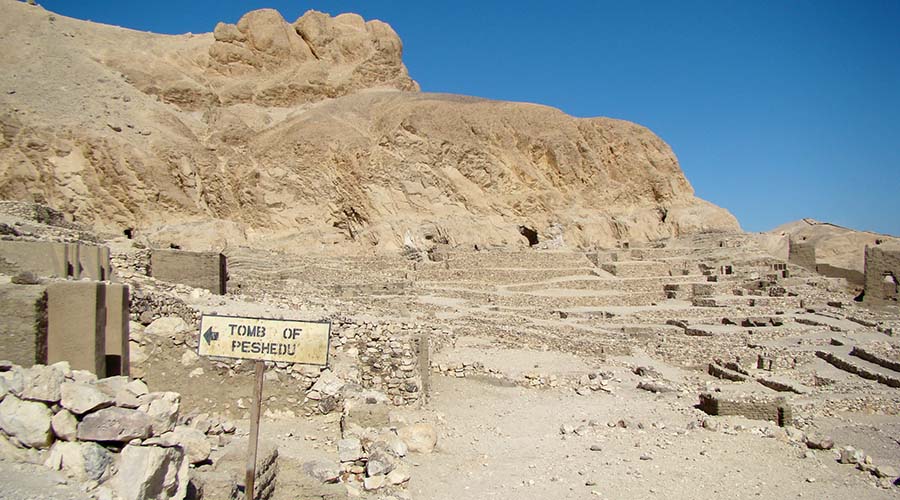
The tomb is open from 6 am to 4 pm in the winter season. To reach the tomb, climb the steps to the Deir El Medina tombs of Sennedjem and Inherkhau. And then, keep going along the steep path up the hillside. A guardian will usually you to unlock the tomb. There is a separate entrance ticket to the tomb which costs 60 Egyptian pound at the gate.

Nearby attractions Information, tours and Online Booking

More of Ancient Egypt

More of Egypt attractions

MORE
Queen Titi tomb Luxor

Queen Titi tomb Luxor

  • Queen Titi tomb Luxor
  • Queen Titi tomb Luxor
  • Queen Titi tomb Luxor
  • Queen Titi tomb Luxor
  • Queen Titi tomb Luxor
  • Queen Titi tomb Luxor

Queen Titi tomb Luxor Qv 52 Egypt tours, prices, booking

Queen Titi tomb Luxor Egypt QV 52 located on the West Bank at Luxor (ancient Thebes). It is in the area which known as the Valley of the Queens. In fact, the tomb is somewhat smaller in scale than many other royal tombs of the 20th Dynasty. It damaged by later reuse. Though we are not sure about the position which Titi held within the Ramesside royal court. We believe that Queen Titi maybe was a wife of Ramses III and maybe also was his daughter. Moreover, Queen Titi maybe also was the mother of Amenherkhepshef. Amenherkhepshef buried nearby Queen Titi tomb in the Valley of the Queens. Queen Titi might have also been the mother of Ramses IV. In fact, the tomb Luxor shares many common features with the tomb of Amenherkhepshef. It also shares many common features with the tomb of Khaemwaset (QV 44).

The decorative program of Queen Titi tomb Luxor is identical in many stances. The painted figures set against a background of white or gray. It is although in some scenes, the background color changes to near yellow. One intriguing feature of the tomb is the way in which Queen Titi depicted. Furthermore, in some scenes, she is a young girl wearing the costume and braided hair style of a teenager. Moreover, the scenes are such as those on the front wall of one of the rear chambers. In the corridor on the left wall, she represented as a middle aged woman. Queen Titi dressed more conservatively and with a hint of make-up.

Further details about Queen Titi tomb Luxor Egypt:

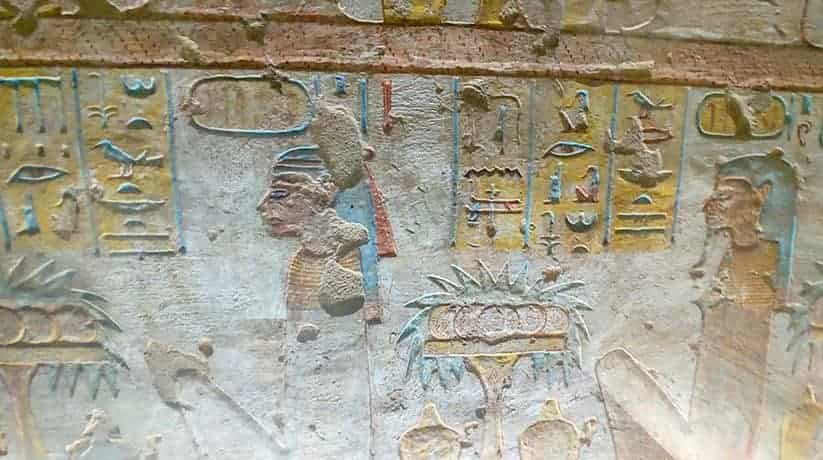
These sorts of representations are not common in Egyptian art. The contrast between the younger woman and the older one are striking. In fact, Queen Titi tomb Luxor takes the form of a corridor. Furthermore, it followed by a burial chamber that in turn surrounded by side chambers. On the entrance jambs leading to the first corridor given the titles of some texts about the queen. Within the corridor, beyond a broken figure of a kneeling, Queen Titi appears in a damaged scene. She worships Ptah, who stands in a shrine. To the right of this, Queen Titi holds two sistra before Re-Harakhty. She stands in adoration before Imsety, Duamutef (Sons of Horus) and Isis.

On the right wall, once again we find a winged Ma’at, and Queen Titi worshiping Thoth. Holding two sistra, she also stands before Atum and worships Hapy, Qebensenuef and Nephthys. Moreover, the thickness of the doorway of Queen Titi tomb leads into the burial chamber. On it, we can see the goddesses Neith on the left and Serqet on the right. In the burial chamber, the ceiling adorned with delicate white stars. They are on a golden background. On the right side of the front wall, Anubis and a relaxed lion protect the tomb.

More details about Queen Titi tomb Luxor Egypt:

Moreover, on the left side, a lion-headed Nebnery stands in front of Queen Titi. It is in the form of the squatting youth, Herima’at. These scenes are the same as those in the Tomb of Khaemwaset. Though here they less well preserved. On the left wall, below several columns of text, stand two baboons and a monkey with a bow. Beyond a gate, a damaged scene of Hememet Genii. He depicted as a vulture, a hippopotamus and a drawn human figure, each holds a pair of knives.

On the right wall there are damaged figures of guardians flanking the doorway. An anonymous bird-headed genie at the right end of the wall. It still retains much of its original color. On the left side of the rear wall, Queen Titi holds sistra before Imsety and Duamutef. It is while on the right, she holds two rolls of papyrus around which coiled cobras. They represent Upper and Lower Egypt. Here, she stands before the gods Hapy and Qebehsenuef. Above them, two boats hold small shrines. A doorway on the left side of the burial chamber leads into a low, square side chamber. Here, side walls depict Queen Titi before the Four Sons of Horus. It is while on the back wall a few traces remain of a destroyed scene representing Osiris. The floor of the chamber has collapsed into a passage that leads to the tomb’s burial chamber.

Further details about Queen Titi tomb Luxor Egypt:

Moreover, on the right side of the burial chamber, another doorway leads into a second side chamber. It is with better preserved decorations. On the left wall, there are three demons with the heads of jackals. There also a snake and a crocodile stand near four canopic chests. The room used for the storage of the queen’s canopic equipment. On the right wall, three more demons stand with the souls of Pe and Nekhen. In fact, the rear wall of this side chamber is particularly interesting. At left, the goddess Hathor, depicted as a cow. He emerges from a well-painted mountain. At right, in a scene that now destroyed, Queen Titi adores a sycamore fig tree in which Hathor resides. A third chamber that opens from the rear of the central burial chamber. It also has some well preserved decorations.

On the front wall, figures of Queen Titi stand on either side of the doorway in poses of worship. On the left wall stand the Four Sons of Horus. In a lower register, sit mummiform figures of Geb, Nut, Nefertum and Harhekenu. It is before offering tables piled high with bread and ewers below. The right wall of this chamber also depicts the four sons. It also depicts the mummiform seated figures of Hu, Sia, Shu and Tefnut. On the back wall, Nephthys and Thoth, to the left, and Neith and Serqet, to the right. They pay tribute to enthroned figures of Osiris.

Entrance to Queen Titi tomb Luxor:

The tomb currently is open to visitors. Ticket for the Valley of the Queens can bought at the gate. It costs 35 Egyptian pound for three tombs including Queen Titi tomb in Luxor. Photography inside the tombs forbidden and can incur heavy fines.

Nearby attractions Information, tours and Online Booking

More of Ancient Egypt

More of Egypt attractions
MORE
Pabasa tomb Luxor

Pabasa tomb Luxor Egypt

  • Pabasa tomb Luxor
  • Pabasa tomb Luxor
  • Pabasa tomb Luxor
  • Pabasa tomb Luxor
  • Pabasa tomb Luxor

Pabasa tomb Luxor Egypt TT279 tours, prices, booking, reviews

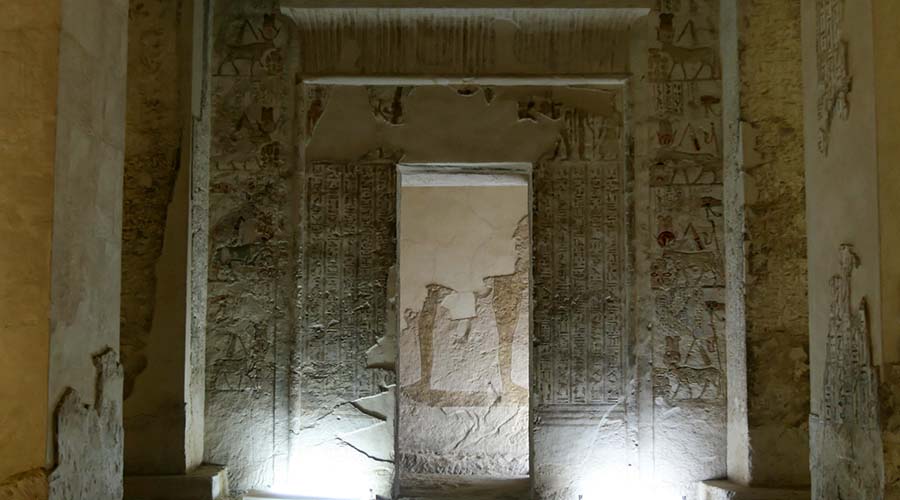
Pabasa tomb Luxor Egypt is a large tomb which located at Asasif in West bank of Luxor. The tomb belongs to Pabasa who also called Pabes. In fact, the tomb is just outside the entrance to Hatshepsut’s Temple at Deir El Bahri. Moreover, Pabasa was the “Chief Steward of the God’s Wife Nitocris” (Neitiqert). It was during the reign of Saite king Psamtek I. Furthermore, Pabasa was like Ankh-hor, who held this important title after him. Furthermore, Pabasa tomb Luxor still has a large mud brick superstructure. It also has a steep flight of stairs. The stairs lead down to the entrance of the subterranean levels. Moreover, on the lintel above the doorway is a fine relief of a barque. The tomb adored by the souls of Pe and Nekhen, by the God’s Wife, Nitocris and by the deceased.

In fact, Pabasa tomb Luxor has a small vestibule. It leads to a larger pillared sun court. The vestibule shows scenes of Pabasa’s funeral procession, including mourners and the “Abydos Pilgrimage”. Moreover, there is a long text of Pabasa and depictions of his son. His son was Thahorpakhepesh, who acted as sem-priest at his father’s funeral. On the inner lintel of the entrance to the court, there is a relief. The relief shows Osiris and Re-Horakhty in the center of a double-scene. It is with Pabasa, Nitocris and cartouches of the king (Psamtek I). Moreover, it also shows his daughter Nitocris on either side. The sun court of the tomb is open to the sky .

Further details about Pabasa tomb Luxor Egypt:

That is why it well lit. It is with three square pillars on each of its eastern and western sides. The most important scenes are on the pillars. These give us a great deal of detail about the daily activities in the estate of the Divine Adoratrice. The pillars include scenes showing a bedroom prepared and men spinning. The scenes also show netting and cleaning fish and catching birds with a throw-stick. In Pabasa tomb Luxor there are also rare scenes of beekeeping as well as viticulture and picking fruit. The reliefs finely carved. Around the walls of the court Pabasa shown in many offering scenes and long texts. It is with beautifully painted hieroglyphs.

Beyond the sun court a hall contains eight pillars, part of which decorated but now damaged. The pillars also decorated with deities and texts on the sides facing the central isle. At the rear of the hall a decorated niche contains Pabasa’s burial shaft. His granite sarcophagus is now in Glasgow Museum. Several other chambers containing burial shafts accessed from the rear of the hall.

Entrance to Pabasa tomb Luxor Egypt:

The tomb is open from 8 am to 4 pm in winter. A ticket costing 80 Egyptian pound can bought at the gate of Hatshepsut’s Temple at Deir El Bahri.

Nearby attractions Information, tours and Online Booking

More of Ancient Egypt

More of Egypt attractions
MORE
Philae temple Aswan Egypt

Philae temple Aswan Egypt

  • Philae temple Aswan Egypt
  • Philae temple Aswan Egypt
  • Philae temple Aswan Egypt
  • Philae temple Aswan Egypt
  • Philae temple Aswan Egypt
  • Philae temple Aswan Egypt

Philae temple Aswan Egypt tours, prices, booking, reviews

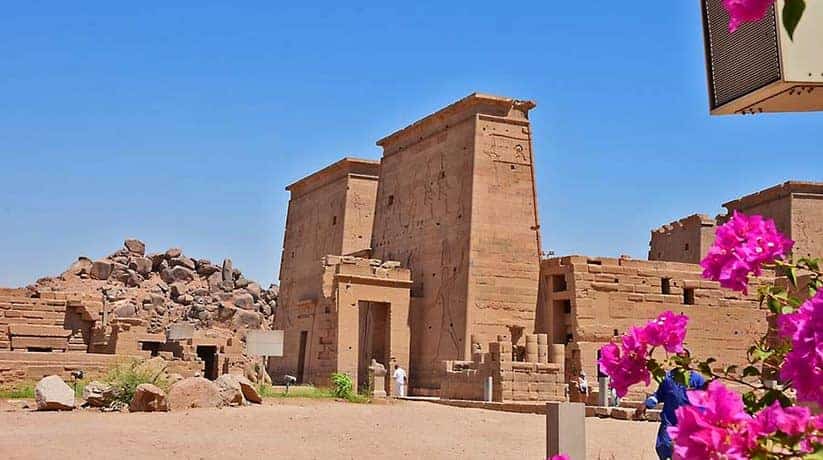
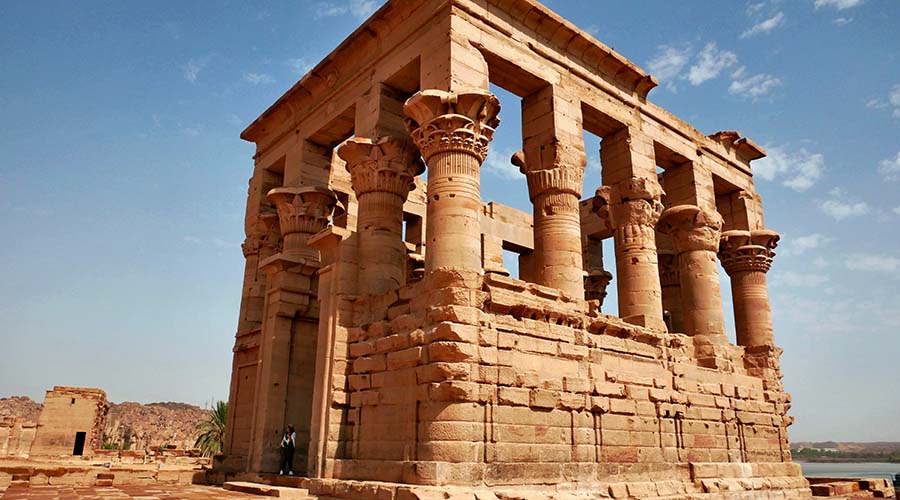
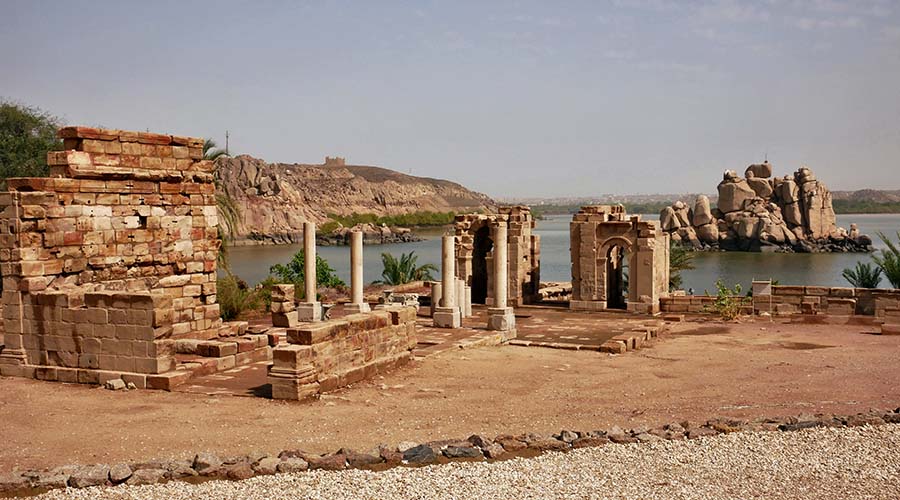
Philae temple Aswan Egypt located 12 kilometers south of Aswan. In fact, the temple was an ancient pilgrimage center for the cult of Isis. It also was for the dazzled travelers with its power for centuries. In fact, the temple is sacred site and venerated from the Pharaonic era up to the Greek, Roman and Byzantine periods. In these periods, each ruler added his own stamp onto the stones here. The First Pylon at Philae temple Aswan, leads into the main temple area. In fact, the temple features two towers and central doorway. Both of them provide a grand 18 meter high entry. The entry with reliefs by Nectanebo. Moreover, there is a doorway in the western tower with reliefs by Philometor. It leads to the Birth House.

In front of the pylon two granite obelisks stand. In fact, they erected by Euergetes II. Moreover, there are also two granite lions. Adjoining the east tower, there is an elegant gateway. It has reliefs by Ptolemy II Philadelphus (on the lintel) and the Emperor Tiberius (on the jambs). The gateway which built by Philadelphus, stands in a brick wall. On the front of the east tower, a huge relief depicts Ptolemy XII Neos Dionysos. He grasps a band of enemies by the hair and raising his club to smite them.

Philae temple Aswan Egypt main Courtyard:

When you pass through the central doorway, look for the French inscription on the right. It shows commemorating Napoleon’s campaign and the pursuit of the Mamelukes. On either side of the Forecourt, you’ll see structures fronted by colonnades. The small building to the east contained rooms for the priests. In fact, the rooms served some scientific purpose. Philae temple Aswan features plant columns in its vestibule. They indeed are notable for their elegant proportions. On the north side of the building’s vestibule, there is a door. The door accesses the inner passage around the temple.

The building on the western side of the Forecourt is the Birth House (mammisi). In fact, it dedicated to Hathor-Isis in honor of the birth of her son Horus. It surrounded on all four sides by colonnades. The columns in which have foliage capitals surmounted by sistrum capitals. The walls, columns, and screens between the columns covered with reliefs. They also covered with and inscriptions by Euergetes II, Neos Dionysos, Augustus, and Tiberius. The Birth House features indeed interesting reliefs in the last chamber. The reliefs depict scenes from the childhood of Horus. They also include Horus as a falcon in the swamps of the Delta. Furthermore, they also include Isis suckles Horus in the swamps.

Philae temple Aswan Egypt Second Pylon:

The Second Pylon provides a regal entry to the inner sanctum of the temple. It is with a magnificent doorway 32 meters wide and 12 meters high. The reliefs on the central doorway are by Euergetes II. Moreover, in front of the doorway are the foundations of a small chapel. Within the central doorway are some much faded early Christian paintings. On the lower part of the doorway is a relief of a large figure of Neos Dionysos. In fact, it dedicates the slaughtered sacrificial animals to Horus and Hathor. On the right, the king depicted while he presents a garland to Horus and Nephthys. Moreover, on the left, he offers incense to Osiris, Isis, and Horus. It is while pouring water on the altar.

Philae temple Aswan Egypt Vestibule:

The eight-columned Vestibule is the first room of the inner temple area. In fact, it separated from the court by screens between the columns on the front. The walls has Coptic crosses and Greek inscription. They show how the temple transformed into a Christian place of worship. It was during the early Byzantine age under the Coptic Bishop Theodore. Above the door, there is another inscription. It commemorates the archaeological expedition sent to Philae in 1841 by Pope Gregory XVI. In fact, the Vestibule’s reliefs unfinished, but they indeed are still interesting. Over the door in the south wall, the top relief shows Horus sits on a bench with Nephthys and Isis. They present the crowns of Lower and Upper Egypt. The below reliefs depict the tomb of Osiris at Abaton, with the body of Osiris borne by a crocodile.

To the left of the door are unfinished reliefs. They shows the king while he makes grants of land. Above are three lines in Meroitic cursive script. On the right hand wall (second top row) is a famous relief. It depicts the source of the Nile, the god of the Nile with a snake. The snake entwined around his body and pours water from two jars. The jars are under a rocky crag on which perched a vulture and a falcon. To the right of this, the soul of Osiris in the form of a bird within the sacred grove. It worshiped by Hathor (left) and by Isis, Nephthys, Horus, and Amun (right).

Philae temple Aswan Sanctuary:

The antechambers which flanked by dark side chambers, lead to the Sanctuary. The sanctuary of Philae temple Aswan lit by two small windows. The granite base here presented by Euergetes I and his wife Berenice. It holds the sacred barque bearing the image of Isis. To the left of the first antechamber is a small room. In fact, the room has reliefs of the king in the presence of Isis. On the west side of this room is a door. In fact, the door leads out of the temple to arrive at the Gateway of Hadrian.

Philae temple Aswan EgyptGateway of Hadrian:

The small Gateway of Hadrian sits within the old enclosure wall of the temple. It is northwest of the Second Pylon. In fact, it built in the reign of the Emperor Hadrian. Furthermore, it decorated with reliefs by Hadrian, Marcus Aurelius, and Lucius Verus. The gateway presumably led to the Sanctuary of Abaton on the neighboring island of Bigga . There, there was a Tomb of Osiris and the reliefs relate to the cult of Osiris. On the lintel, Hadrian depicted while he makes offerings to Osiris, Isis and Harsiesis. On the left hand jamb is the sacred relic of Abydos. Furthermore, on the right hand jamb, the djed pillar of Osiris.

The ancient Egyptian name of Philae was Pilak, from which the Greek and Latin Philae derived. During the Islamic era, it known to the local people as El-Oasr which means the palace. The oldest surviving temple buildings here date back to the time of Nectanebo I (circa 370 BC). The principal deity worshiped was Isis. The imposing buildings that stand today erected by the Ptolemies in the last two centuries BC. They also erected by the Roman Emperors in the first three centuries AC. Many inscriptions show that pilgrims flocked to Philae in Greek and Roman times. It was to pay homage to the mysterious and benign Isis, goddess of healing.

Further details about Philae temple Aswan Gateway of Hadrian:

In fact, the Nubians remained faithful to the cult of Isis. It was long after introduction of Christianity. In the time of Justinian (527-565 AC) the temple closed. Some of its chambers converted for use in Christian worship. From then until the coming of Islam, a Coptic town flourished on the island. The island of Philae temple Aswan ranked as one of the most beautiful places in Egypt. Furthermore, it attracted large numbers of visitors every year. In fact, it was Until the construction of  The Old Dam. Thereafter it was under water for the greater part of the year. The temple was accessible only between August and December. The construction of Egypt’s High Dam project threatened to engulf the temple for good. In fact, the temple saved from this fate between 1972 and 1980. It was through the great international rescue operation which sponsored by UNESCO.

The Temple of Hathor at Philae temple Aswan Egypt:

Just 50 meters east of the temple of Isis is the little temple of Hathor. In fact, it built by Philometor and Euergetes II in honor of Hathor-Aphrodite. The vestibule and the sanctuary (destroyed) of the temple added by Augustus. The best preserved part of the structure is the main temple chamber. It is on the front of which are two plant columns linked to the walls by screens. The columns of the Vestibule decorated with charming reliefs. The reliefs include flute-players and harpists, Bes with a tambourine. They also include Bes dance and play a harp , monkeys play the lyre, and priests bearing an antelope.

Kiosk of Trajan at Philae temple Aswan Egypt:

Nearby is the Kiosk of Trajan which indeed is the most distinctive of Philae’s monuments. Moreover, it is the focus of the second half of the Sound & Light Show. Reliefs inside the rectangular structure of 14 columns with screen walls. They depict the Emperor Trajan making offerings to Isis, Osiris and Horus. The roof is now no longer. The kiosk which was at one time the main entrance to the temple from the river, is airy and open. You can get a magnificent view of the kiosk from the river on the return journey from the island.

How to get to Philae temple Aswan:

The quay for motor boats to the Islands between the dams, is south of the Old Aswan Dam at Shallal. It reached by taxi from Aswan. The easiest way to visit Philae temple Aswan is as part of an organized trip. The organized trip often will not cost much more than going it alone. The ticket office for the temple is at the end of a tourist bazaar. It is at the gate to the boat landing. Tickets for the temple cost LE 120

Nearby attractions Information, tours and Online Booking

More of Ancient Egypt

More of Egypt attractions

MORE
Qattara Depression Egypt

Qattara Depression Egypt

  • Qattara Depression Egypt
  • Qattara Depression Egypt
  • Qattara Depression Egypt
  • Qattara Depression Egypt
  • Qattara Depression Egypt
  • Qattara Depression Egypt
  • Qattara Depression Egypt

Qattara Depression Egypt information, tours, prices, booking

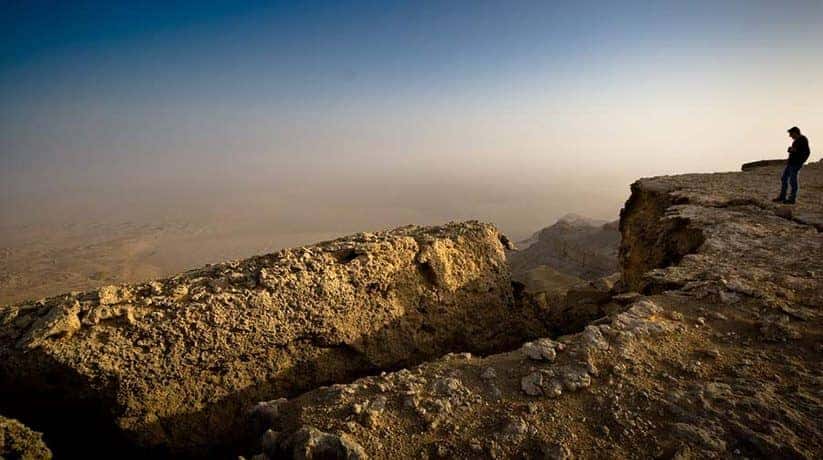
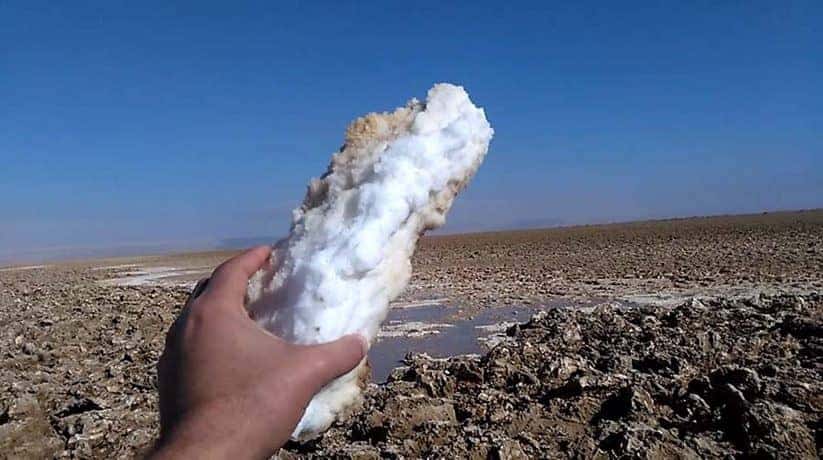
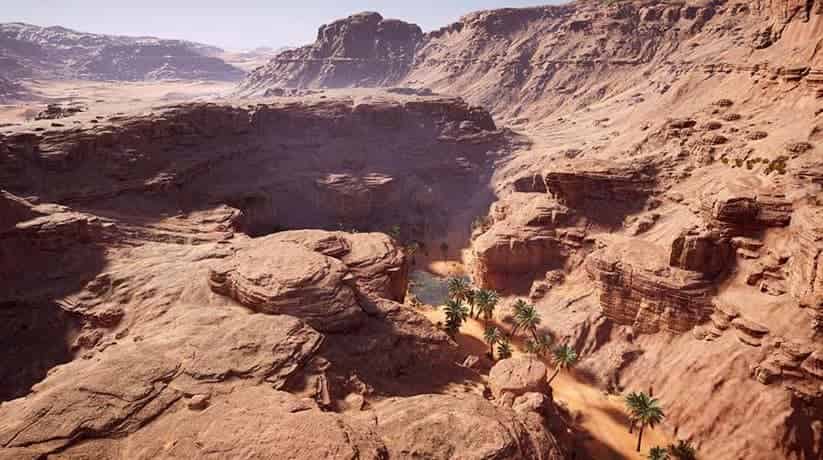
Qattara Depression is the lowest point in Egypt. In fact, the depression is under sea level. Qattara Depression situated in the Northern part of the beautiful Western Desert. Its depths reach to 134 m below sea level. Moreover, it is the largest of seven such depressions in Egypt. Moghra Oasis is the oasis of the Depression. Moreover, it not inhabited. The depression covers about 18,100 square km. Moreover, it contains salt lakes and marshes. During World War II, the depression formed a natural anchor. It was at the southern end of the British defense lines at El Alamein. It was against the final advance of Field Marshal Erwin Rommel’s German army in July 1942. In the late 1970s oil deposits discovered in the southern part of the depression.

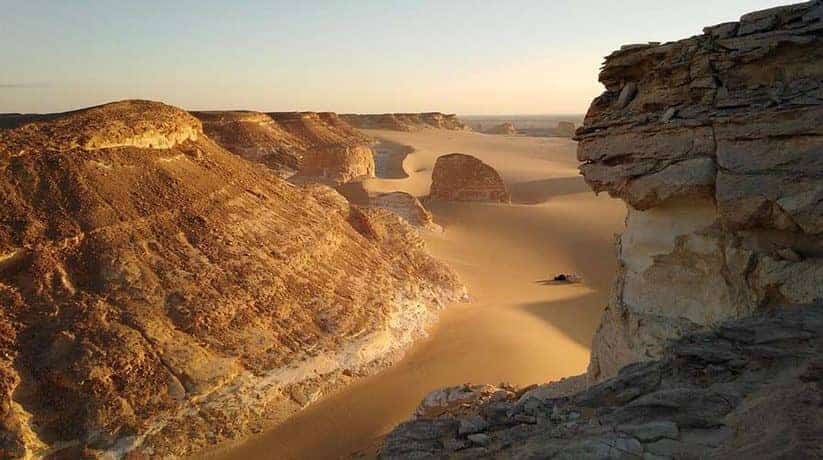
In fact, Qattara Depression extends between latitudes of 28°35′ and 30°25′ north. The longitudes of 26°20′ and 29°02′ east. The region created by the interplay of salt weathering and wind erosion. Some 20 kilometers west of the depression lie the oases of Siwa and Jaghbub. In fact, they are smaller but similar depressions. Moreover, the depression has the shape of a teardrop. Its point facing east and the broad deep area facing the south west. The northern side of the depression characterized by steep escarpments. They are up to 280 meters high, marking the edge of the adjacent El Diffa plateau. To the south the depression slopes gently up to the Great Sand Sea.

Further details about Qattara Depression Egypt:

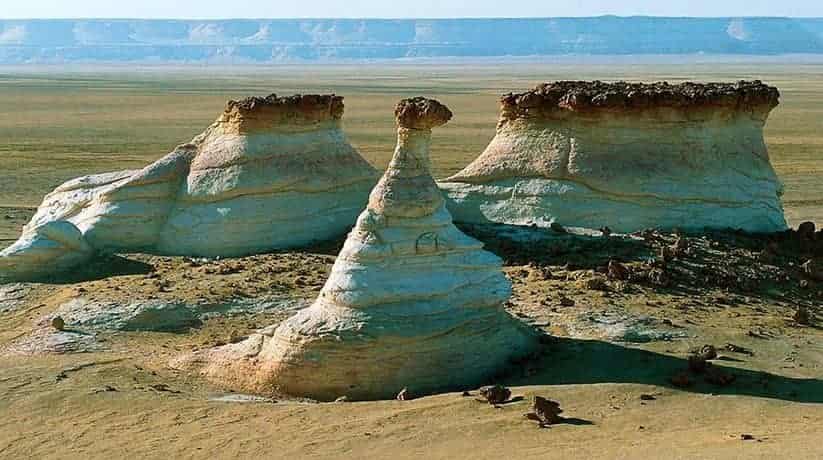
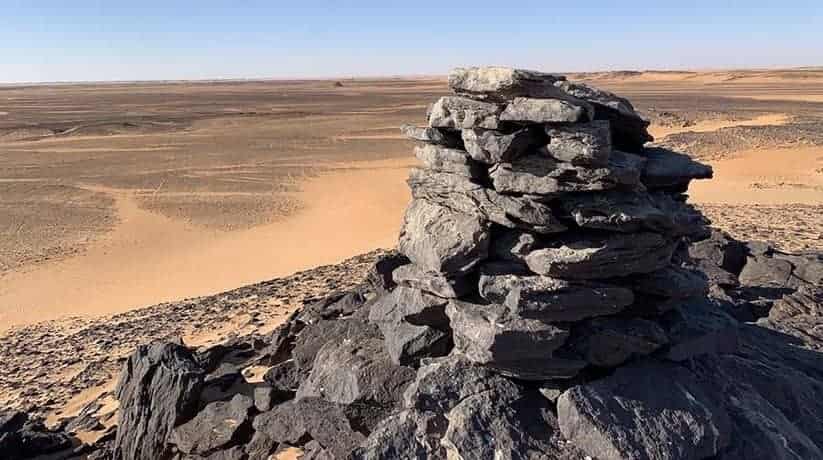
Bedouin tribes and their livestock do move through the area. They use the waters and grass of Moghra for grazing. Qattara Depression indeed features beautiful rock formations. Moreover, they differ in size and shape, as well as saline marshes. It also features black dunes. Black dunes called Al Ghorood As Soud. They located in the South West of Qattara. These dunes are black due to the high shale content. The depression is the last known location where cheetahs found in Egypt. There are not enough individuals to sustain a population. Dorcas Gazelle also found there.

Nearby attractions Information, tours and Online Booking

More of Egypt Desert & Oases

More of Egypt attractions

MORE
Rekhmire tomb Luxor Egypt

Rekhmire tomb Luxor Egypt

  • Rekhmire tomb Luxor Egypt
  • Rekhmire tomb Luxor Egypt
  • Rekhmire tomb Luxor Egypt
  • Rekhmire tomb Luxor Egypt
  • Rekhmire tomb Luxor Egypt
  • Rekhmire tomb Luxor Egypt

Rekhmire tomb Luxor Egypt TT 100 tours, prices, booking

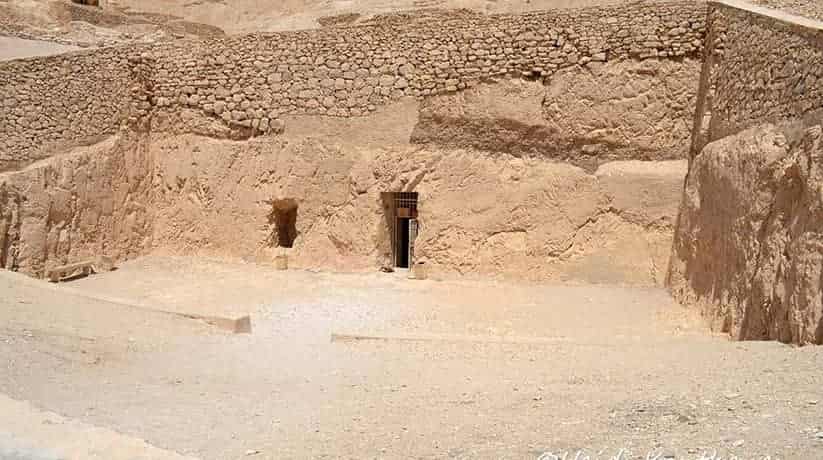
Rekhmire tomb Luxor Egypt located on the south-eastern slope of the upper enclosure. It is at Sheikh ‘Abd el-Qurna, a little below the tomb of Sennefer (TT 96). Rekhmire was “Governor of the Town” (Thebes) and “Vizier”. It was during the reigns of Thutmose III and Amenhotep II of Dynasty XVIII. As the highest civil official of the land, Rekhmire built his tomb as a simple T shaped structure. It is in the traditional style, although on a larger scale. Moreover, Rekhmire tomb Luxor has the unusual features of a long passage with a sloping ceiling.

The passage does not contain a burial shaft. Thus, it leads us to suppose that Rekhmire buried somewhere else in the necropolis. Perhaps in the King’s Valley, although another tomb has never found. Furthermore, The hall and passage decorated with lively and well preserved scenes. Some are conventional and some are unique. They give important details of daily life in the New Kingdom. In fact, the scenes make Rekhmire tomb Luxor the most interesting tomb in the Theban necropolis.

Further details about Rekhmire tomb Luxor Egypt:

The entrance of Rekhmire tomb Luxor decorated with the usual offering texts and prayers. The wall of the hall to the left of the entrance (south-west) shows Rekhmire in the Hall of Judgement. He inspects the produce of Egypt including cattle, grain, gold and delivered to him as taxes. In fact, the text describes the goods brought from the areas of Elephantine down to Asyut. It was the vizier’s responsibility to receive and account for these taxes for the king. The short wall at the left side of the hall also has a long autobiographical text of Rekhmire.

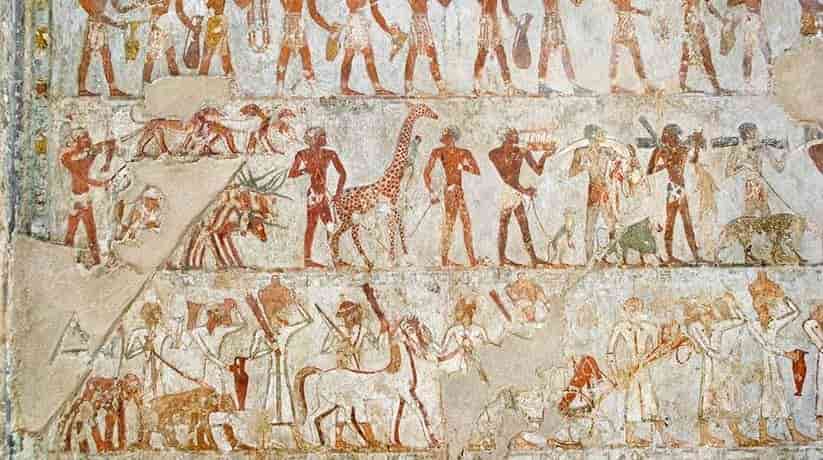
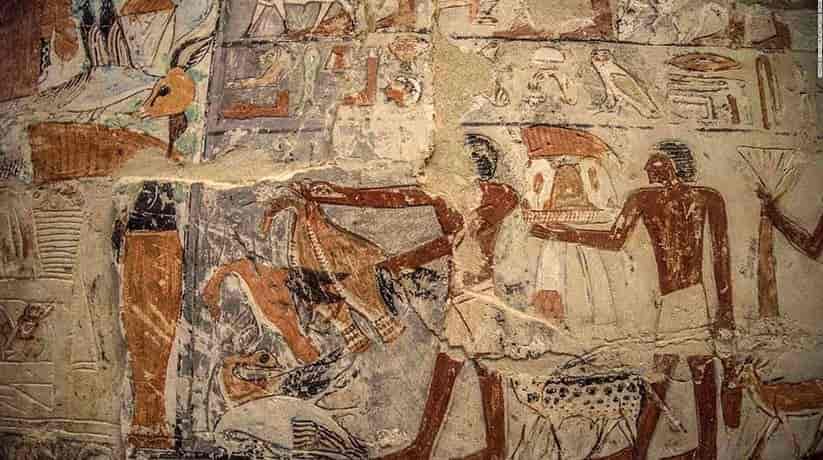
The wall opposite the entrance at the southern end depicts a tribute. In fact, it brought from foreign countries in five registers. In the top register produce from the land of Punt recorded by scribes. It includes incense trees (myrrh), gold and precious stones and ivory. It also includes a baboon, monkeys and animal skins. Below this comes the tribute from Keftju (Crete or the Mediterranean Islands). It also includes decorative vases, silver, lapis lazuli and amphorae. Moreover, it also includes and pots in the shape of animal heads. The men bringing the tribute painted wearing Mycenean rather than Minoan kilts. They also show that Mycenean trade began during the reign of Thutmose III.

More details about Rekhmire tomb Luxor Egypt:

In the next register Nubian or Kushites bring various animals. They bring giraffe, leopard, baboons, monkeys and cattle. They also bring dogs as well as ostrich eggs and feathers. Below, Syrians (from the land of Retjenu) dressed in long white robes and pointed beards. They bring their tribute in the form of wagons and horses, a bear and an elephant. Furthermore, they also bring weapons and metal vessels, copper ingots and pottery. In the bottom register, there is a diverse group of foreigners. It also includes women and children brought by military escort as captives or hostages. At the end of the wall is a damaged scene. It once depicted Rekhmire before Thutmose III seated on his throne.

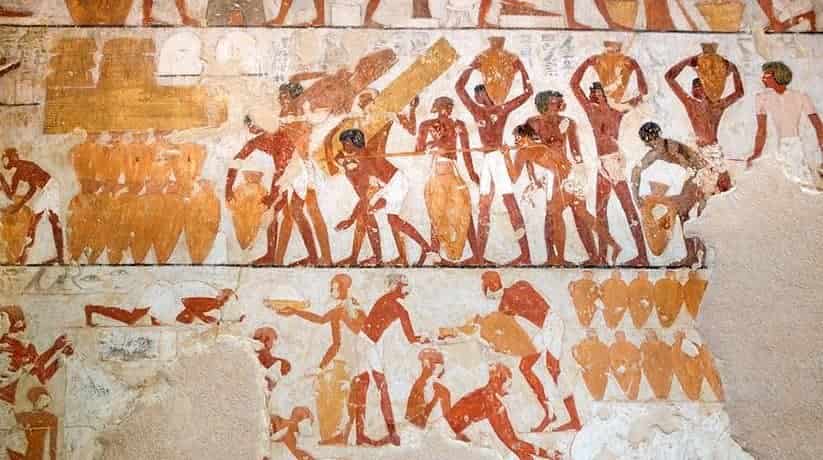
Rekhmire tomb Luxor wall to the right of the entrance also shows scenes of tax collection. It is from the northern regions. Rekhmire supervised the work of artisans in the temple workshops and royal statues. He also did sphinxes made for the Temple of Amun. Other objects in the top register include necklaces, weapons, various vessels and furniture. They maybe intended as burial equipment. Below, men bring provisions, with scenes of baking and brewing. At the end of this wall there are agricultural scenes. They also show the recording of cattle, measuring the crop and the usual ploughing.

Further details about tomb of Rekhmire in Luxor Egypt:

The short wall at the right hand end of the hall contained many members of Rekhmire’s family. In fact, it is not now in good condition. Furthermore, Rekhmire and his wife Meryt can no longer seen. Their sons Menkheperresoneb and Amenhotep named with their wives in the inscriptions. It is along with the tomb-owner’s grandparents and other relatives. Rekhmire’s grandfather Ametju and uncle User were both viziers before him.

The wall opposite the entrance to the right in Rekhmire tomb Luxor also depicts Rekhmire. He inspects the produce of the ‘Road to Horus’, ibex, oryx and also wild bulls. It also depicts hyenas brought with a hunting dog. Below this, there is a scene of treading grapes to produce wine and preparing fish and fowl for cooking. Though, these are not as well portrayed as in Nakht tomb or Menna tomb. Further along the wall are remaining scenes of hunting in the desert. It is with slain animals heaped up waiting to record by the scribes. There are also ostriches, wild bulls, lions, gazelles and hyena in a fenced stockade.

Further details about the tomb of Rekhmire Luxor Egypt:

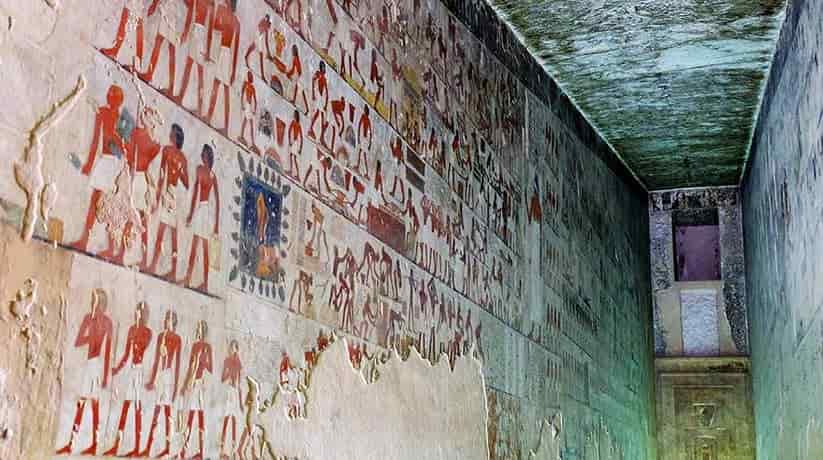
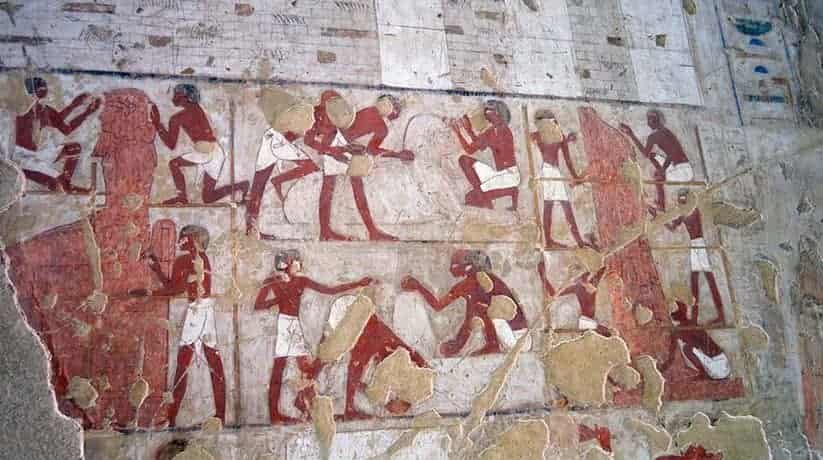
In fact, the paintings in the long passage in Remkhmire tomb better preserved. They are also superb in their detail. Some of those at the far end , are high up on the wall and difficult to photograph. Beginning on the left-hand wall are six registers. It is where Rekhmire supervises the preparation and storage. He also supervises distribution of provisions for the temple. Next is a series of scenes in eight registers. They includes the industries of Amun temple. They also include the weighing and recording of gold collected as taxes. The paintings show the artisans at work on their craft. It is with leather-workers, rope-makers, carpenters, metal-workers, brick-makers and builders. Sculptors haul stone to used in the manufacture of two royal colossal statues. In fact, these are important scenes in Rekhmire tomb Luxor. They show the methods of production of the crafts of ancient Egypt.

Towards the end of the left-hand wall there are ten registers in the tomb. They depict the funeral procession moving towards the garden of Osiris. It is where the Goddess of the West waits with Anubis and Osiris to receive the deceased. Moreover, pictures include the setting up of two obelisks and a “teknu” and the “Pilgrimage to Abydos”. The funeral rites end with Rekhmire and his wife Meryt. They seated before an offering table. It is while their sons offer to their parents too. The hieroglyphic text transcribes the offering-list. The end wall of Rekhmire tomb Luxor had a niche at the top. It bordered by texts on either side and a false door with the remains of another below. In fact, it is now in the Louvre museum.

More details about Rekhmire tomb Luxor Egypt:

On the right-hand wall of the tomb, there are also more scenes. They are of offering and purification. It is where Rekhmire shown holding the sekhem-sceptre of his office. It is with his wife Meryt behind him with their sons Menkheperresoneb, Amenhotep and Senwosret. In ten registers the funeral rites carried out before statues of the deceased. Rekhmire tomb Luxor indeed has a magnificent walled garden. It surrounded by trees contains a pool with a boat on it. It is in which the deceased’s statue is standing, also part of the funeral rites. The funeral banquet comes next and arranged in eight registers.

They show Rekhmire’s daughters and sons offering to the deceased and his wife. With the guests who waited on by servants there are male and female singers. There are also musicians playing lutes, tambourines, harps and clappers. In one scene a small servant girl stands behind Rekhmire’s mother. She shown in a back-view – the only known instance of this aspect in ancient Egyptian art. In the last scenes on this wall in Rekhmire tomb Luxor, Rekhmire takes a journey by boat. He returns from “Het-sekhem” (north of Thebes). It is where he received and confirmed in his office presumably. It is by the new ruler, Amenhotep II, a cause for great rejoicing.

Entrance to the tomb:

The tomb is open from 8 am to 4 pm in winter. A ticket for Sennefer tomb and Rekhmire tomb can bought at the ticket office.

Nearby attractions Information, tours and Online Booking

More of Ancient Egypt

More of Egypt attractions
MORE
Penout tomb Aswan

Penout tomb Aswan Egypt

  • Penout tomb Aswan
  • Penout tomb Aswan
  • Penout tomb Aswan
  • Penout tomb Aswan
  • Penout tomb Aswan
  • Penout tomb Aswan

Penout tomb Aswan Egypt tours, prices, booking, reviews

Penout tomb Aswan Egypt belongs to Penout who was once a Viceroy of Kush. It was during the reign of Ramses IV (12th century BC). The tomb of Pennout has carvings on the wall in which Ramses IV honors his civil servant. In fact, the tomb located in Aniba, an area which was the home to many tombs. Penout was also a priest of Horus, that is why his tomb is fine and contains its own altar. The statues which once stood on it are now missing. Moreover, Penout tomb Aswan also features large sections. The sections containing inscriptions, carvings, and many high quality paintings. In fact, the tomb itself robbed and no sign of Penout’s mummy ever found. Furthermore, Penout was a governor of Lower Nubia and was Nubian as well. In fact, in the Egyptian tradition people buried in the land where they born.

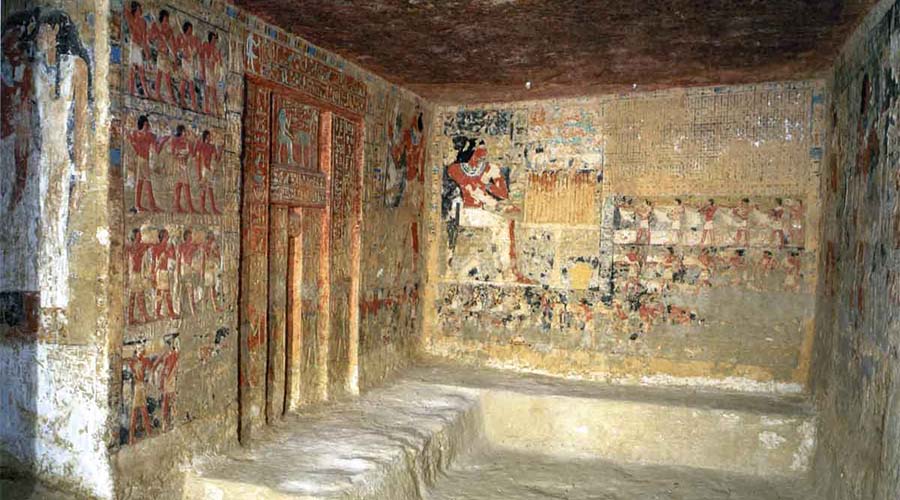
In fact, the tomb is rock tomb which decorated with wall paintings. The paintings depict scenes of Penout’s life. In fact, many damaged when peoples tried to steal some of these decorations. Penout tomb Aswan indeed is a rare example of a high official tombs south of Aswan. The ancient bodies carried back and buried in Egyptian soil. It makes them secured. That was the ancient Egyptin’s beleif. The tomb’s wall paintings reflect this conviction and expresses Penout’s desire. In fact, his desire was to lay to rest in the hills of Thebes. The walls decorated with traditional themes, including the deceased and his family. Before entering on the left, there are the deceased and his wife Takha in adulation.

Further details about Penout tomb Aswan Egypt:

On the main wall is the judgement scene with the weighing of the heart against a feather. Moreover, below the traditional mourners pouring sand on their heads. On the end wall Horus leads the deceased and wife to Osiris, Isis and Nephthys. It is for a blessing but the lower register all disappeared. To the left of the inner chamber of Penout tomb Aswan, there is a representation of the solar cult. In fact, there is no entry into the inner chamber. The three badly mutilated statues of Penout, and his wife with Hathor between can viewed. The actual burial chamber lies 3 m below. Above on the lintel is the sun-god barge and howling baboons. The decoration on the wall to the right shows Penout with his wife and six sons. On the end wall, Pennout illustrated in golden colors. In fact, it continues on towards the exit.

Nearby attractions Information, tours and Online Booking

More of Ancient Egypt

More of Egypt attractions

MORE
Queen Nefertari tomb Luxor

Queen Nefertari tomb Luxor

  • Queen Nefertari tomb Luxor
  • Queen Nefertari tomb Luxor
  • Queen Nefertari tomb Luxor
  • Queen Nefertari tomb Luxor
  • Queen Nefertari tomb Luxor
  • Queen Nefertari tomb Luxor
  • Queen Nefertari tomb Luxor

Queen Nefertari tomb Luxor Egypt tours, prices, booking

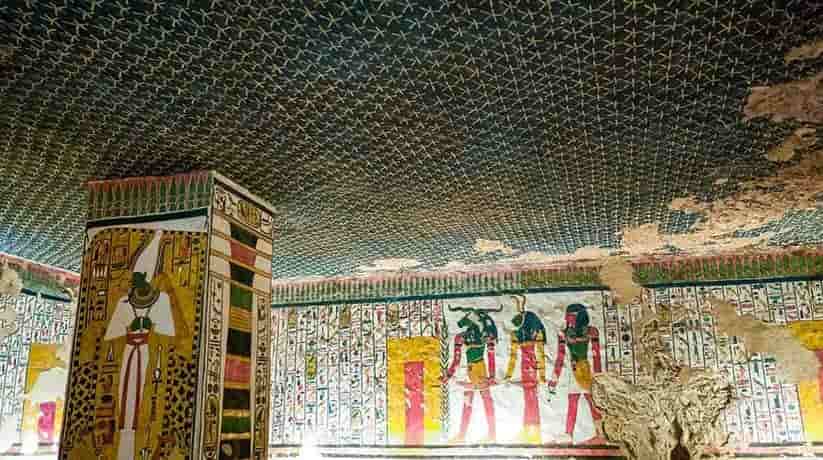
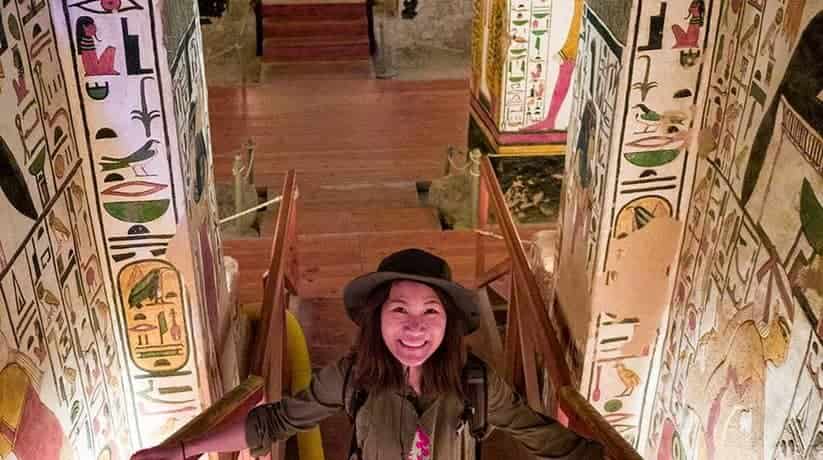
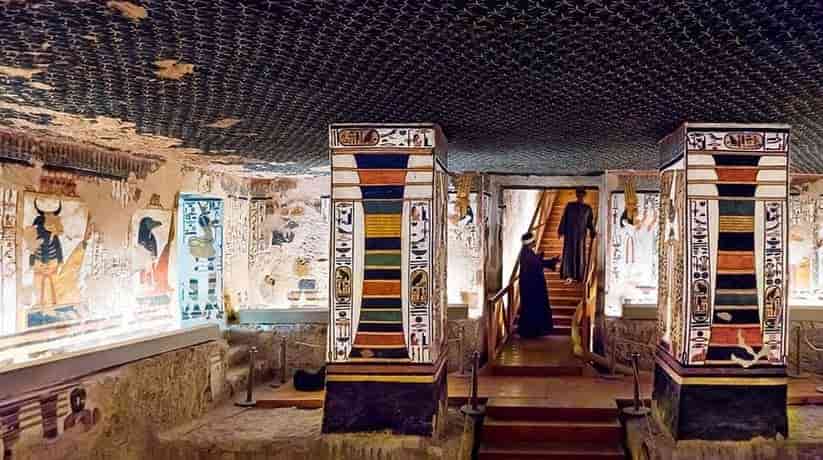
Queen Nefertari tomb Luxor Egypt QV 66 discovered in the Queen’s Valley in 1904. In fact, the tomb hewn out in the Valley of the Queens. Moreover, it called by the ancients “The Place of Beauty”. The tomb indeed is the most beautiful in the Valley of the Queens. It is on the whole worthy of her position in history. Queen Nefertari tomb Luxor features decorative motifs on walls and ceilings which indeed are mythological. In fact, they concerned with life in the netherworld and meetings with gods. Furthermore, they concerned with deities, genii and monsters.

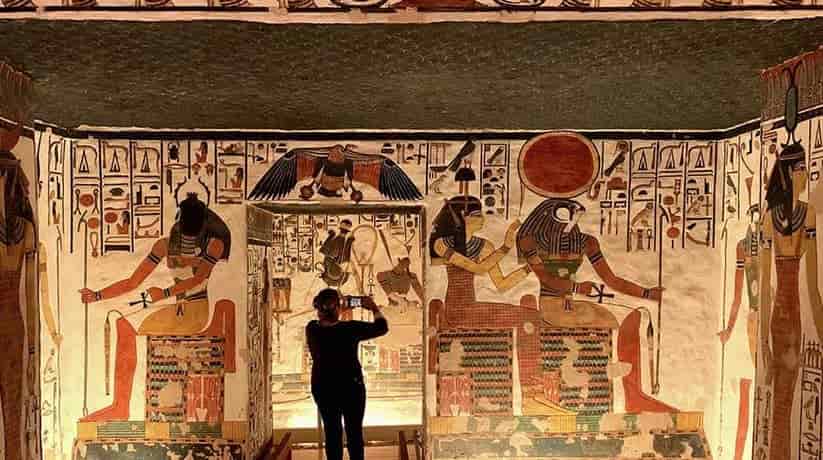
In these scenes, Queen Nefertari represented always wearing long and transparent white garments. Moreover, it is with two long feathers over the vulture-like headdress of gold. In fact, Queen Nefertari wears rich jewels, besides to bracelets and a wide golden collar. The tomb has an outer doorway from entrance staircase into outer hall. The two lambs inscribed with the name of Nefertari. Moreover, the lintel over the doorway decorated with a sun-disk. It sets in the horizon flanked on both sides by Wadjet-Eye. The scene also included a depiction of Isis and Nephthys in falcon form. Left and right thickness of the door decorated with the goddesses Nekhbet and Wadjet.

Further details about Queen Nefertari tomb Luxor Egypt:

Outer Hall of Queen Nefertari tomb Luxor has an almost square format of 5.20 m by 5.30 m. Moreover, a rock cut bench has niches below it. Furthermore, it supports part of the funerary equipment, projects from the western and northern walls. The long inscription above the bench a rather garbled version of 17th Chapter of the Book of the Dead. The upper register filled with various scenes. They serving as illustrative register of the southern wall containing different scenes. On the left, Queen Nefretrai shown on a throne. In her right hand she holds a kind of wand, with the other she reaches for a game. The scene placed in a kiosk made of reeds. Here the queen plays with her soul. The next scene shows a bird with the queen’s head. It is the Egyptian representation of the individual soul.

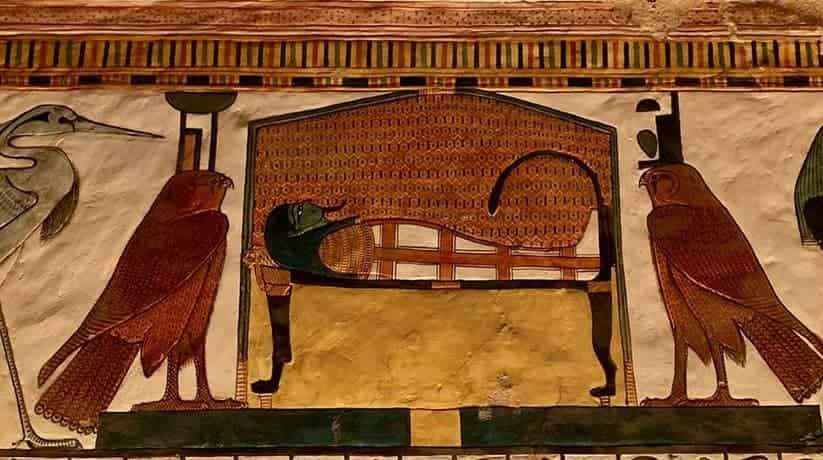
The ba-bird stands on a scale and takes a shape of Queen Nefertari tomb Luxor. In fact, the ba was a psychic force. The word employed as a synonym of the manifestation of a god. Then the queen Nefertari herself kneels in front of her soul. It is with hands uplifted in adoration of two juxtaposed lions, between them the sun’s disk. In fact, these scenes of the two lions mean “yesterday and tomorrow” or “the past and the future”. Then, the graceful bird “benu” is the representation of the phoenix. It is the sacred bird of Heliopolis. The phoenix regarded as the soul (ba) of Ra’, but was also a manifestation of Osiris. The bird Benu followed by many scenes . In fact, the scenes consist of a shrine with a bier on which a prepared mummy of the queen placed.

More details about Queen Nefertari tomb Luxor Egypt:

This shrine flanked on either side by representations of both goddesses Isis and Nephthys. The next scenes consist of two figures, one squatted bearded deity who holds a palm branch. The other standing before him holding his two outstretched arms over two squares. Furthermore, next is the seated figure of a falcon headed deity before a large scale “Sacred Eye”. The decoration continues with the registers. They begin at the left with the scene of a cow resting on a support. The next illustration is a composite scene. Its center is a coffin with a jackal placed inside. It surrounded on both sides by two mummiform figures. The right part of the upper register contains the four “Sons of Horus”.

They accompanied by a fifth Horus himself. To the right is the Jackal- headed Anubis, the god responsible for embalming. On the north side of the passage Osiris shown in his shrine. In the recess the thickness of the passage decorated on both sides. It is with the representation of a goddess Selket (Scorpion). West inner face of the recess, the decoration consists of a Djad pillar. It is the symbolic representation of Osiris. North face of the recess, the scene shows the goddess Isis leading Queen Nefertari to the right. It is in the realm of god Khepri. South face of recess decorated with a depiction of Harsiese (Horus son of Isis). He holds Queen Nefertari by her hand and introducing her to Harakhty and the West (Hathor).

Further details about Queen Nefertari tomb Luxor Egypt:

The scenes decorating the west wall of the side room show the queen bringing linen offering to Ptah. Moreover, behind the shrine of Ptah is a large Djad pillar, the symbol of Osiris. The scene on the north wall shows Queen Nefertari paying her respects to the god Thoth. Furthermore, the left part of the wall covered with a text of eight columns. It is a copy of Chapter 94 of the Book of the Dead. The east wall of side room filled with two scenes separated in the center by an up-right standing fan. In the left scene the god Osiris shown enthroned in the mummiform body. Moreover, before him are the four “Sons of Horus”. Queen Nefertari shown stretching her arm. The parallel right scene depicts the queen’s offerings to god Atum. South wall of this side room divided into three registers.

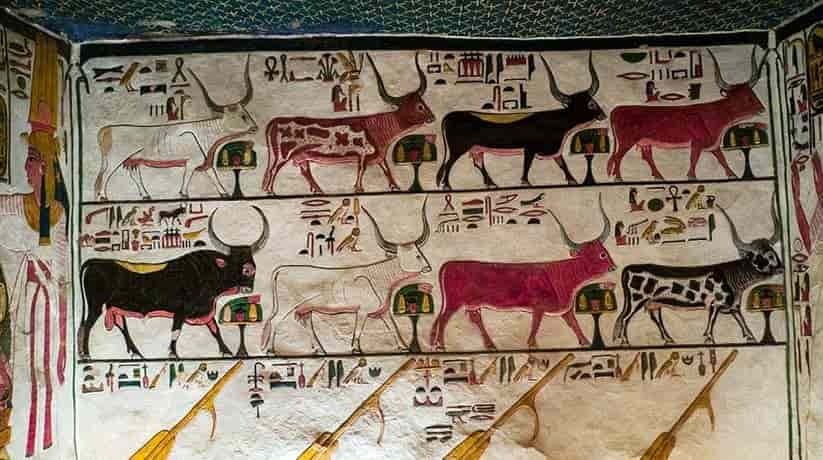
In fact, the two upper filled with seven cows and one bull. Moreover, the bottom register shows four steering oars. On the following wall, Nefertari with her raised arms in adoration is part of the adjoining last scene. The other panel on this west wall represents Ra’ and Osiris. They united in the form of a ram-headed figure between Isis and Mephthys. From the Outer hall there is a corridor. It descends 18 steps and continues the funerary designation of Queen Nefertari tomb Luxor. The descent to the underworld decorated. North thickness of upper part of West and East wall of corridor, the space decorated. It is with the Djad-pillar with two arms holding a scepters. Southern thickness of upper part of West and East wall decorated. It with the goddesses Neith and Selket.

More details about Queen Nefertari tomb Luxor Egypt:

On the left hand Nefertari offers two bowls of milk to goddess Isis behind whom sits Nephthys with Maat. Moreover, on the right hand, Nefertari makes a similar offering to Hathor behind whom sits Selket. It is with Maat as before in the background. Lower down there is a winged Uraeus, guarding two carts of the queen. The underneath, beginning about the kneeling figure of Maat, is another scene. It features Jackal Anubis stretched out on a tomb welcoming the queen. The bottom part of the east wall decorated by the figure of Nephthys. It is while the parallel part of the west wall decorated with Isis. The doorway lambs of the burial chamber inscribed with the name and titles of Nefertari. It is while the sofas decorated with a winged Maat.

This corridor leads to that part of the Queen Nefertari tomb Luxor. It is where the funeral ceremony terminated. The burial chamber is a large rectangular room (10.40 x 8.50 m). It is with four square pillars supporting the ceiling. Two side rooms and a small inner room are accessible from it. The entry walls to the burial chamber adorned by four goddesses. It is while the walls decorated with scenes from the Book of the Dead. Queen Nefertari represented passing through nine gates from the domain of Osiris. They guarded by dreadful demons. On the northern wall of the chamber she shown before Osiris, Hathor, and Anubis. The four pillars form a kind of shrine to contain her sarcophagus, now lost. The pillars decorated with the Djad pillar and various deities. The two side rooms flanking the burial chamber on the west and east preserved.

Entrance to Queen Nefertari tomb Luxor:

In fact, the opening of the tomb was in 1995. Since then, many restrictions took place on entry to the tomb. In January 2003, the tomb completely closed to visitors. It is for an indefinite period investigate the condition of the painted walls. Please contact us for update.

Nearby attractions Information, tours and Online Booking

More of Ancient Egypt

More of Egypt attractions
MORE
error: Copyright © www.etltravel.com !